Maps Archive

Newly updated maps

I have gone through all of my Google Earth maps available for download from the blog for 2010 federal election boundaries, and updated the colours to the latest election results, assuming that seats in doubt such as Brisbane and Hasluck do not change hands.

I have also decided to colour all Liberal National seats in Queensland as blue, rather than attempting to distinguish between which party they will be representing in Canberra, due to the fact that the LNP is running under a single banner. Below I’ve posted the overall maps of seat results in the areas around Sydney, Melbourne and Brisbane.

You can download these maps and manipulate them yourself by visiting the Tally Room maps page.

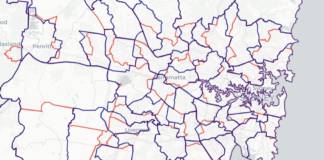
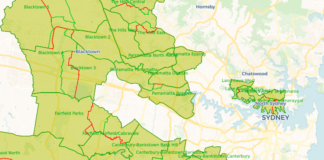
Sydney and surrounds.

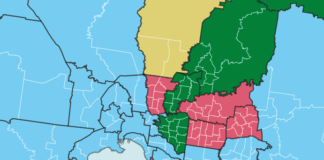
Melbourne and surrounds.

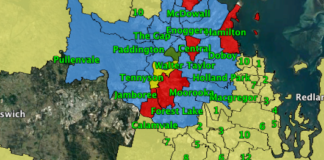
Brisbane and surrounds.

Maps of federal MPs by gender

A year ago I made a map where I colour-coded seats in the NSW parliament according to gender. With the rise of our first female Prime Minister, and the impending federal election, I figured it would be worth making a similar map for federal electorates.

After the fold, I have maps showing the gender of each federal MP after the last federal election.

Read the rest of this entry »

Tags: ,

Using Google Earth electoral maps on the iPhone

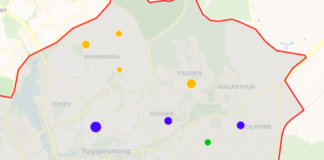
I’ve recently discovered that you can view Google Earth maps in the Google Earth app on the iPhone. The attached image was taken this morning on my iPhone, showing an electoral map of central Sydney, with the blue dot showing my GPS location (I was on a bus to Rozelle for some election campaigning).

You can view Google Earth maps on the iPhone (and presumably on other smart phones such as those using Android) by uploading a map to “My Maps” in Google Maps, and then logging in to the Google Earth phone app.

I have uploaded the 2010 federal election maps to my own Google Maps account, and you can access them and add them to your own maps collection at the following links. I have taken all labels and included them in a separate file, allowing you to turn labels on and off as you wish.

Tags:

New pages on the blog

I have now posted a page on the blog profiling the upcoming South Australian election, which you can read here.

I have also now posted a tutorial explaining some of the ways you can use the Google Earth maps posted on this blog to make your own maps by overlaying maps and changing colours  and styles.

Have a read of those, and the flow of federal election seat profiles will resume shortly.

Cameron cutting seat numbers in UK

David Cameron, the leader of the Opposition in the United Kingdom, is planning to immediately cut the number of seats in the House of Commons following an election victory this year, according to reports.

Cameron’s plan involves immediately introducing legislation following an election which would trigger a rapid review of electoral boundaries in England and Wales in order to cut the number of seats by approximately 10%.

Electoral boundary reviews in the past have taken as long as seven years, and the new boundaries being used for the 2010 election are based on registered voter figures from the year 2000. Cameron’s legislation would give only 18 months for a new review.

The Conservatives are arguing that the cut in the size of the Commons, which will have 650 members after this year’s election, is intended to cut the cost of politics, not to achieve electoral gain. While it is probably a good idea to shrink the Commons to less than 600 seats, the costs of those 65 members of Parliament really don’t add up to a lot in the scheme of things.

There is some electoral benefit for the Conservatives in speeding up the process of boundary reviews. Strong Labour areas like the inner cities tend to be depopulating, which means that boundaries drawn using out-of-date data will tend to mean that the number of voters in Labour seats is less than in Conservative seats. Yet this is only a minor issue. The main bias against the Conservatives in the electoral system comes from the geographical distribution of Conservative voters. Labour voters tend to be more ‘effective’, spread efficiently over marginal seats, while Conservative voters are locked up in huge majorities in safe seats. This is the main reason why the Conservatives need to beat Labour by a wide margin to win a majority. No redrawing of the boundaries will fix this: all systems of single-member electorates favours one party over another.

Labour in the UK is crying ‘gerrymander’ over the proposal, although it seems that numerical fairness is on the Conservative side. It seems that the Conservative plan is a good idea, but won’t achieve any of the aims being spun by either side about removing the bias in the electoral system.

In other news, I have just finished the South-East England region in my map of the 1997-2005 electoral boundaries, which I am hoping to finish before the UK election later this year. Maps below the fold.

Read the rest of this entry »

New South Australian electoral maps

With South Australia’s state election coming up on March 20, I have taken the opportunity to improve the electoral maps for South Australia posted on this blog. The maps for the 2006 election and for the upcoming 2010 election had already been posted, but were quite large files which took a while to download and were difficult to view on slower computers. I’ve now fixed these maps to be much smaller files and easier to use, without reducing the accuracy of the maps.

In addition I have also produced maps for the previous two redistributions. South Australia holds a redistribution after every election, so these maps cover elections from 1997 until the coming election.

You can download the maps at the following links:

Screenshot images from the new maps posted below the fold.

Read the rest of this entry »

UK electoral map finished

I have finally completed the UK electoral map for next year’s general election for the House of Commons.

I had previously completed maps for England, Wales and Northern Ireland, and have now completed the map for Scotland. I have also updated the map of England to take account of by-election results and the change of Speaker.

Maps below the fold:

Read the rest of this entry »

Northern Ireland maps finished

I have today finished electoral maps for Northern Ireland. I have completed boundaries for the period 1997-2007 and the new boundaries for the 2010 general election. Northern Ireland uses the same 18 constituencies for both Westminster elections and Legislative Assembly elections. When electing the Legislative Assembly, each constituency elects six MLAs for a total of 108.

I have completed two sets of maps. The first set of maps covers the 1997, 2001 and 2005 general elections and all three elections for the Legislative Assembly in 1998, 2003 and 2007. The new boundaries will be used at the next UK and Northern Irish elections, due in 2010 and 2011 respectively. These maps posted below show how much Northern Irish politics has changed since 1997, with the first map showing the results of the 1997 election, while the second map shows the notional 2005 results using the 2010 boundaries. It shows how the Democratic Unionist Party (dark orange) and Sinn Fein (dark green) have come to dominate Northern Irish politics at the expense of the more moderate Ulster Unionist Party.

Results of the 1997 general election in Northern Ireland. Parties shown are the Ulster Unionist Party (blue), Social Democratic and Labour Party (light green), Democratic Unionist Party (orange), Sinn Fein (dark green) and the UK Unionist Party (purple)

Results of the 1997 general election in Northern Ireland. Parties shown are the Ulster Unionist Party (blue), Social Democratic and Labour Party (light green), Democratic Unionist Party (orange), Sinn Fein (dark green) and the UK Unionist Party (purple)

Results of the 1997 general election in Northern Ireland. Parties shown are the Democratic Unionist Party (orange), Sinn Fein (dark green), Social Democratic and Labour Party (light green) and the Ulster Unionist Party (blue)

Notional results of the 2005 general election in Northern Ireland using redistributed boundaries. Parties shown are the Democratic Unionist Party (orange), Sinn Fein (dark green), Social Democratic and Labour Party (light green) and the Ulster Unionist Party (blue)

Most boundary changes have been relatively minor, with all eighteen constituencies keeping their existing names and no seats changing hands on a notional basis following the redistribution.

From 1997 until 2005 there was a complete reversal in Northern Ireland political fortunes. In 1997 unionists won 13 seats while nationalists won 5 seats, and the UUP won ten seats all in their own right. Sinn Fein and the DUP each held only two seats while one seat was held by the anti-home rule UK Unionist Party, who won a seat in the 1996 North Down by-election and retained it in 1997. In 2001, following the Good Friday accord and the establishment of the Legislative Assembly, the UUP won back North Down but lost five other seats: three to the DUP and two to Sinn Fein. The UUP remained the largest party with six seats, but were closely followed by the DUP, who held five seats.

In 2005, the UUP was almost wiped out, losing five of its remaining seats. They lost four seats on the outskirts of Belfast to the DUP. In a shock result, the SDLP won Belfast South, despite unionist parties winning a majority of the vote, due to an unexpectedly high DUP vote lowering the UUP’s vote. Sinn Fein also won a fifth seat off the SDLP.

You can download both the 1997-2007 and 2010-2011 maps from the maps page and from right here. As a policy, I colour in maps with the most recent election results, but you can download the 1997 maps and change colours to see the changes over the last decade.

Final boundaries determined for next federal election

The AEC yesterday released the final electoral boundaries for New South Wales for the next federal election. While they are planning to commence a Victorian redistribution early in 2010, it won’t be done in time for the election, meaning that all seats in Australia have now had their final boundaries determined. I have now completed the new electoral boundaries for all states, although I plan to make some minor changes to the WA map which most people would not notice. You can download the 2010 New South Wales map here, and all maps can be downloaded from the maps page.

MDMConnell in comments summarised the changes:

A few fairly minor nips and tucks to several seats, but no radical re-invention.

* Exchange of Forbes/Parkes for Wellington/Midwestern between Parkes and Calare (Nat objection- assume it benefits them in Calare).

* Re-uniting a few thousand electors in some rural shires (Tenterfield, Gwydir, Lachlan, Central Darling)

* Very minor touch ups to a handful of rural and urban seats.

* Most significant change is the proposed ‘McMahon’ being re-named ‘Reid’, with the existing division of Prospect being given the new name of ‘McMahon’.

Antony Green has also posted a completed pendulum, and I will complete the pendulum on the 2010 federal election guide when I get a chance. Finally, I’ve posted below an image of the electorates for the next federal election:

australia2010

Click to enlarge.

New Queensland federal boundaries finalised

Last Friday the AEC released the final Queensland electoral boundaries for the next federal election. These boundaries include a small number of changes from the draft boundaries, and Antony Green has posted updated notional margins for each seat based on the 2007 election results. You can download the new boundaries as a Google Earth map here. I will also update the pendulum on the federal election guide tonight to include Queensland electorates.

brisbane2010

Click to enlarge and see seat names