

We now have a quiet period following the federal election and the Tasmanian election, and I’m using it as an opportunity to complete my election guides for the elections next in the queue.
The South Australian election guide has already been published for some time, but today I’ve published my Victorian election guide.
The Victorian election will be held in November 2026, so that is 15 months from now.
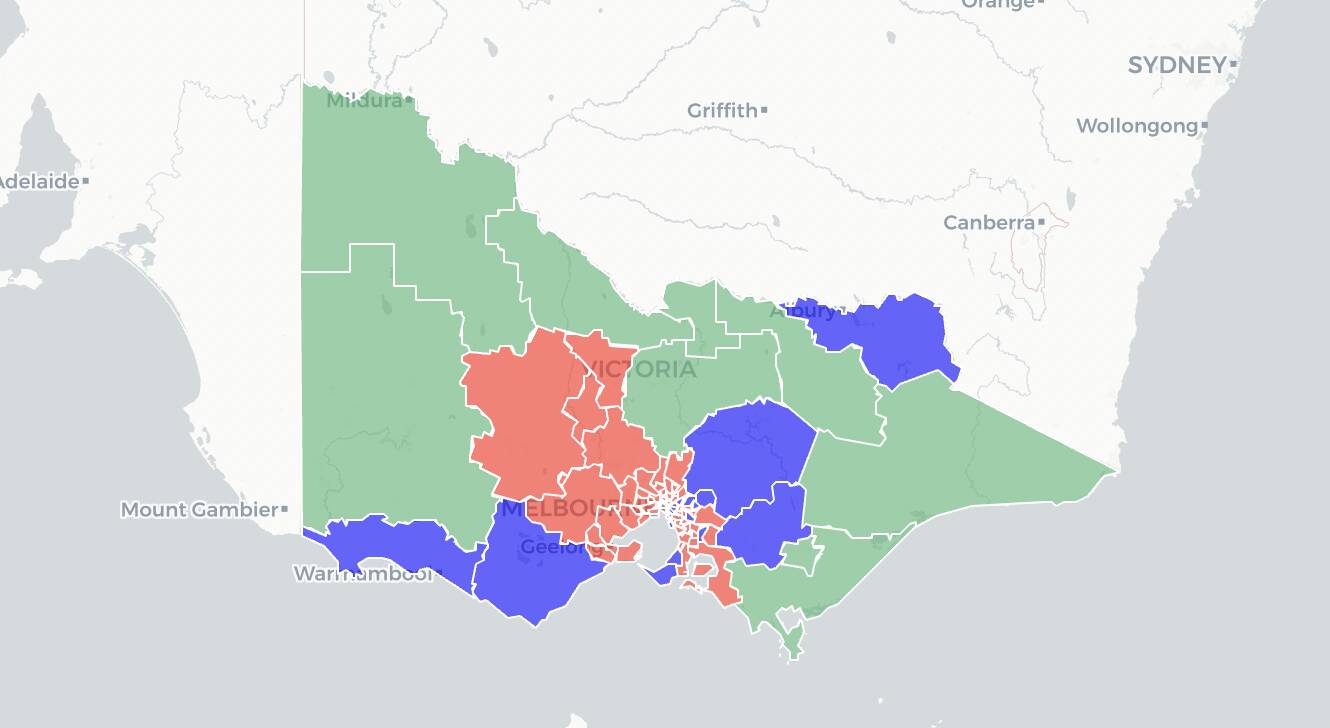
The guide features profiles of all 88 Assembly contests and the 8 Legislative Council regions. These profiles feature results tables, historical information and maps.
Most of the guide is exclusively available for Tally Room members. To become a Tally Room member, sign up as a donor for $8 or more per month via Patreon. Those of you who have been donating $5 or more for a while now are still grandfathered in with access (and if you have trouble with access let me know).
For those of you who are currently contributing – thank you so much. I wouldn’t be able to keep up this work without the support of donors on Patreon.
While there won’t be as much public attention on Australian elections over this year, there will still be plenty of stuff to do. We have redistributions in two Australian states and a territory, and a state redistribution in Queensland. A federal redistribution will be held in Queensland next year, and state redistributions will also take place for Western Australia and both territories.
I’m also hoping the downtime will create more space for things like history podcasts. Either way, your support will help balance out the cycle of interest in elections. If you find this work useful, please sign up.
To give you a taste of what is available, I’ve unlocked four profiles. I tried to pick a range of interesting contests:
- Mornington – a seat the Liberal Party barely held on to against an independent in 2022.
- Richmond – a seat the Greens hold in inner city Melbourne.
- Yan Yean – a marginal northern suburbs Labor seat – the kind of seat that has been becoming stronger for the Liberal Party relative to the rest of Victoria.
- Northern Metropolitan – this upper house region elected Adem Somyurek in 2022. It contains the Greens’ best areas but also outer suburban areas.
I am also planning to publish a guide to the NSW state election later this year, and a partial guide for the next federal election, covering the 100 electorates unaffected by redistribution. Those will be fully available for $8+ Patreon donors.

@ Trent
As I keep mentioning Nether Portal calculated Greenvale on federal results and it would be 17.2÷ Labor margin or it voted 11% to the left of the state if you keep saying that Prahran is not winnable i don’t know why you keep mentioning Greenvale but exclude Bentleigh and the sandbelt which are much Whiter and fiscally conservative. you can add Eureka to the list
@Pollster we’re still a year out from the election. I’m sure they’ll find someone.
@Trent as @Nimalan said I’ve looked at Greenvale, and if the Liberals win it then Labor are in serious trouble based on federal figures.
Even if Labor are neglecting those parts of Melbourne funding and infrastructure-wise they simply prefer Labor policies on welfare and economics as they are impoverished and quite ethnic. It’s the same as how Labor won’t ever be able to win rural farming/fishing towns, they simply don’t like Labor policies.
New Redbridge poll today has a headline 2PP of 50-50 but it’s Kos Samaras’ comments in his Facebook post that I think are more interesting.
Firstly on geographic breakdowns, he says that the 2PP in both Melbourne and regional cities is 54-46 (to Labor). Within Melbourne, he says that the middle-suburbs are where the Liberals are doing best, but makes a specific point of highlighting that the sandbelt / Frankston Line seats are an exception where the Liberal vote is under-performing. He also states that the Liberal vote is under-performing in the outer south-eastern seats.
That demonstrates to me that the Liberals will probably have the most success in the middle suburbs in the eastern suburbs, and the outer north & west suburbs that are on smaller margins like Melton, Sunbury & Yan Yean which all include semi-rural areas.
On demographic breakdowns, the Liberals doing best in the middle-suburbs makes sense because Kos also says the biggest swings are with Gen X, and based on when the middle-suburbs became unaffordable, my guess is that Gen X are probably pretty concentrated in middle-suburbia as the last generation to not be priced out of it.
The other interesting point about the demographic breakdowns which I mentioned in the Prahran thread (as it was in response to a comment about Resolve’s age breakdown) is that Redbridge’s results are vastly different to Resolve’s – but a lot more aligned to every other poll – which I think highlights how much of an outlier the Resolve breakdown was.
For context, the Resolve breakdown had a whopping 37% (!!) LIB primary among 18-34 voters. Pretty different to the narrative in every other poll which has had them in the 10s or 20s.
Redbridge break down by generation instead, and had the LIB primary at 20% for Gen Z and 32% for Millennials. Much higher than in the recent federal polls, but the difference largely correlates to the overall difference in LIB primary between federal & VIC polling.
Given the 18-34 cohort has roughly a 65-35 split between Gen Z & Millennials, that would translate to roughly a 24% LIB primary for 18-34 year olds; although even that is probably being generous since younger Millennials (29-34) within that cohort are likely to have had a lower LIB primary vote than older Millennials (35-45) outside it.
Either way, that sounds far more realistic than Resolve’s eye-popping age breakdown, and also in my view Redbridge appear to be leading the way when it comes to demographic analysis, which is their primary focus.
I would have reservations about looking too closely at ‘Frankston line seats’ or even ‘provincial cities’ from a statewide sample of n=1021.
@ Trent
I agree i think the Narre Warren seats will not swing much which i what i always felt as Kos Samaras saying Libs are underperforming in the Outer South East. Niddrie is middle ring and middle class so i think that seat may swing to Libs.
Redbridge is run by Dan Andrews’ former strategist, Kos Samaras, who also has a VIC Labor MP as his wife.
I wouldn’t at all say that his analysis is “leading the way”.
The sandbelt or Frankston Line seats (e.g. Mordialloc, Carrum) are on margins of 8%+ and they are quite socially progressive or ‘teal-ish’ in some parts. They decided the 2010 and 2014 elections. I don’t think they’ll be as swingy in 2026 but hey, there could be a surprise.
I think the libs path to victory lies in other seats this time. If they are winning those sandbelt seats it’s probably a landslide and they’re already in govt and those seats are just a bonus.
I’m expecting Labor to get a large whack in their heartland with some seats falling from what I’ve been hearing the brand seems to be good form in Eastern suburbs but in poor shape on the other side of town which isn’t a surprise given the feeling of neglect and Labor investing more in Eastern Melbourne. There appears to be a re-alignment and Labor could be defeated in their own backyard. I think the problem with the last federal election is it papered over Labor’s problem with its traditional heartland and they’re yet to address this problem.
I’m expecting Labor to lose all the seats on the liberal target list with retiring members. Bayswater, Melton, Pakenham, Sydenham, Bass. The libs with a new leader and labor with a premier who’s popularity is on par with Vladimir Putin. I reckon we are looking at the libs picking up possibly Glen Waverley and Yan Yean. The only marginal with ? Is Ripon given it’s history though I think the Nats can get that. If they can knock over Ashwood, Sunbury, Eureka, Ringwood and Monbulk. That’s 13 seats. That gets then to 42. Niddrie is a wildcard since it’s occupied by the deputy premier. Hastings gets them to 43. The west is where they’ll need to make up the numbers. Bendigo East, Wendouree in the regional cities. I think they could target Bellarine, South Barwon. Other then that they or an ind could possibly win Point Cook Werribee. Mulgrave could also potentially be a target. They performed well enough and got 45.5% of the 2pp which was better then.Cook. so realistically they can probably win govt with some combination. The greens will probably have a go at pascoe vale northcote and Preston and probly throw a lot at Footscray. All in all I think the Libs have a better shot at majority govt. Labor can probably hope for minority with the greens if they can’t recover any ground by that time.
On the topic of the federal election, it seemed that the Liberals over-campaigned and were too optimistic with the red wall in the western suburbs e.g. Hawke, Gorton. There was barely any swing there. It could’ve been an anti-state Labor vote. There were varying swings to Labor over in the east. This could be part of a realignment or a trend of middle/upper class voters in the eastern suburbs becoming less Liberal-voting.
I think they were well placed in that optimism as the swing elsewhere went massively backwards. They screwed themselves though. Polling from before the campaign had them competitive there.
I agree with Votante comment.
The Liberals cannot afford to lose any seats to teals/Labor/Greens. I know some have said the Liberals will lose Prahran but I can’t see them form government without it and after all they have incumbency so they should be doing everything to sandbag it as losing it just makes it even harder to form government.
I think they will try to sandbag it for, and I think retaining is a (slim) possibility, but I would say the scenario of the Liberals forming government without Prahran is more likely than the scenario of winning Prahran without forming government.
https://www.tallyroom.com.au/61799/comment-page-4#comment-863286
Wendouree is ~4% safer than Eureka, so if the Liberals are winning 1 of the 2 (as they did in with those seats predecessors in 2010), then it is far more likely to be Eureka they gain.
So far the Victorian Socialists are running in 21/88 lower house seats which is impressive. It’ll be interesting to see how much of a primary vote they’ll end up getting state wide.
Anyone have any data on preference flows from Vic Socialists to Greens in ALP v Greens contests? Is it higher than Greens to Labor in traditional contests? I was scrutineering at a booth in Northcote (Cooper) where the flow was 91% which is the highest flow I’ve ever seen from one party to another with a proper sample size.
In the last Federal Election, Victoria Socialist has its highest primary vote around Footscray with 16-19%. I think VS base tends to be low income/lower middle-class while being socially left-wing with many being descendants (or even still themselves) of old-schooled inner city working class families who haven’t seen upward social mobility.
I suspect Victorian Socialists will also do well in CALD working class areas especially where there is a high concentration of Muslims. They did well there in 2022 and that was before October 7th. I think Victorian Socialists can appeal to Grievance like One Nation do they can can use Anti-Elite, Anti-Establishment rhetroic
At the 2025 federal election, Victorian Socialists got double-digit primary votes at some booths in Thomastown, Mill Park and even beating the Liberals in Footscray. They’ve mainly tapped into the disaffected low or middle-income and working class vote in metro Melbourne. A lot of their voter base is young.
Comments are closed.