

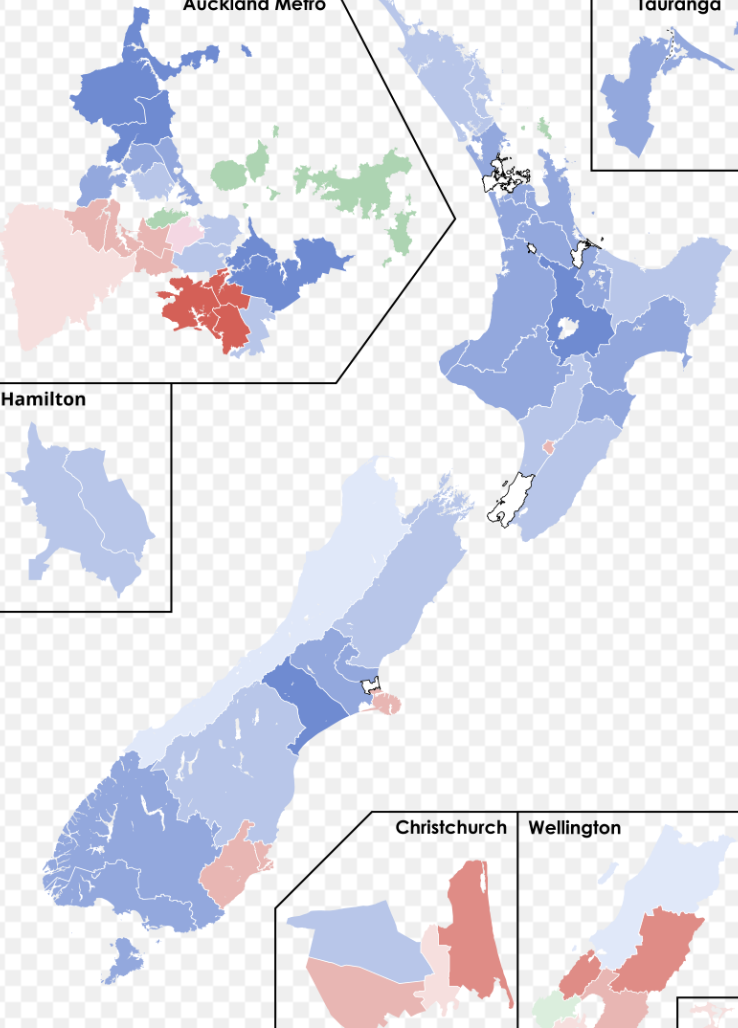
The New Zealand election produced a reult that didn’t quite fit the model of proportionality that was promised when the mixed-member proportional (MMP) system was introduced in 1996.
While results are not yet final, the interim results show significant over-representation for the National Party and Te Pati Māori. Compared to their share of the national party vote, the Nationals have won seven extra seats, and TPM have won four extra seats.
This is a creature of how MMP was designed, and has been anticipated from the beginning. Voters get two votes, and they are free to vote for different parties on those two ballots. While the parliament is designed to produce overall proportionality, the existence of single-member seats using first-past-the-post creates the potential for disproportionality so bad that the system cannot adapt.
In 2026, both of these problems emerged: significant numbers of voters split their ballot, and the governing National Party won a majority of electorates with much less than half the vote.
For this blog post, I am going to run through a variety of alternative systems that could be used to elect the New Zealand parliament, and look at my estimates of how this election would have played out under those other systems. Some of these involve small tweaks: others would completely change the electoral system.
It’s also worth noting that we would expect voters to cast different voters if the system changed. I will address that as we go. But it is useful to see how a given set of votes would play out under different models.
First off, let’s clarify the actual result of the New Zealand election, at least at this stage. The ‘special votes’ are currently being counted, but we will get no further updates until the final declaration. So all of this is based on the interim results.
The parliament is designed to hold 120 seats. But the National Party was entitled to 35 seats on the party vote, and Te Pati Maori were entitled to just one. Those two parties actually won 42 and 5 electorates each, so this created an overhang of eleven seats, for a total parliament of 131.
It turns out that most of the overhang canceled out, but it is enough to give the right-wing government a three-seat majority on the interim results – without overhang seats, they would hold exactly half the seats, but not a majority.
This next graph shows a number of different results under different systems. The white dotted line shows the majority, so you can see that under some systems the result produces a right-wing majority, and under others it produces an Opportunity balance of power. I will run through these systems one by one.
No overhang seats – some electorates don’t get a local member
36 Labour, 35 National, 16 Green, 13 ACT, 12 New Zealand First, 7 Opportunity, 1 Te Pati Māori
This is basically the current German MMP system.
In Germany, a party needs to win at least 3 electorates seats or 5% of the party vote to qualify for seats.
If a party wins more electorates than their seat entitlement, they don’t get an overhang. Instead, those electorate winners are sorted by their electorate vote (it’s not clear if this is percentage or raw votes) and those with the lowest vote miss out on being elected in the seat.
So in the case of the recent New Zealand election, the 7 National Party electorate winners with the smallest vote would not be elected to parliament, along with the 4 Te Pati Māori winners with the lowest vote. This chart shows which seats I think would be affected by this change:
On my reading of the current German system, it appears that these electorates simply do not have a specific local member, and there are additional list MPs to fill the gap.
In six of these eleven electorates, someone else was elected on the list after standing in the electorate. In two Māori electorates, the Green runner-up was elected on the party list. In the other two seats, a Labour and independent candidate respectively came second and did not run on the list. Labour’s Kieran McAnulty was elected on the list after coming second in Wairarapa, and there are three seats where a New Zealand First or ACT candidate came third in the electorate and was elected on the list.
Of course such a change would change party behaviour – there may be people who would have voted Te Pati Māori on both ballots if the low party vote would have deprived some of their MPs of seats. As we will see further on, the big differences between the two votes lead to very different results depending on which dataset you use.
Adding 30 extra list seats
Labour 44, National 44, Green 20, ACT 17, New Zealand First 15, Opportunity 9, Te Pati Māori 5. Overhang of 4.
If there are more list seats, every party would be entitled to additional seats, and thus the size of an overhang would be expected to be decreased.
By expanding the parliament from 120 to 150 seats without any additional electorates, you completely eliminate the National overhang. The major parties are each entitled to 44 seats, allowing National two list seats.
But the scale of the Te Pati Māori overhang is untouched – their party vote was so low that they still only qualify for one seat in a parliament of 150.
This change makes it harder to produce an overhang, but it doesn’t eliminate the risk, or the potential for voters to deliberately split their votes to produce an advantageous overhang.
Adding extra list seats until there is no overhang
Labour 231, National 230, Green 105, ACT 86, New Zealand First 77, Opportunity 47, Te Pati Māori 5
If you want proportional, you’re gonna get it.
This is basically the system that was used in Germany until 2021, with the exception that Germany allocates list seats on a state basis.
If one party wins more electorates than their share, every other party receives compensatory seats to balance out the proportionality.
We already know that 30 seats is enough to eliminate the National overhang, but the TPM overhang requires an additional 661 seats for a total of 781. That would be one of the largest parliaments in the world, and would require many more candidates on the party lists.
Using electorate votes to decide list seats
National 52, Labour 42, Green 11, New Zealand First 6, ACT 5, Te Pati Māori 5. TPM overhang of 1.
Using party votes to decide electorate seats
National 40, Labour 36, Green 16, ACT 13, New Zealand First 12, Opportunity 7. National overhang of 4.
Part of the problem with disproportionality is caused by voters splitting their votes – either sincerely or strategically. So one option is to have voters cast just one vote, and the vote applies to both the electorate and the list. I have modelled using either sets of votes from 2026 to this scenario, but presumably the result would end up somewhere in between if a single vote counted for both.
The major parties poll substantially more on the electorate vote – National in particular, who polled 41% of the electorate vote and 29% of the party vote.
For the larger minor parties, they win less seats on the electorate vote. Opportunity doesn’t make the 5% threshold using the electorate vote.
Interestingly, even though their vote is higher, ACT and Green do not win a single electorate on the party vote – their electorate vote tends to be higher in their strongest areas and weaker in general.
As for TPM, they only have an overhang of one if their much higher electorate vote is used to determine their seat entitlement, and they don’t qualify for parliament (not close to it) if party votes are used. Even in the Māori electorates, their party vote was very low.
Overall, both results produce a similar net result as the actual interim result: a narrow majority for the right-wing government.
Of course merging these two votes can create strategic voting dilemmas – if you live in a marginal seat but prefer Green to Labour, do you vote sincerely or for the party that can win that seat? One resolution to this issue is to allow for preferential voting, which brings me to the next idea.
Use preferential voting for the electorate seats
National 43, Labour 36, Green 16, ACT 13, New Zealand First 12, Opportunity 7, Te Pati Māori 5. TPM overhang of 4 and National overhang of 8.
This scenario imagines Australian-style compulsory preferential voting in single-member electorates, but doesn’t change the list element. I produced estimated preference flows between each party.
It does nothing to improve the proportionality – indeed it makes it worse. National win Epsom off ACT, and the National overhang thus becomes eight seats (while ACT recovers their thirteenth seat on the list).
If the overhang was caused by one side’s vote being concentrated behind one party and the other side being split between multiple parties, then preferential voting may help. But that’s not the case in New Zealand. National are the leading party in the larger bloc, so they will win a majority of seats in such a situation – and that is more than their fair share.
Use 3-member districts for the electorate seats
National 36, Labour 36, Green 16, ACT 13, New Zealand First 12, Opportunity 7, Te Pati Māori 3. TPM overhang of 2 and National overhang of 1.
This scenario involves merging the electorate seats to form 3-member districts which then elect their members using Saint-Laguë party lists, just like the national list.
The new electorates wouldn’t be super-proportional, but it would be enough to take the edge off, and potentially allow some minor party members to win in their stronger areas.
This sort of system is used in a few countries like Denmark, Norway and Austria – like New Zealand, there is a national level of seats that compensate for disproportionality in the lower level. But the burden of proportionality is not placed entirely at the national level. Instead, there is some proportionality at the local level.
In this scenario, it reduces the National overhang to just one seat and TPM’s overhang from four to two. The Green Party win four electorate seats, but ACT and New Zealand First aren’t strong enough to win seats at the local level in this scenario.
To create the electorates, I merged three neighbouring electorates to create one 3-member district. I needed to create two 4-member districts to make the numbers add up to 71.
5-member districts using Single Transferable Vote
Electorate vote: National 56, Labour 44, Green 7, Te Pati Māori 5, New Zealand First 3, ACT 2.
Party vote: National 41, Labour 35, Green 13, ACT 13, New Zealand First 12, Opportunity 2, Te Pati Māori 1.
This scenario abandons the two tiers of MMP entirely and creates 23 local electorates, each electing five members (with the two larger electorates each electing six). It adds up to a total of 117 – if these districts were drawn properly they could be more even in size and add up to the same size as the current parliament, although it might be necessary to tweak the size of the districts or the parliament to make the Māori seats or South Island seats work.
5-member districts using STV are not super-proportional and tend to punish parties with a lower vote. If we use the party vote, the bigger parties get about the same representation (a bit less to the Greens, and the Nationals end up getting about what they get with the overhang) but Opportunity only gets two seats. TPM’s results end up the same – one with the party vote and five with the electorate vote.
If you use the electorate vote, the major parties win a lot more seats, but I suspect the party vote does a better job of showing how people would vote.
Unlike the MMP system, there is no hard-and-fast threshold at 5% – Opportunity voters could vote for them without worrying about them falling just short. They could win in some regions and their preferences could elect someone else in others.
List seats chosen at the regional level
National 45, Labour 36, Green 17, ACT 12, New Zealand First 11, Opportunity 7, Te Pati Māori 5. Overhang of 9 National and 4 TPM.
This system is modeled on the Scottish electoral system, which looks similar to New Zealand but instead of an overhang it reduces the number of list seats in a region to account for overhang constituencies. This has the effect of reducing proportionality. Scotland has also seen some differences in voting between the two ballots – some pro-independence voters choose to vote Green on the regional list and SNP for the constituency vote, helping bolster the pro-independence majority. I have still used the overhang we see in New Zealand.
One advantage of this model is that it eliminates the need for a hard threshold at 5%. I created eight regions, electing 7-11 local electorates MPs each with an additional 5-8 list seats per region. In practice, you need about 5% in a region to win your first list MP, but a party can do better in some and worse in others. It also makes the list MPs more “local”, although the experience of some regional systems suggests that the regions are too large to have meaningful local representation (see the Victorian Legislative Council).
But this model does nothing to deal with the current overhang problem. Indeed it makes it worse. The list results are almost identical to those in the actual election. National and Green win one more, and ACT and New Zealand First win one less. But the application of the overhang at the regional level means National still picks up list seats in their weaker areas, and it produces a National overhang of nine seats instead.
Overall, I think most of these models are off the table. Regional lists wouldn’t help, and neither would preferential voting in single-member electorates. An expanded list would reduce the scale of overhangs but still allow the mechanism for strategic creation of overhangs – something which may increase at future elections. At the ultimate extreme, you could imagine two parties, one of whom only runs for the list and the other for the electorate. TPM has almost reached that point, with practically no-one voting for the party on the list.
If MMP is to be maintained, the options would either be to add a substantial number of extra list seats, or to follow the Germans and eliminate overhangs – if a party elects more electorate MPs than their seat share, some of those seats would not have a local MP. The former would maintain the incentive to create overhangs, while the latter would eliminate any incentive.
Alternatively, New Zealand could look at other models like Single Transferable Vote. STV does not guarantee perfect proportionality at a national level, but in practice MMP cannot deliver that either. But it does simplify the contest to a single vote for a mostly-local MP. 5-member districts would produce a fairly good level of proportionality, while limiting party fragmentation in the way that the 5% threshold is meant to do. 7-member districts would allow for greater proportionality, but also widen the field of parties winning seats in Parliament.
I don’t think ‘doing nothing’ is a serious option – the National overhang appears to have produced a right-wing government majority. The TPM overhang is the only reason the right wing hasn’t fully locked in a majority prior to the special votes being counted. Other parties would be crazy not to consider this in the future, and there will be more of an incentive to encourage voters to split their votes, increasing the importance of local electorate races over the national party contest and distorting the results.