

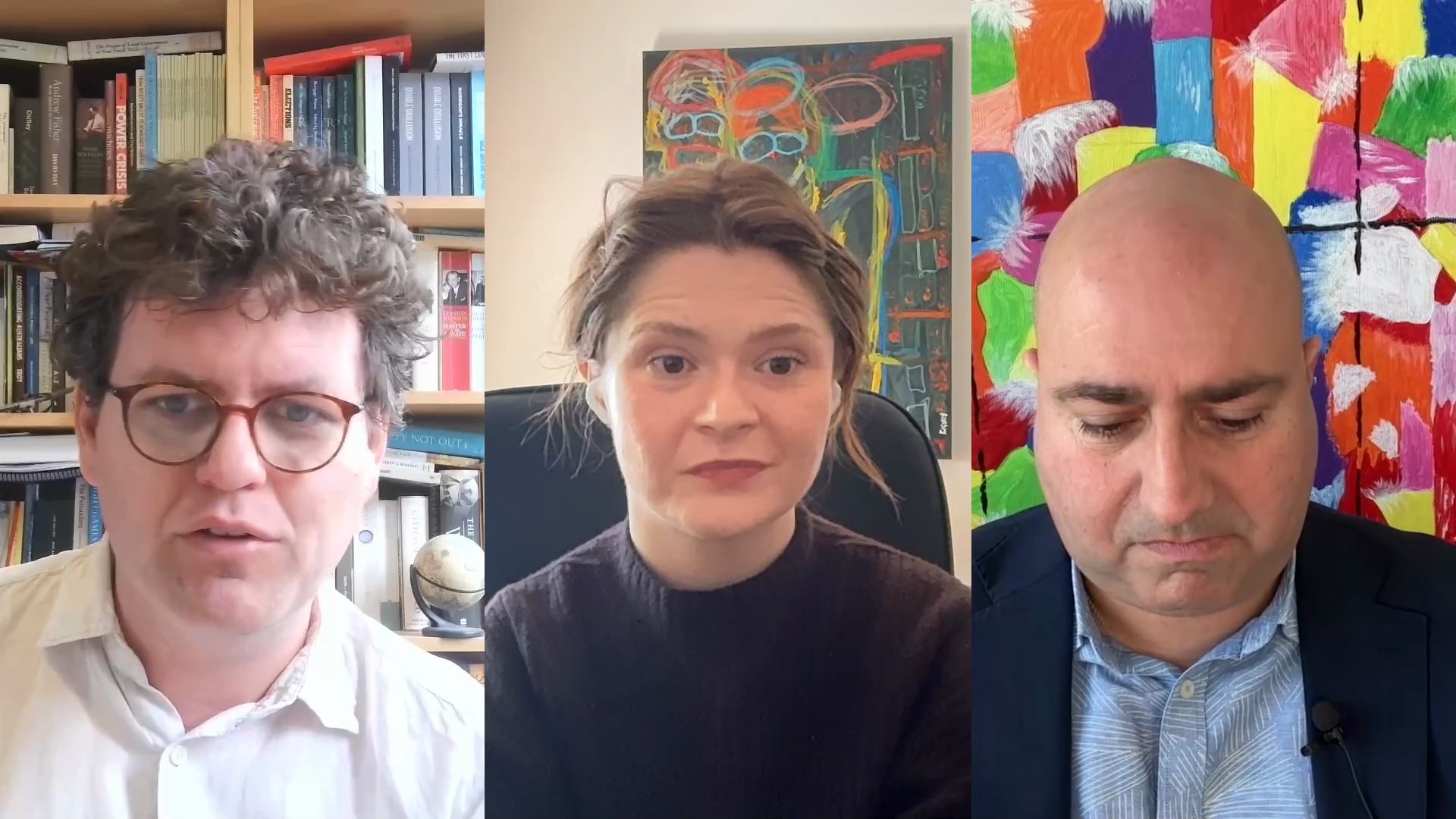
Ben is joined by Phoebe Hayman and Zareh Ghazarian to discuss the Victorian election, with a particular focus on the campaign messages and campaign tactics as a new poll puts Labor under 20% and opening up the possibility of a Coalition landslide on a third of the vote.
This podcast is supported by the Tally Room’s supporters on Patreon. If you find this podcast worthwhile please consider giving your support.
Buy a ticket for the second live show in Melbourne.
You can listen to an ad-free version of this podcast if you sign up via Patreon for $10 or more per month. And $10 donors can now join the Tally Room Discord server.
Ben: Welcome to the Tally Room Podcast. I’m Ben Raue. The Victorian election is now less than three weeks away, and this week we’ll be exploring the political contest across the state, with three parties regularly polling over 20%, there will be different types of contests in different kinds of seats. So how should we expect these different races to play out? I have two guests today.
My first guest is Zareh Ghazarian. Zareh is an associate professor in politics and international relations at Monash University. Hello, Zareh.
Zareh: Hi Ben, good to be with you.
Ben: And also we have back on the podcast Phoebe Hayman. Phoebe is a PhD candidate in the Department of Politics, Media and Philosophy at La Trobe University. Hello, Phoebe.
Phoebe: Hi Ben, nice to be here.
Ben: thanks both of you for coming. But first you can still buy tickets for the second Tally Room Live podcast recording in Melbourne on Wednesday, December the 2nd. My guest will be Benita Kolovos from The Guardian and Todd Farrell from the University of Melbourne. There’ll be a link to buy tickets in the show notes, so check it out.
So, in our last episode, we caught up on the last four years of Victorian politics, looking at the party leaders and the issues. Today we’re going to be looking some more at the complexity of an Australian election where you have three parties all polling over 20%. Now we’re recording this on Monday, the 9th of November, and our plan was to start by talking a little bit about candidate nominations because they’ll be closing about now and they’ll all be out by the time anyone’s listening to this tomorrow.
But instead, we’re going to be talking about a Demos poll that came out this morning, DemosAU, it’s a bit of an extreme poll, producing figures that are worse for Labor than I think we’ve seen from any other pollster or from Demos. it has the Coalition on 33, it has One Nation second on 21, Labor third on 18, with the Greens just behind Labor on 17.
So it’s a very good poll for the Greens. it’s not the best poll for One Nation, but it’s one that has them in second place. And so we might start by talking about this poll and talking about the situation in general. Zareh, what are your thoughts about about what this poll means?
Zareh: Ben, Phoebe, I think this is a disaster simply for the Labor Party, but it’s been on the cards for a while. I think we saw last week another poll that was sort of similar. was a 55-45 favouring the Coalition. And that suggests that there is real momentum now for the Coalition. thinking back to where the Coalition was just four years ago, the party just got a ombined absolute thrashing essentially but their vote back then was around 33% the primary vote. On the two-party preferred basis they were 45%. So in essence what we’re seeing with these two polls is something like a 10 % swing from last election on the two-party preferred vote. That’s extraordinary.
Ben: yeah, at this point when Labor’s on 18%, I guess the two party preferred sort of loses its meaning. But for a point of comparison, this Demos poll, yeah, has them on 56-44 on the 2PP. So that’s a very big swing. and you know, traditionally I think a vote of 33% for a party wouldn’t have been very good, right? It would have been a pretty disappointing result. But actually this probably would be a very good result for the Coalition if this was to be replicated, Phoebe.
Phoebe: Yes. it’s a result where we are seeing a growing primary for those other characters, so One Nation, Greens, and that’s really going to determine where those votes wind up. 30% when we’re looking at races that have three corners, perhaps even four in some cases, can be a pretty big primary in that context. So it’s a very, very different context than we saw ten years ago or even four years ago. It’s kind of part of this ongoing shift and fragmentation that we’re seeing across the party system in Australia, which at this point looks like going to work out quite well for the Liberals.
Ben: I don’t want to focus too much on one poll because I do think possibly this is a bit of an outlier. And I would say good on George Hasanakos and the team at Demos for actually publishing the poll because I think a lot of the problems that Australian polling has had in the past is people going, those numbers don’t look right. Let’s tweak them, let’s try something a bit different.
Maybe this will be an indication of the scale of what is going on here and how much things are changing. But right before we start on this podcast, I was doing some very basic, very simple modeling of what this result could look like. just applying from a previous MRP and applying some swings and then applying preferences.
I had the Coalition getting over sixty seats, so quite a large majority. And why that’s going on in this situation, I think, is that there aren’t a lot of seats where the Coalition falls into third place, and that’s probably going to be the best opportunity for One Nation to win seats in the outer suburbs, maybe, is for the Coalition to fall into third. And so, somewhere like New South Wales, the federal polling at the moment, that looks quite promising. It happened a bit in South Australia, and their highest vote will be in rural areas, but they’re going to be facing off against the Coalition there. And on these numbers, One Nation, you know, 21 is not as impressive as some of their previous polls have been. And so you do still have a decent part of the state that is a Labor-Liberal contest, and then you have quite a few seats where the Greens make the top two. And so what ends up happening here is that when the Coalition is in a race against Labor, they get preferences from the right.
When they’re in a race against One Nation, they get preferences from the left. And they are effectively the center party right now in this political system. And they end up winning all over the place. And so my again very rough estimate had Labor under 20 seats, but actually had One Nation in fourth on four and had the Greens winning more seats than One Nation.
And I think that does reflect that on these figures, One Nation isn’t doing well enough to win seats without the benefit of preferences and they don’t get a lot of preferences. And so even though One Nation comes second, they don’t end up winning a lot of seats.
Phoebe: Yeah, it looks like a exaggeration of a role that One Nation has historically played in a number of elections is to kind of be a force that props up the Liberal Party or kind of helps flow preferences to the party. So despite the amount of media attention and discussion we’ve had around One Nation, it is in some ways I think a real reversion to form for the party and its role within the system.
Ben: Zareh, one of the big things that’s happened over the last couple of weeks since our last podcast is we’re seeing a bit more of Ben Carroll. he’s been the Premier for a little while. He’s pursuing a strategy that’s very much disavowing Labor of the past, trying to go for a different direction. I wonder whether what we might be seeing here is that in addition to it not attracting back the more conservative voters. It’s potentially voters on the left that Labor relies on to at least hold on to their core.
Zareh: Absolutely, Ben. when we look at how Victorian politics has really changed over the last four years, we just cast our minds back. When we think back to 2022, Labor won 56 of the 88 seats in the lower house. That was remarkable for a party that had already been in government for a while. It was absolutely steamrolling.
When we look now at reports and polls and we look at where Labor is reportedly spending significant money to try and keep seats. It’s doing so in seats like Dandenong, which it is Labor heartland, that’s on the south eastern side of Melbourne, traditional Labor seat. Just to give you a sense of how strong this seat is, it’s an 18% margin for Labor and they’re deciding to spend resources here. Other seats like Werribee on the west are held with over 10%. Kalkallo up in the north held by 16%.
These are heartland seats and when we start to see Labor starting to spend money, significant resources, you know that it’s in trouble. And part of it, I think, goes back to your question about Ben Carroll. We know that Ben Carroll wanted the leadership when Dan Andrews retired in 2023.
He was, however, not from the left faction, he’s from the right faction. And so it sort of makes sense that he’s been more focused on things like law and order, he’s been focused on things that you could basically argue are more bread and butter state government issues like state of the roads and transport. So I think what we see is a real challenge for Labor and for Ben Carroll to connect but the more people are seeing of Ben Carroll the more people seem to be turning off Labor.
Phoebe: I think it’s put the party in a real double bind that way. They do need to obviously get him out there in front of voters because he isn’t despite being in the seats of government for so long, he is not that well known still. he doesn’t have a kind of firm identity. It’s starting to firm up at the moment, I would say, but he has been a bit of an unknown quantity.
There’s been a need to introduce the electorate to him, which has really had the effect of centering their campaign on this figure that’s turned out to not be particularly appealing, it seems, who has kind of been following the Liberal Party down some different policy rabbit holes.
We’ve had some big announcements around youth crime in the last couple days. He’s also, I think importantly, worth noting along with Zareh’s excellent list of different electorates where we are seeing Labor having to play a more defensive game. Niddrie itself, so Ben Carroll’s own seat, is kind of within that.
So he’s looking at what might be a reasonably tough fight within his own electorate, on top of trying to win over an entire state. It’s a very tall order. He had a very short run-up to this election. And it’s also one that is about to get trickier as the public hearings start for the Big Build Royal Commission.
Ben: This very basic model I made this morning based on the latest poll has him losing Niddrie by three points. has him on 47 after preferences. it does make me think a little bit about this classic idea, particularly in a two-party system, of there being a median voter and you want to claim the middle ground. And, you know, that is not unimportant, you know.
I do think that does play a role, but sometimes you can’t just move further to the centre without losing your flank now. Because maybe back when Australia was very much a two-party system, you could kind of take your left flank or your right flank for granted. but again, looking at this one poll, 35% of people are voting either for Labor or the Greens and barely half of those people are voting for Labor. And so at that point, maybe that’s not the factor that’s deciding who wins government, but that will have an enormous impact on the number of seats Labor can win.
It feels like the strategy is very much about ignoring that flank and going for the centre. And, maybe if that centrist part of the plan was working, they could cop losing that support to the Greens, but it doesn’t seem like either is working right now.
Zareh: I think the writing has been on the wall in Victoria. When we look at the last election, Labor’s primary vote fell by 6 % and yet they still won, indicating how poorly the Coalition travelled. But we saw the rise in support for parties like the Freedom Party, for example, Family First, so right of centre parties starting to take a bit of the vote away from the major parties.
I think that’s something that potentially may have been missed in the strategy of the Labor Party. That in Victoria there was the sense that the old idea that John Howard I think once labelled Victoria being the Massachusetts, the sort of socially progressive left-leaning state that would continue to vote that way.
The signs were there, that there was some frustration with Labor and that’s coming out and Ben Carroll’s receiving the brunt of it I think.
Ben: Yeah, it’s starting to resemble, we saw it in New South Wales and we saw it in Queensland, the last time Labor governments got kicked out in New South Wales, the second last time for Queensland, 2011, 2012, where the government had really run out of puff. And maybe if they’d lost three years earlier it would have been kind of a respectable defeat, but it was a pretty devastating defeat.
And it was also at the point where like, parties like the Greens, it’s not that they were supporting having a Coalition government, but they had given up on trying to work with Labor. They didn’t do preference deals, that kind of thing.
And those elections were devastating for Labor. They got about 20 seats in New South Wales. I think they ended up with seven in Queensland. And so in that sense, it’s not far off what the Victorian election is starting to look like potentially for Labor. but it’s in a very different political circumstance where that vote for all those other minor parties is much bigger.
And so there’s this One Nation story going on. But I think maybe that’s masked the growth in the right wing vote because the Coalition vote is not that high. but you know, thanks to that kind of key position in the spectrum, maybe they can kind of get a kind of Barry O’Farrell or Campbell Newman style victory. That seems to be on the table now.
Phoebe: Yes, it’s had the feeling of a government that’s day is done.
They’ve been in power for an incredibly long time, which at a certain point incumbency does start to cost you. It makes you responsible for every difficulty that people are feeling. and as we can see from the kinds of policies that have really been centre of this campaign, they’re bread and butter issues. People are feeling like life is a bit more difficult, is the general sense. That is what parties are trying to speak to, are these kinds of day-to-day problems.
It’s potholes, it’s can you get to a dentist and afford it if you get there? Are you kind of concerned about basic access to security and safety in your day-to-day life? So it is generally these kinds of issues that speak to how well a government is performing. And when they are centred in this way, it’s never going to be particularly good for an ageing government like this one.
Carroll has stepped in in an attempt to rebrand and refresh this ageing government.
And has failed to sell it as something new. While he’s done a lot of telling everyone that he is not Jacinta Allan and he’s not Daniel Andrews and this is a new day, a lot of the policy still looks quite similar. A lot of it’s quite responsive. There hasn’t been a strong narrative about what his new government would be about, who it’s for, what it’s gonna do. And I think that’s really been a significant shortcoming in the campaign so far.
Zareh: I think that’s a really good point. just thinking about Ben Carroll’s brief, essentially when he took over, as you say, Phoebe, he’s positioned himself essentially to be not his predecessors. That was one of the big things that he came in with.
And the brief that he set for himself, it seems, was to launch an inquiry into investigating allegations of misconduct in major projects, to focus on law and order, and to focus on the basics of road surfaces for example which is a big issue in Victoria at the moment. Is something that people from outside of Victoria may not be fully aware of but it’s something that is dominating the airwaves, it’s something that’s dominating the political debate so potholes and this potentially could be the pothole election.
Phoebe: Zareh you raised the stuff around corruption that this government’s been trying to address. The Big Build Royal Commission, which was Carroll’s first announcement, it was in his initial press conference when he was made Premier.
That has been going on in the background but privately up until now. This morning, I think about an hour ago, so we’re on Monday, the 9th of November, the public hearings began and they’re gonna go for the next two weeks. They are likely gonna mean a series of news stories coming out about different details and controversies and accusations of corruption, who said what when throughout the campaign period.
I believe it’ll overlap with at least some of early voting. So this is not likely to help at this point. There’s a lot of help needed and this is essentially the worst thing that could be happening to this government.
Ben: Is there a case to be made that this Royal Commission had to happen and actually it would have been better if it happened a year or two ago and you know, that actually it’s the delay rather than the calling of it that’s the problem here?
Phoebe: Probably personally agree with that assessment. It did need to happen. For Labor, it’s probably best that they had gotten on the front foot and done this. Obviously, there was a lot of debate, it seems, within the party. Jacinta Allan was very, very against agreeing to a commission. so it was never going to happen under her leadership, which means ultimately they would have been better off perhaps replacing the Premier either earlier or just sticking it through and writing out the loss and coming back next time.
Zareh: And these things have a great political cost even before anything is revealed, right? We’re talking about the premier, previous premier, from memory, media conferences being sidelined by questions from the press about calling an inquiry, investigation and so on. So this has been a really long standing problem for Labor that cost some significant support for Jacinta Allen’s premiership. I think that the timing obviously is not ideal to do it during an election campaign, but it was something that was really prominent and was something that many Victorians felt very strongly about.
Ben: What have we been hearing from the parties about how they’ve been talking about each other too? Because if I was in Jess Wilson’s position right now, they’re on a bit of a high, they’re in quite a strong position, their support seems to be building. and I’m interested in what rhetoric we’re getting between the parties.
Phoebe: I might start with the AI ads because they’ve been everywhere for the last fortnight. So we have seen this in previous elections. I have been taking a look through the major parties’ social media over the last few weeks. They have been so, so many AI-generated ads, mostly attack ads.
So by and large it’s generating a video of your opponent usually looking silly. I believe Labor were the first to release one, and Jess Wilson came out quite appalled, but since then both major parties have been rolling them out pretty consistently against one another. so this has really set quite a negative tone overall.
Her job has been to connect every issue that people are feeling up to the current government. and this has been a big part of how that’s done. The other one’s been sock puppet, astroturfing accounts. So on the digital ads side, we’ve seen a lot of other accounts. so I think Don’t Risk Vic is the one from Labor that’s running ads trying to associate Wilson with One Nation.
So making the connection that if you were voting for the Liberal Party, you were voting for One Nation. We’ve also seen Climate 200’s come in with Think Again, which is a kind of rebrand for some digital ads that they’re running on that side of things. So yeah, there’s a lot going on in that digital space, which is mostly where I’ve been looking, and it has been quite negative, quite focused on the leaders, I would say.
Zareh: I think one group that isn’t prominent in the current debate are the independents. The independents we saw at the 2022 federal election, 25 election, but in Victoria they don’t seem to be as prominent or as visible in the campaign or the debate.
And I think one of the things that’s been a very potent attack that Labor had earlier on was the question to Jess Wilson, the Liberal leader, about what they would do if they were to find themselves in minority situation. Would they govern with One Nation support? Would there be a Liberal-One Nation coalition?
For a long time, Jess Wilson has said that they aim to govern in their own right. And I think these polls start to paint a picture that that’s probably going to be the situation, that the Coalition will not need the One Nation party. And I think there’s also been this sense in Victoria that One Nation was expected to do really, really well.
I’m not so sure, I’ve never been so sure that they would do well because this hasn’t been a strong state for One Nation ever. It’s really struggled in the past and the best I think they did was at the last election when they were able to win an upper house seat and that was essentially the high point of the One Nation party.
It hasn’t traditionally done well in Victoria and now that the Coalition has started to really find its groove and get the support of voters. It looks to be that this is going to be, again, an election where One Nation may not achieve what its grand aspirations may have been.
Ben: Well, that’s an interesting one because I think in terms of the vote share that they’re polling, it’s still a very remarkable, very high vote share, right? But I think this is showing us that it’s not just about what vote you poll, it’s also about what everyone else’s vote looks like and how those votes interact and how preferences play out. And I think that’s where they could potentially get shut out. I should caution, of course, that you know, this Demos poll today is probably the best one that the Coalition has had. we’ll have to see if this is repeated in other polls. I don’t think minority government is out of the picture, but I also think we might be looking at a different kind of minority.
There was a point earlier in the campaign where we were looking at effectively a three-way tie between One Nation, Labor and the Coalition. And it’s not looking like that now. So, if ten One Nation members get elected and the Coalition falls two or three seats short of a majority, they’re gonna be like a strong minority government, of the kind that we see in New South Wales, right? Where we have a minority government in New South Wales, but everyone kind of forgets we do because they are in such a strong position that it’s not really a problem for them.
So that’s possible that we could see something like that as well. Like I think there’s a variety of different kinds of minority governments and I do think it’s less likely that One Nation will kind of have the Coalition over a barrel.
Having said that, it’s also worth noting the upper house. Now the group voting tickets have been abolished. The upper house is going to do a pretty good job, I think, of proportionally representing the bigger groups and then cutting out all the smaller ones. And, you know, if the state is voting with a majority for One Nation in the Coalition, we’ll get a One Nation-Coalition majority in the upper house.
The coalition is not going to get close to a majority if they’re polling 33%. and they may find themselves in a position where they can choose. They can work with One Nation, they can work with Labor, or theoretically they can work with the Greens. And Zareh, I know you’ve done a lot of stuff on like Senate minor parties and those Senate dynamics in the past. You’ve written a book on it.
I do wonder about how that dynamic plays out in the upper house. Does does the Coalition go work with One Nation or is it just easier to work with Labor?
Zareh: I think that’s the question and I think that’s the great unknown for the Coalition if they are to win this election. And I think just to step back Ben, I think it’s a really important point you raise that minority government is not out of the question because when we look at the electoral pendulum and we look at the seats that are held by Labor, less than 5%, the traditional sort of marginal seat margin, we take out the contests with the Greens. There are only eight seats that Labor holds with a margin of 5% or less.
So that gives us an indication of how big the swing has to be for the Coalition to be able to steamroll their way through and break through the 16 seats that they need to win this election in their own right. So there’s still huge barriers confronting the Coalition because some of those electorates, even things that have been traditionally marginal, like the sand belt seats, South Eastern beachside suburbs like Bentleigh, Mordialloc, these are on over 8%. So it gives us an indication of how strong Labor is positioned. So you’ve got to have a huge swing and a swing that’s replicated in many seats to be able to dislodge the current MPs.
Ben: Famously in 2022, the Coalition actually gained votes, both primary and 2PP. but actually lost seats because the swings were gained in very inefficient areas and a lot of those traditional marginals actually became safer for Labor.
And so in effect, if this had been a bit more of a conventional two-horse race, it would have been a bit harder for the Coalition, but there’s something about the way that the whole board has been kind of tipped up that means that we aren’t really talking very much about this seat or that seat. The map has been totally reshuffled.
Zareh: And I think that’s going to be the challenge obviously to get through those and to win those seats but also with the One Nation party presuming that it does win seats in the upper house they’re going to be very very powerful and they’re going to yield significant influence because the upper house in Victoria is a powerful chamber it can’t block budgets but it can obviously have a say on the overall shape of what governments do.
Ben: Phoebe, what are you seeing about the effect of this campaign in terms of how the parties are operating on the ground? ‘Cause you would imagine usually when a party is in the difficult position that Labor is in now, that might put a lot of strain on their ability to field a campaign.
Phoebe: Hm, certainly. I think overall looking at the state as a whole across parties, you see really big differences in how the campaign is conducted by everyone, depending on what kind of seat you’re looking at. So if you’re looking at the inner city, you’re looking for volunteers on the ground. That’s what you’re gonna see. The Greens reckon that they have run their biggest ever campaign in Victoria in Northcote. They’re claiming the most doors knocked in a single weekend, I think the most in a campaign overall. So they’re going very hard on a seat that is held by a 0.2 margin, I believe it is. It’s minuscule.
But we’ve seen similarly really big ground game from Labor Party inner city in Greens held seats, like Richmond. So Richmond is currently held by Gabrielle de Vitri. And at the moment, Labor seems to be, again, claiming their biggest ever ground campaign in this area. So we are still seeing them go on the offense in some of those regions. It’s worth keeping in mind where you run a big field campaign is often in part dictated by where your volunteers are.
So it might not necessarily reflect a strategic choice by the party so much as branch composition.
If we’re looking further afield, I have been personally quite surprised by the number of people who One Nation actually seem to be able to get out and about. They’re holding a number of campaign events. A lot of them are fundraisers, seems to be a kind of ongoing theme. This is not a party of big grassroots door knocking, it appears. But they’re running kind of trivia nights and talks and events at the pub and these sorts of things. And they seem to be getting a surprisingly good turnout, one that would have been kind of completely inconceivable a couple of years ago. again inner city in Hawthorn actually is where you will find some independent movement.
So Shima Ibuki, I think is running one of the largest campaigns, if not the largest, of an independent in this current contest. and she’s facing off against John Pesutto, who was famously the former opposition leader.
Prior to Jess Wilson, who ran into a lot of trouble with Moira Deeming. and he’s looking to hold on to his seat. He again door knocks. I don’t think I’ve ever seen a Liberal who enjoys talking to his community as much as that man seems to. He has been a real grassroots campaigner throughout his career, and this is reflected in the current efforts. Once you get out of that inner city pocket though, you start looking online for big messages, these sorts of branding efforts.
Part of that’s practical. Campaigning in the regions is tricky. Door knocking in rural areas would require a lot more walking, at the bare minimum. But we do see these kind of shifts in the context, and I think in what voters sort of expect a campaign to look like these days. They’ve really been shaped by what have been a lot of really, really fiercely fought efforts over the last few cycles.
Zareh: I think the rural regional electorates are also going to be fascinating to watch because we see, for example, on the New South Wales-Victoria border, especially where just up north, One Nation did really well in Farrer at a by-election, is that going to rub off on the Victorian state election and when we look at seats like Mildura with a margin of 1.2% for the Nationals, when we look at places like Shepparton, potentially even Benambra, are these areas potentially going to be the ones where One Nation does best?
So I think there’s a lot of pressure this election on the National Party, a party that often is lumped in with the Coalition more broadly. But I think for the National Party in Victoria this is going to be a huge test as to whether they can maintain their representation. you can think about this outer ring of electorates in rural regional areas where the National Party has held seats and has held seats for many years.
Are these going to come under threat? This is the election to find out.
Phoebe: I don’t know if you saw there was a One Nation ferry up and down the Murray that’s been going along, which seems like an excellent campaigning tool if that’s what you’re trying to do is bridge the gap between Farrer and the north of Victoria.
Ben: If we were looking at an election like what the federal polls or what the New South Wales polls look like, I think the National Party in those rural areas and those independents in rural areas in New South Wales are in a lot of danger to One Nation. it does seem like the Coalition’s recovery might protect them in Victoria. We’ll see what the reporting says, but for that kind of voter who is considering switching between, say, the National Party and One Nation, how much of a difference it makes that Victorian coalition right now is viable.
You know, like they’re serious. They look like they’re going to form government. They’re going to get the opportunity to form government. Which you couldn’t say for the South Australian Liberals. You can’t really say it for the Federal Coalition. And frankly at this point the New South Wales Coalition is starting to look a bit similar to that. And so Victoria in that sense is starting to look like a bit of a disappointment for One Nation.
But I feel like we don’t want to get into that too early. They are still polling over 20% of the vote. And I think there could be a lot of races where a few points here or there make a huge difference. Which is where, a Coalition vote of 33 or 35% produces a very different result to a Coalition vote of like 28 or 30.
So that’s about it for this episode of the Tally Room Podcast. Thank you, Phoebe and Zareh for joining me. Thank you, Zareh.
Zareh: Thanks so much for having me, Ben.
Ben: And thank you to Phoebe for joining me.
Phoebe: Thanks for having me been. It’s been great.
Ben: You can find this podcast on your podcast app of choice. If you like the show, please consider rating or reviewing us on Apple Podcasts or Spotify. You can follow me on Bluesky at www.benraue.com
You can now also follow the Tally Room on Instagram, TikTok, and YouTube at @thetallyroom. This podcast is made possible thanks to the generous support of our donors on Patreon. Sign up at patreon.com/tallyroom
And free versions of this podcast are now available for Patreon subscribers. And if you sign up for $10 or more per month, you can join our Discord where we’re having great conversations about elections.
If you’re a Tally Room member, you can also now access election guides for the next federal election and state elections in New South Wales and Queensland.
Information about this podcast is available at tallyroom.com.au and you can email questions or feedback to podcast@tallyroom.com.au
Thanks to Chris Dubrow for writing the music here in this episode. Once again, thanks for listening.