

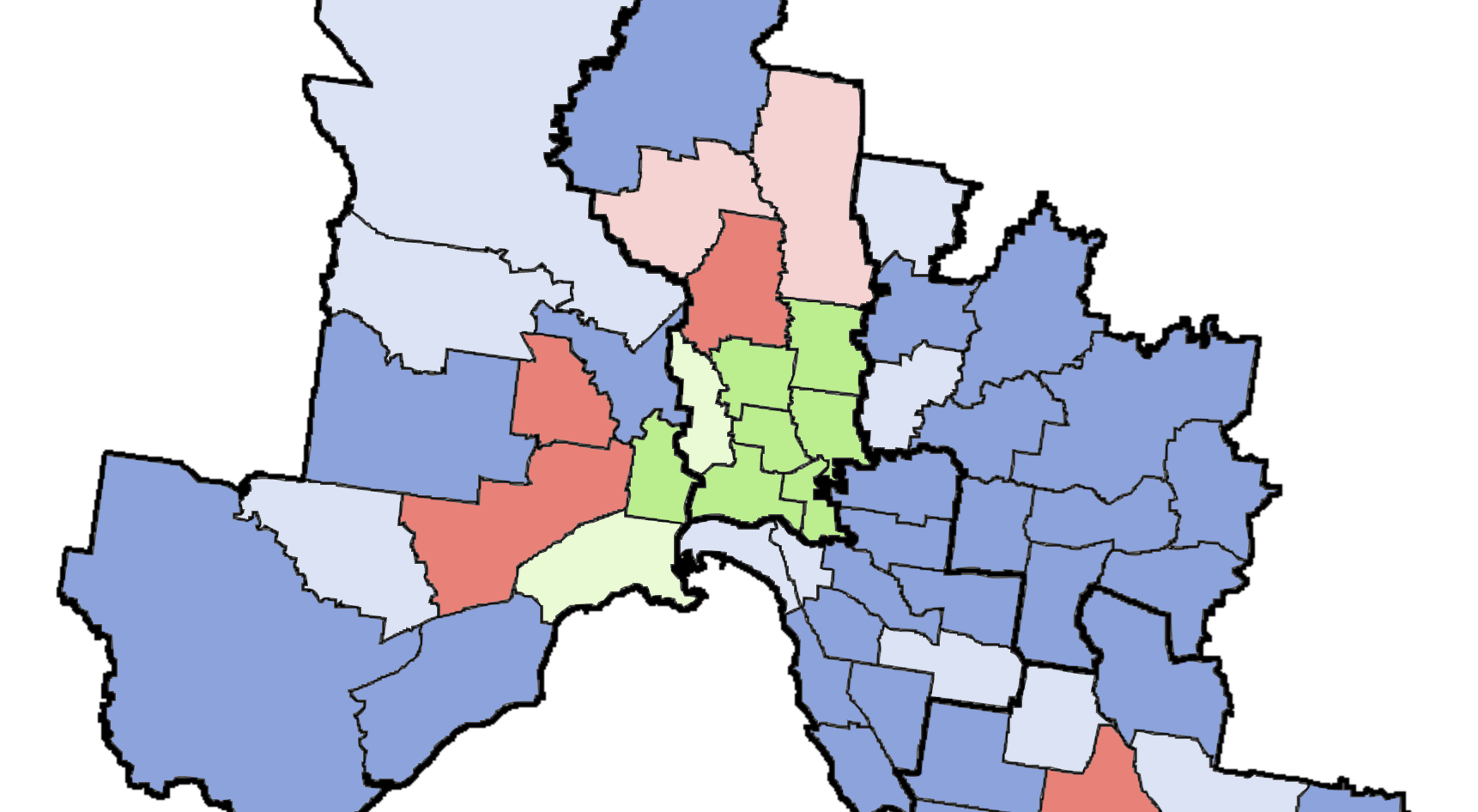
In some ways, Victoria’s state election was very clear. But in other ways, it was very messy and confusing.
It was undoubtedly a clear victory for the Coalition – perhaps it wouldn’t have been under another system, but under our preferential system, a party that sits at the centre of the political spectrum (at least in the 2026 climate) and has a substantial primary vote lead will make the top two in most seats and will benefit from preference flows in a number of directions.
I have spent some time this morning checking each seat to double-check the status I have for each seat.
My current totals are:
- Liberal – 37 won, 21 leading
- Nationals – 10 won, 1 leading
- Greens – 7 won, 2 leading
- Labor – 3 won, 4 leading
- One Nation – 3 leading
Right now I have a tremendous list of 31 undecided seats. I have checked Poll Bludger and ABC and there are a few disagreements but this is mostly consistent.
At a general level, the trends played out as we expected. The Coalition primary vote right now is slightly higher than the upper end of recent polls, while One Nation is right in the middle of their range, and Labor’s result is about as poor as any polls had predicted. Most recent polls had Labor in the low 20s, and they currently sit on 18%.
I will do some analysis later looking at the distribution of primary vote by party. I suspect part of the story is the Greens having a more efficient concentration of support than One Nation. But One Nation’s problem was also that they performed best in areas where their main opponent, the Coalition, was able to resist their wave, while Labor was too weak to resist the Greens wave. The Greens vote tended to be higher in places where the vote was severely fragmented while a lot of rural seats were very clear Nationals-One Nation contests.
If you appreciate this work, please consider signing up to support the Tally Room on Patreon or buying a ticket to our live show in Melbourne on Wednesday.
Determining who wins is no longer a matter of just looking at which candidate is winning the preference count. In a lot of seats, it’s not even a matter of looking at which two or even three candidates are leading. With votes going to independents and Victorian Socialists, there were seats where candidates in fourth place on primary votes were projected to make the 2CP and potentially win.
To take one example, the Greens are projected to poll a very close fourth in Tarneit, but Poll Bludger’s calculator has them making the 3CP and gives them a 9% chance of winning.
There are very few seats which are in play because we have a correct preference count between two clear leaders and the two vote piles are very close. Instead, most of the uncertainty is about the need to determine which candidates are the top two, or even top three, and then do a correct preference count. For many of those seats, that final preference count may be quite decisive, but a 3CP count may be closer. Or neither may be close, but we just don’t know enough now to be sure. There are also two seats where I think even a 3CP won’t be enough, and we’ll need to wait for a full preference count.
There is also quite a few seats where we know who has won, but we don’t know the top two. The Coalition is mostly the beneficiary here. I have a list of 4 Greens seats, 12 Liberal seats and 2 Nationals seats where the party is definitely win, but against who we do not know. The VEC does not plan to do 3CP counts in these seats.
Of course it’s possible some seats move between categories as the pre-poll and postal votes are added in the next few days, so we’ll have to keep an eye on this list. And of course as the VEC does fresh 2CP and maybe 3CP counts there will be a dwindling list of close races. The VEC will need to make their own call about where they do extra counts, and they may need to prioritise.
So here is the list of categories. I will start with the 31 undecided seats.
There are six seats in play where the 2CP is correct and the totals are just close:
- Prahran – LIB vs GRN
- Clarinda – ALP vs LIB
- Lara – ALP vs ON
- Murray Plains – NAT vs ON
- Sydenham – ALP vs LIB
- Wendouree – ALP vs LIB
Poll Bludger has called four of these seats, while the ABC has some of them as ‘likely’ rather than ‘won’. Prahran and Murray Plains are the ones everyone agrees are close, with Lara also listed as close on the ABC.
There are also some seats where the VEC got the 2CP count wrong and it is clear who they should count. This includes eight seats where the winner is clear, and three where they are not:
- Albert Park – need LIB vs GRN instead of ALP vs LIB
- Mulgrave – need ALP vs LIB instead of ALP vs IND
- Thomastown – need ALP vs LIB instead of ALP vs ON
Presumably these can be done early next week. They may produce close races, or be decisive.
There is also a very large number of seats where the top two is not clear and a 3CP would be needed to determine the top two. By my count, there are 38 seats in this category, compared to 14 where the AEC conducted a 3CP count in 2025.
While the AEC tried to do a 3CP count in every seat where the 2CP wasn’t clear in 2025, the VEC has sensibly decided to only do so where it affects the winner. By my reckoning, that halves the list from 38 to 20.
Those twenty seats are:
- Liberal vs Labor vs One Nation – Cranbourne, Eureka, Greenvale, Kalkallo, Kororoit, Melton, Mill Park, Narre Warren North, Narre Warren South, Ripon, Werribee, Yan Yean
- Liberal vs Labor vs Greens – Essendon, Geelong, Ivanhoe, Monbulk, Oakleigh, Williamstown
- Liberal vs One Nation vs Independent – Benambra
Finally there are two seats where I think a 3CP would not solve anything, since there is doubt about who makes the top three – those are Tarneit and Broadmeadows.
I’ve also looked at the range of 2CP pairings around the state, although we should note that these are not a transitory status that can change from election to election and during the count, rather than a permanent status. There are 40 seats where we don’t know who the top two are. There are just 19 seats that are clearly classic Liberal-Labor races, although others may end up in this category.
The Greens are now facing off against the Liberal Party in more places than against Labor now.
There are also 14 races between the Coalition and One Nation.
That’s it for now, I plan to come back with an analysis of preference flows and primary vote distributions per party, perhaps this evening.
If you appreciate this work, please consider signing up to support the Tally Room on Patreon or buying a ticket to our live show in Melbourne on Wednesday.