

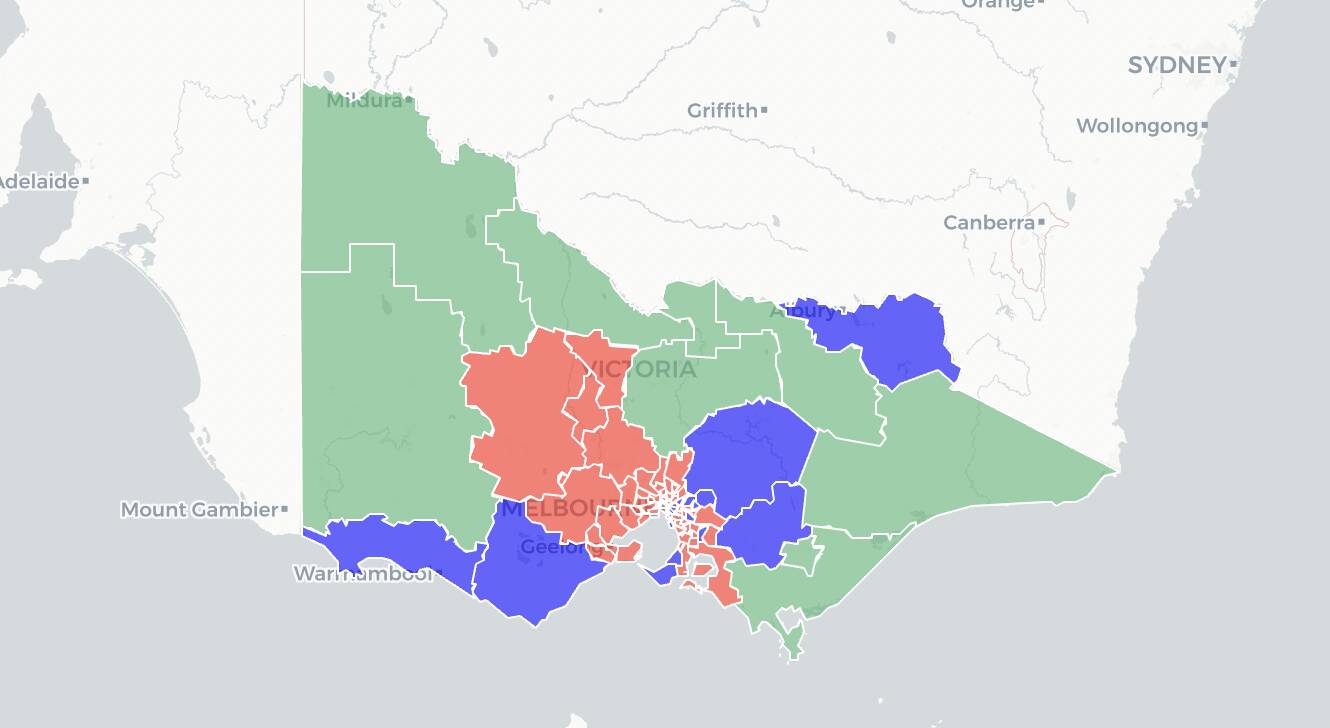
We’re just about three months out from the Victorian election. The list of announced candidates for the election has been growing, and it is quite interesting to look at the field of candidates that we have so far.
I have 341 candidates on my list of Legislative Assembly candidates. These candidates are running for eleven parties, along with fourteen independents. As a comparison, 740 candidates were nominated in 2022, representing twenty-one parties.
I expect that this field will grow a lot, but there is a question as to how the abolition of group voting tickets might affect motivations to run large numbers of candidates.
Under group voting tickets, a party may only be aiming to win in one region, but has an incentive to run candidates in every region so they can swap those preferences. Now, preferences will only flow according to voters (who may follow how-to-votes). For a small party, there may be an incentive to focus efforts on one or two regions. This could also flow through to the lower house where some minor parties have made a big effort to run a lot of candidates. In 2022, Animal Justice ran candidates in all 88 electorates, while Family First ran in all but one and the Family Party ran in 58 out of 88.
This time around, Labor and the Greens are leading with 74 announced candidates each. Both parties will undoubtedly run a full slate of 88. Victorian Socialists are not far behind with 68 announced candidates – a very large number this far out for small parties.
Often when a minor party runs a huge number of candidates, a lot of those candidates are announced at the last minute, with little details about those candidates at the time of nomination. Yet most or all of those VicSoc candidates have profiles on the party website.
The Liberal Party has announced 56 candidates and the Nationals have announced ten. The two parties have only announced competing candidates in the seat of Ripon, so the Coalition has 65 seats covered – less than the Socialists.
The Animal Justice Party, New Democrats, West Party and Socialist Alliance have all announced 6-12 candidates each.
It is fascinating how few seats have announced One Nation candidates. So far they have announced just eleven candidates. These candidates are mostly in outer suburban seats like Pakenham, Yan Yean, Sunbury and Melton. Only in Murray Plains and Narracan have they announced candidates in deeply rural seats where they will likely be in a head-to-head contest with the Nationals. I wonder if this reflects an analysis of the SA election which showed that they needed a much higher vote to win those rural One Nation-Liberal contests compared to their viability in a Labor-One Nation outer suburban race.
I have been categorising candidates by gender. Labor and Greens are running a clear majority of women. Indeed if the two parties announce men for all of their remaining seats, they would have a bare majority of men. The Victorian Socialists are about even, while the Liberal, Nationals and One Nation parties are all male-dominated.
There are an average of 3.875 candidates per seat. Only one candidate has been announced in the Liberal seat of Mornington and the Nationals seat of Lowan. There are six candidates in Essendon, Melton, Narre Warren South, Pakenham, Sunbury, Frankston and Werribee. These seats all have a Labor and Liberal candidate – two seats are missing a One Nation candidate and Sunbury does not yet have a Greens candidate.
As for the upper house, we don’t really have that big fields in most regions yet. For most minor parties, they only have a chance of winning one seat, so it’s more a question of whether a lead candidate has been announced rather than the total volume of candidates.
The Liberal Party, One Nation and Greens have all announced full tickets. Animal Justice, Victorian Socialists and Family First have all announced lead candidates in four regions. Sustainable Australia has recently announced close to a full slate.
In 2022, the ballot papers were almost all the same size in every region – 22 groups in most regions, and 24 in West Metro.
With the new optional preferential system, voters will be instructed to number at least five boxes above the line. Experience from Senate elections suggest most voters will number five, no more, no less. But Senate experience also shows us that, as the ballot papers have shrunk, those five preferences have been more meaningful and lasted further into the count. Five preferences is more likely to stay in the count in a race of 15 groups than a race of 25 groups.
I suspect in the medium term of the next ten years we will see amalgamations and the closure of some small parties, but the trajectory for this year’s election may already be set.

It looks like Labor’s preference harvesting ground game is in full swing!
What on earth could that possibly mean? You think Victorian Socialists are a Labor front?
Any independents announced for lower house seats?
and any that have a chance I thinking the Flinders and Wodonga area?