

For the last four decades, each federal election produced a full two-party-preferred (2PP) count for the whole country – adding up who ranked Labor or Coalition higher across the country. This figure has been a useful measure of the direction of the country, and of the relative political strength of the major parties, as primary votes continued to change over time.
The value of the 2PP has been questioned in recent years, as an increasing number of seats were not Labor-Coalition contests, but it still helped explain three quarters of seats in 2025.
Yet since 2025, the surge of support for One Nation has meant that the meaningfulness of the 2PP is in serious doubt. And it may be the case that the increasing number of non-classic seats will force electoral commissions to abandon counting the 2PP everywhere.
The two-party-preferred vote (2PP) evolved in an era of Australian politics when almost every seat was a contest between Labor and the Coalition – but there was a growing number of votes cast for everyone else. Pretty much every seat ended up as a Labor-Coalition race, so the 2PP was synonymous with the final preference count, which would determine who would win.
Up until 1984, a final head-to-head count would only be conducted in seats where no candidate reached a majority of the vote at an earlier stage. In order to achieve a complete two-party-preferred count for the whole country, and to produce margins for safer seats, psephologists like Malcolm Mackerras and Colin Hughes would use preference flows from close races and make estimates of the final margin.
As of 1984, the Australian Electoral Commission was required to conduct a full preference distribution (which would then produce a two-candidate-preferred figure) for every seat, even if the winner achieved a majority of the primary vote.
In the 1980s, the two-candidate-preferred count and the two-party-preferred count were synonymous. A ‘non-classic’ seat is a race where the top two are not Labor vs Coalition. In other words, a non-classic seat is one where the two-candidate-preferred and two-party-preferred figures are not the same.
In 1983 and 1984, every single seat was classic. That was almost true in 1987 too, but things got messy.
In the seat of Newcastle, independent George Keegan came second, with 27.1% of the primary vote compared to 16.5% for the Liberal candidate Alan Taggart.
Despite Keegan clearly coming second, the AEC was required by law to do a Labor-Liberal 2PP count, not a Labor-independent 2CP count.
The law must have changed after this election, because in 1990 there were three non-classic contests in Newcastle, North Sydney and Cunningham. Ted Mack in North Sydney became the first crossbencher to win a seat in the House of Representatives since the 1960s.
The Australian Electoral Commission has regularly conducted a process called ‘scrutiny for information’ (SFI) – this process seems to have been conducted for all but one seat since 1990.
For most of that time, the SFI process wasn’t needed in many seats, since most seats naturally produced a 2CP which was also used as the 2PP.
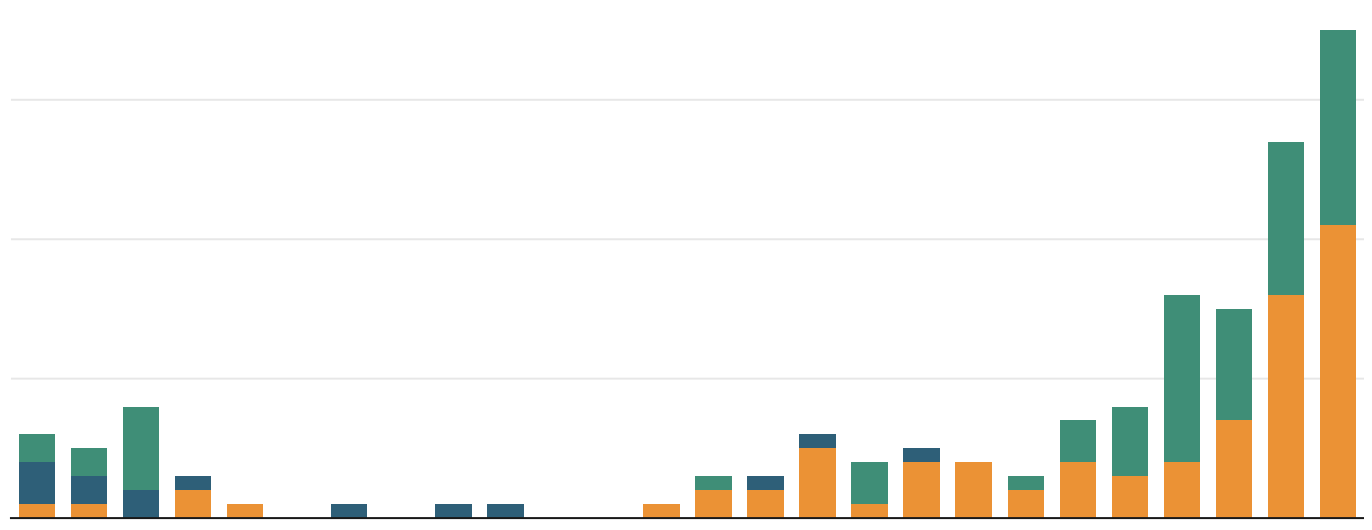
From 1990 until 2007, there were never more than six seats requiring a extra 2PP count.
Of course this count isn’t an automatic thing – it required the employment of staff for a longer period and would extend the election counting period.
But over recent years, as the number of non-classic seats has increased, there has been a growing list of seats requiring this special treatment, peaking at 35 in 2025.
Up until 2025, you might have been under a misapprehension that this counting process is required by law – but it is not. In 2025, the AEC declined to conduct an SFI count in Bradfield due to the ongoing court case and close 2CP count. Instead, the AEC came up with its own estimate of 2PP figures to fill in the results system, but there was no reason to think they were accurate.
So in 2025, it was necessary to conduct extra SFI counts in 35 out of 150 seats – over 23% of all seats. This was about seven times the average in the 1990-2007 period.
There’s reason to think that the number of non-classic seats may skyrocket at the next federal election.
DemosAU has conducted four MRPs over the course of about a year. In the last three MRPs, about a quarter of seats would still be Labor-Coalition contests.
If the last MRP was to play out, and the AEC was to maintain their previous policy, they would need to do an extra 2PP count in 111 seats.
It seems genuinely unclear as to whether 2PP counts will continue at federal elections. There are practical issues with collecting all of that extra data, and questions about the value of that data.
Indeed we’re seeing some different approaches from this year’s state elections.
At the South Australian state election in March, just 13 out of 47 seats were classic seats. It was reported at the time that ECSA planned to do extra counts only in seats where Labor didn’t make the 2CP, thus creating a statewide Labor vs other 2PP. I haven’t actually seen the results of such a count, and I don’t know if ECSA made progress.
Not every state has consistently produced 2PP counts in every seat, unlike the AEC.
When a state mostly has complete 2PP counts, it is usually not too difficult to make estimates for the few missing seats. In the case of Queensland, most elections have a statewide 2PP figure, but there’s a break in the series in 1998 and 2001 when One Nation hit their previous peak. 2PP became a meaningful figure again from 2004 – so the current moment may not be the end forever.
The Victorian Electoral Commission held a briefing for psephologists last week, and they mentioned that they still plan on conducting a 2PP count in every seat.
Meanwhile, New South Wales uses an entirely different method of counting votes by data-entering the full ballot into the computer. This means that every single 2CP pairing can be estimated, and there is no extra effort involved in calculating 2PP for every seat. Still, those two upcoming elections may be the last to produce full 2PP figures for the entire jurisdiction.
So what do you think? Should the AEC maintain the 2PP count, or does the changing party system mean this measure has run its course?