

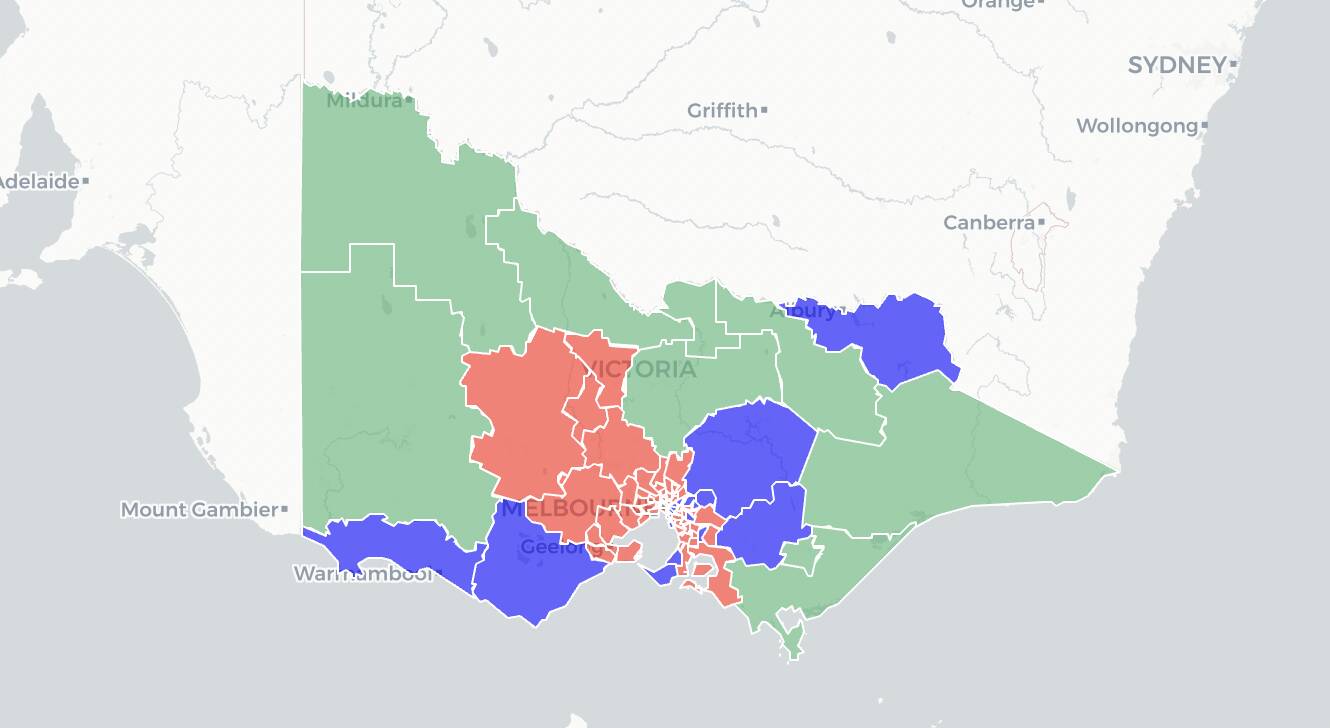
Nominations close on Monday for the Victorian state election, but the Victorian Electoral Commission (VEC) has been gradually publishing candidate names on their website as nominations are accepted.
It is typical for the bigger parties to announce their candidates some way out, but it has been notable that the Labor government has not officially announced their upper house candidates. A number of MLCs have announced their retirement, but the party had not announced candidates. The VEC nominations give us some sense of who is running where – and a number of sitting Labor MLCs have switched regions.
I’ve also analysed the number of retiring MPs at this election and compared them to numbers in the past. Numbers are high, but not much higher than in the past.
The number of candidates on my lower house list has now reached 697 – 32 of whom have not yet appeared on the official VEC list. Most of the missing candidates are Libertarians. I assume they will turn up, but we’ll see.
This is a slightly smaller list than 2022, when a record field of 740 candidates nominated for the Assembly. So it seems likely that the 2026 field will be slightly smaller, but I can’t be sure of that. It would still be the second-largest field.
Compared to 2022, the candidates are concentrated amongst a smaller range of parties. Labor, Greens, One Nation and Victorian Socialists are running in all seats, and one of the two Coalition parties is running everywhere (with both running in Ripon). Family First have nominated 70 candidates, so it is plausible that they could end up running a full ticket. Animal Justice has nominated candidates in almost half the seats, with the Libertarians in 20 seats. Everyone else is running small numbers.
For quite a while now, the size of the candidate fields in the upper house seemed diminished. At this point, it seems plausible that the upper house ballot papers really will be smaller. So far, 274 Legislative Council candidates have nominated, compared to 454 in 2022.
Unfortunately the nominations data does not group candidates together, but most candidates are running for parties and it’s pretty clear which independents are running together. Based on this analysis, so far we have an average of 11 groups nominated per region. The average in 2022 was 22.25. I expect there will be some increase, but overall the upper house ballot papers look much smaller without group voting tickets.
Eight parties have nominated tickets in all eight regions: Labor, the Coalition, One Nation, the Greens, Victorian Socialists, Sustainable Australia, Legalise Cannabis and the Democratic Labour Party. In comparison, the same 22 parties nominated in every region in 2022.
Under group voting tickets, there is an incentive to nominate a full slate of candidates as it is quite easy to control your voters’ preferences, and you can then swap those to gain strong flows in your best areas. Under the new system, there is no reason to run a bunch of candidates where you can’t mount a campaign. It makes more sense to concentrate.
Family First have nominated in six regions, the Shooters in the three (rural) regions, Animal Justice, the Libertarians and Socialist Alliance are running in two, and the West Party is focused entirely on one region. It is possible some of these parties may end up nominating in more places, but it looks like a clear shift in strategy.
Now we finally have information about which Labor MLCs are running again, and there’s some interesting shifts.
During the debate about the future of the Legislative Council, I argued that the massive regions of the upper house do not provide meaningful local representation, and pointed to examples of MPs shifting to different regions a long way away from each other. We have a lot more evidence of that now.
Labor won 15 upper house seats in 2022. Four are retiring this year, and the other eleven are running for re-election. These eleven have been spread across the eight regions, so there is no region without an incumbent Labor MLC running. But three of these MLCs have moved to a new region.
Enver Erdogan and Tom McIntosh have swapped regions, with Erdogan moving from North Metro to Eastern Victoria and McIntosh the opposite. Ryan Batchelor has moved from South Metro to North East Metro. There was no incumbent MLC running for re-election in the north-east, whereas Batchelor would have likely needed to run second in his previous region. It suggests that Labor is concerned that he wouldn’t be re-elected in South Metro as the #2 Labor candidate. Unfortunately we don’t yet know the candidate rankings within the Labor ticket, but we’ll know on Monday.
More generally, I looked at the numbers of MPs in both houses who are retiring this year. Every MP except for Darren Cheeseman has announced their intentions. I assume Cheeseman will retire but I won’t assume that until nominations formally close.
This final chart compares the number of MPs retiring at each election since 2002.
So far we have 28 retirements in 2026. This includes 15 Labor MPs, 9 Coalition MPs and four others. I have counted the late Tim Read, who had announced his retirement before his death earlier this year, as well as Adem Somyurek, Will Fowles and David Ettershank of the Legalise Cannabis party. Arguably two of those four retirements are driven by the upper house reforms.
The previous record was 26 in 2022, but the number of Labor retirements was actually higher last time than this time.
That’s it for now. I will be looking for websites for all of the newly-nominated candidates and will keep updating candidate lists as time allows (around analysing the New Zealand election results). The final lists should go up on Monday evening.