

The first expansion of parliament was passed in 1948, and came into force at the 1949 election. It was also the largest increase we’ve seen, either proportionally or in raw numbers. The House and Senate were each expanded by two thirds – the House grew from 74 to 121, while the Senate grew from 36 to 60.
This blog post follows the model of my previous analysis of the 1984 parliamentary expansion, and will likewise be the first of two parts.
The collection of data is much messier for 1949 than for 1984. For a start, the collection of full preference counts only commenced in 1983 (backdated after legislation was passed after the election). And the calculation of two-party-preferred estimates in every seat usually date back to 1949, not 1946.
The 1946 election (and to a lesser extent 1949) also were less purely two-party than politics in the early 1980s. There were four non-classic races in 1949, and six in 1946. I have been able to estimate two-party-preferred figures for all seats in 1946 and 1949. For the 1946 results adjusted to the 1949 boundaries, I have used estimates produced by Colin Hughes in a 1978 paper.
First up, how does the 1946 results compare to the notional seat count following the redistribution but prior to the election?
Labor’s share of seats was about steady. I have matched Coalition seats to the primary party at the 1949 election. The new seats benefited the Liberal Party much more than the Country Party, before factoring in Coalition gains at the election.
This next chart shows the proportion of seats that have a particular Coalition 2PP (or less) before and after the redistribution.
While a stable 2PP produces the same result on old and new boundaries, Labor does better if the 2PP is slightly lower or slightly higher. The old boundaries gave less than half of the seats to Labor with a 2PP of 53% or more. The new boundaries gives Labor 52% of seats on that 2PP.
The next question to consider was where the marginal seats were located before and after the redistribution.
The proportion of seats with margins under 6% slightly dropped overall, but it varied more in each state. New South Wales and Queensland gained more marginal seats, Victoria had less, and South Australia and Western Australia a lot less.
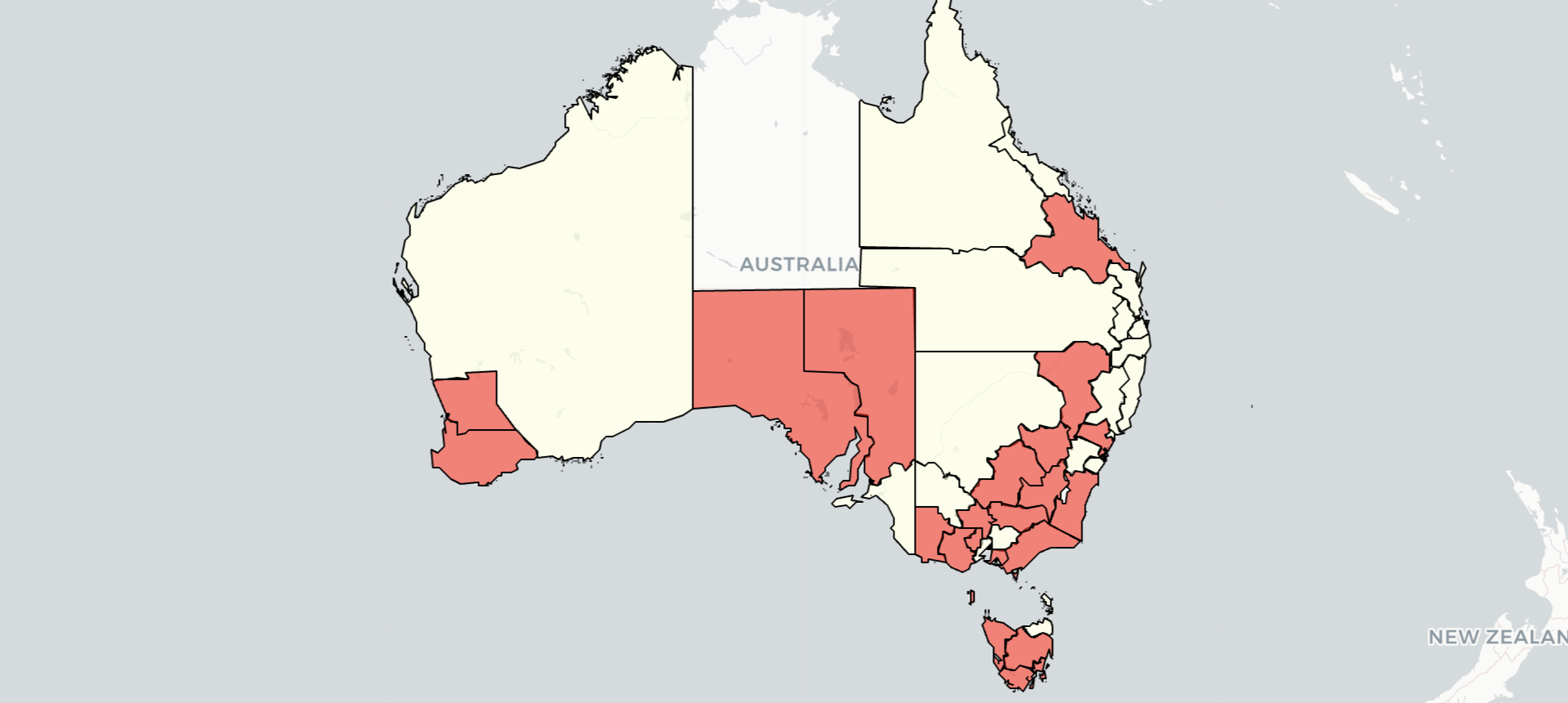
As with the 1984 redistribution, I’ve produced a map showing the old and new boundaries. Seats with 2PP margins of under 6%. The NT and ACT aren’t included in this analysis, as their members weren’t full voting MPs at this time. Unfortunately my historical boundaries dataset is missing Western Australia’s 1949-54 boundaries, so the map only shows WA’s pre-redistribution map.
The 1948 expansion was much larger than the 1984 expansion – 64%, rather than 18%, and the map understandably changes quite a lot more. A lot more rural seats were marginal than today, and not many urban seats, but it does look like the expansion shifted the marginal seats slightly into the cities.

Great map @Ben Raue
I use this tool to look at past maps.It is interactive as well. I can see 1949 WA maps so i hope this tool assists you.
https://pappubahry.com/pseph/aus_stats/?plot=map&year=2013&colour_by=informal&multiple=max&geo_map=1
I went back to 1943 the last election where Labor won a victory comparable to 2025. To see what was where. To think that John Curtin took 70% of the 2PP in Kennedy. On the flip side, old Billy Hughes occupied the territory now held by Nicolette Boele. Much has changed…
Craig – looking back at the early 20th century a lot of things were different in Australian society.
Multiculturalism as we know it today did not exist, and the country was essentially monolithically white with almost all migrants coming from European and Christian type backgrounds.
In those days, primary industries like agriculture, mining and forestry were heavily unionised and thus blue-collar workers in these sectors still backed Labor strongly unlike today where union influence in these sectors has declined.
On another note – looking at the 1949 maps, it appears the version of Bradfield existing at the time had almost identical boundaries to its 2019 configuration
An urban seat like Bradfield was well settled by 1949, as opposed to, say, Fiinders, which was mentioned in another thread recently. This seat, held by Stanley Bruce, stretched into western Melbourne but contained few people back then. I did not begin to follow elections closely until 2007-2010-2013, when I was in uni, and it was Rudd vs Gillard vs Abbott. Even now, that seems quaint. To think that as late as 1966, the Labor Party fought an election on the White Australia Policy while at the same time discussing nationalisation. As the figures indicate, immigration shifted from a European-based to an Asia-based pattern around 2011.
Agree Craig, I moved into Australia as a young child just before Rudd’s 2007 victory and back then Sydney was nowhere near as diverse as what it is today. Many suburbs (like Chatswood and Castle Hill) still had majority white populations, and the city was much less dense. In fact, the city during that time functioned similarly to what the smaller state capitals (Brisbane, Perth and Adelaide) do today with little or no mass transit connections.
Looking at the 1949 map, the AEC had better boundaries for inner Melbourne than today’s map, I wouldn’t use the 1949 boundaries as they look a bit odd, however, they show why the current parliament needs to be enlarged, as the 1949 map better reflects local communities.
You can also see how much Sydney’s map has changed. To think there were 4 seats along the coast from South Head to Botany Bay! Now you can barely squeeze 2 there.
@ CJ correct those areas would have already well developed by the start of the Second World War so while there maybe some densification population has not exploded there in the Post War period. We can see this in the Upper Inner West as well From Homebush to the Light Rail line wish now pretty much only covered by Reid but there used to multiple seats there. The area that has exploded the most in SW Sydney. Werriwa used to have Surf beaches and places in the Southern Highlands where there is the occasonal dusting of snow.
There would have been plenty of areas of Bradfield that weren’t that heavily settled in 1949 – especially the northern and bushy parts. Much happened in the 50’s and 60’s. The bridge didn’t open till 1932 don’t forget so it was a lost less developed than south of the Harbour, That’s why it was pretty much as big in 1949 as it was in 2019 – although it was under quota in 2019. Warringah and especially North Sydney are a lot smaller than now
Agree Nimalan and High Street, back in the 1950s and earlier – places like Parramatta and Hornsby represented the edge of the metropolitan area (pretty much like Penrith and Campbelltown today) and thus could be considered prime mortgage belt territory in contrast to their current status as established areas.
Just looking at the inner-south of Melbourne on the 1949 map is fascinating how the seats moved.
In the context of “Balaclava” later becoming “Goldstein” (and not really shifting too much with both being based around Brighton), it’s very strange that the new 1949 seat of “Isaacs” was entirely based on the old City of St Kilda, when now it has moved to the other side of Goldstein and is based on the more middle-bayside suburbs from Mentone down to Carrum. It’s like it just jumped over Balaclava/Goldstein rather than both of them shifting south.
Trent@ in 1968 Isaacs (St Kilda) was in fact abolished and the name transferred to a newly created bayside seat that may have provisionally been given a geographic name until it was resolved that Isaacs was too significant a name to disappear.
Ahhh that makes a lot of sense! Thanks for the context Jeremy!
If I’m not mistaken, 1968 was also when Melbourne Ports moved out of Williamstown / West Melbourne, south to St Kilda (but pre-Caulfield), and also took in parts of the South Yarra to Windsor corridor, similar to what many people including myself have proposed for Macnamara. Which would explain the abolition of the St Kilda based seat of Isaacs, and I assume Fawkner (which had the South Yarra area) was also abolished in that same redistribution?
If the AEC was in charge of a similar decision now, they’d have just shifted both Balaclava and old-Isaacs south. Balaclava would be where Isaacs now is.
I also had a look at JWoods’ redistribution tool, as I wanted to see how much parliament has to expand by to guarantee two seats fully located in the Northern Beaches (ie, not crossing Middle Harbour) today.
The absolute minimum to facilitate such a change is an increase of 11 NSW seats, an expansion of Parliament by 24-25%. Such a change would likely see Warringah lose all sections south of Middle Harbour and a new North Sydney recreated.
Wasn’t sure where exactly to post this comment, but seeing as the 1948 redistribution was the last major house expansion I thought it would be fitting to put here, and that redistribution gave the Northern Beaches two seats for the first time.
I am making my own redistribution map based on a 16-senator scenario as a thought exercise – in the case of the Northern Beaches, you can fit Mackellar and Warringah on the northern beaches with a few suburbs to spare. So Bradfield moves a little bit into the Davidson area.
Looking forward to seeing that map Ben!
@Nimalan I’d like to see both Warringah and Mackellar become fixed to the Northern Beaches. Under such a scenario, NSW needs to get to at least 58 seats, an increase of 12 (or 26%) from current numbers. That way, we can also create a new North Sydney.
I’m not sure how feasible it is either to have both Hughes and Cook be located on the one side of the Georges River but it’s something I’d like to look into.
Agreed re Kingsford Smith and Fowler.
@ CJ
If there is an Expansion of parliament i think it needs to be at a miniumum more than 51 seats which is what NSW had in 1984.
I would like a new North Sydney resurrected. If that can take part of Mosman that will be the icing on the case and have two exclusively Northern Beaches seats. Worst case i dont mind Mosman joined in Warringah i feel Mosman feels a bit more beachside than the rest of the Lower North Shore. Parts of the Nothern beaches like Fairlight, Clontarf and Seaforth feel connected to Mosman. I have visited the lovely Balmoral Beach in Mosman. I have heard many students at Queenswood School and Mosman Prepatory School live in Clonarft, Seaforth, Fairlight etc-i Call them Harbourside Northern Beaches.
For Hughes i feel the part of Liverpool East of Georges River feels connected to the Shire. Chipping Norton should be in Hughes while Liverpool, Warrick Farm in Werriwa. So if we can have a purely Shire Cook and partially Shire Hughes. I am happy. I dont want Hughes to move South into the Illawara as i want Cunningham to shrink and Whitlam to move North and Shed the Southern Highlands and be a purely Wollongong and Shellharbour seat.
There should be some new rural seats created. I am hoping a second Macarthur seat will take Camden and Leppington out of Hume.
Some may have seen the map I drew of Sydney under a 14-senator scenario giving 54 seats in total for NSW, but I’ll share it again:
https://ibb.co/HLxXQYvB
As @CJ has stated, not enough to put Warringah completely north of The Spit, but would revive North Sydney and effectively return to the previous 2016 boundaries for the North Shore divisions.
And not quite as neat as your solution @Nimalan with Hughes extending down to Thirroul but I think reasonable given the geographical gap between the Liverpool suburbs and Sutherland suburbs even if more demographically related.
McMahon still a basket case but at least it is in service of fixing up Blacktown and Fairfield!
@Ben Raue
Also very interested in seeing this map!
Illawarra as well:
https://ibb.co/xScrNtb3
That map will be up in the morning. It’s a 16-senator scenario. And yes you can fit Cook and Hughes both in the Shire and Mackellar and Warringah in the Northern Beaches.
@angas the map is awesome you or someone should do more maps for other states as well
@Angas great map, thanks for sharing!
@ Angas
Great map thanks for sharing. Are you able to show me the regional NSW seats in a 14 seat senator scenario and just one request can you name the proposed seats maybe just give them a number so it is easy to discuss the seats
Comments are closed.