

Late on the Friday afternoon, the Australian Electoral Commission has released a long-promised report into informal voting at the 2025 federal election.
The typical process of counting ballot papers at the election doesn’t usually distinguish different types of informal votes. A vote could be informal because the voter has left their ballot blank, because they’ve only numbered one box, or because they have made a mistake in their numbering. Federal informal voting rules are quite strict, and there could be numerous reasons why a vote could be informal.
If you want to know more about why voters are casting informal ballots is by conducting a survey where you revisit those ballot papers and categorise them, recording the cause of the informality.
The last survey of informal ballot papers took place in 2016, but the AEC had promised to produce another report after the 2025 election. You can read it here.
The AEC has not reviewed informal ballot papers in all seats, but instead has selected 25 seats to review. They’ve reviewed the ten seats with the highest informal rate, another eleven seats which had at least one booth with 50 or more votes and an informal rate of over 25%, and four more seats as a comparison. These seats have a bias towards New South Wales, since informal voting tended to be higher in that state.
Past informality reviews have split the different voting categories between those that are apparently deliberate and those that are apparently accidental. Blank ballots, for example, are presumed to be deliberate while those where a voter has numbered some boxes but hasn’t successfully filled out the ballot are presumed to be accidentally informal.
For this report, the AEC has categorised completely blank ballots, and sorted those with some numbers into those with a single ‘1’ only, those with numbers 1-6 (which is what would happen if you took Senate advice and applied it to the House) and those with other incorrect numbering. A small number of ballots involved a voter identifying themselves (0.2%) and 8.4% don’t fit into any of those categories.
A clear majority of informal votes involved someone filling in the numbers, specifically:
- First preference only – 16.9%
- Numbered 1-6 only – 12.3%
- Incorrect numbering/method – 37.0%
Unfortunately the data doesn’t make it entirely clear if all of these votes have a clear ‘1’, but the first two categories at least would count as formal under optional preferential voting (OPV), and I suspect most of the incorrect numbering would also count as formal.
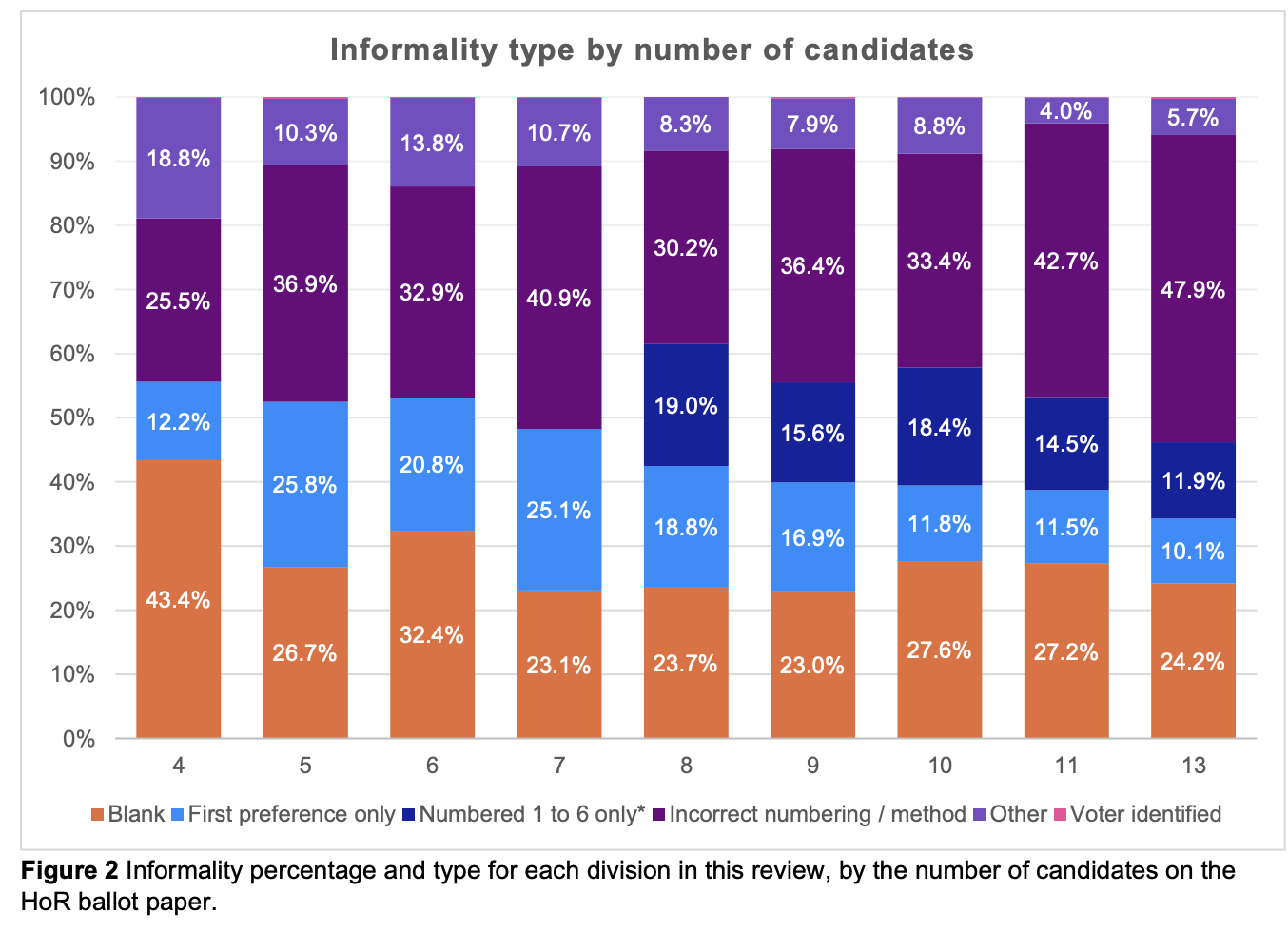
The report breaks down the type of informal votes based on the number of candidates on the ballot.
As the ballot gets bigger, numbering issues become a more significant issue, with 1-6 numbering issues making up 12-19% of informal votes once the ballot is longer enough for 6 preferences to not produce a formal ballot. This is consistent with data we had on ballot paper size being correlated with informal voting.
The AEC survey identified a significantly higher rate of 1-only votes in New South Wales, the only state currently using an OPV system for single-member electorates in state elections.
The AEC survey also looked at specific polling places with extremely high informal rates. There was one booth, Missabotti in the NSW seat of Cowper, where 45% of votes were informal. The AEC has identified that 64% of those informal votes were voters who numbered 1-6. Eleven candidates ran in Cowper, so a voter filling out six preferences didn’t come close to a formal vote. It does look like incorrect ballot paper instructions (potentially combined with incorrect word-of-mouth) did have an effect there.
The big question for me is how much informal voting is driven by the requirement for voters to number every box. There will always be people who intentionally vote informal simply out of protest at being required to cast a vote, and those voters are easy to identify through blank ballots or scribbled messages. But then there are those who cast a vote with a clear intention, but aren’t counted because of our strict formality rules.
It’s a bit hard to compare like-with-like between 2016 and 2025, both because the categories have changed slightly and because the 2025 survey doesn’t cover every seat. In 2016, incomplete and non-sequential numbering made up 40% of informal votes, and blank votes made up 25%. I think it’s also possible that the “incorrect numbering/method” category in 2025 would cover ticks and crosses, which brings the equivalent number in 2016 up to 48%. But in 2025, that number is up to about 66%. So it does seem like numbering issues are playing a bigger role than they used to be.
The AEC report seems to have an unspoken assumption that anyone who just numbers one box, or numbers a handful and then stops, has intended to vote formally and has misunderstood the rules. But I think it’s entirely possible there are voters who refuse to mark certain preferences, and know that their vote will be informal. On the right, One Nation has been sending signals of such a position, and I think we could see some voters on the left who refuse to preference either major party. Right now it is the position of the electoral system that it’s too bad, those voters have to number every box. I’m not so sure.

Any chance of bringing back the “Langer” Vote?
WA is the only jurisdiction that is still using it.
Comments are closed.