

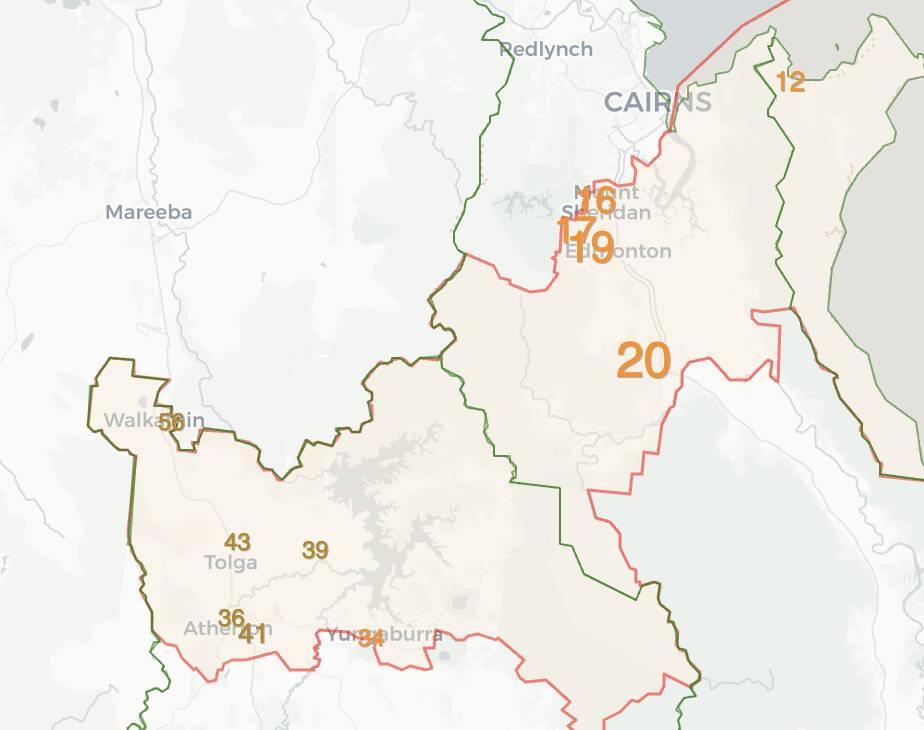
After publishing my Queensland state redistribution estimates on Monday, it was drawn to my attention that there was a different way of calculating the margin for the seat of Mulgrave, in the southern suburbs of Cairns.
Tally Room member Quokka asked me to look up the primary vote figures for Katter’s Australian Party, and upon examination I realised that it was more likely that the two-candidate-preferred count in that seat would end up as KAP vs LNP, rather than LNP vs ALP, and that the seat would flip to be notional KAP.
I will explain the logic below, but in short this means that Katter’s Australian Party does not lose a seat in the redistribution, with the abolished seat of Hill being replaced by the seat of Mulgrave, and the Liberal National Party only have a net gain of one seat, not two as previously reported.
Multi-party politics makes the exercise of estimating redistribution margins far more complex. The step that slowed me down the most on Monday afternoon was dealing with seats which take in parts of electorates that had different 2CP pairings (for example, ALP vs LNP in some parts and LNP vs KAP in others). Generally my approach in these cases was to to take the 2CP which applies to the largest part of the new seat, and then calculating preference flows and applying them to the primary votes in the remainder of the seat.
I should point out that redistribution estimates can only deal with the actual votes cast at the previous election (in this case 2024). So I cannot take into account the polling surge for One Nation, nor the LNP’s gain of the Katter’s Australian Party seat of Hinchinbrook at a 2025 by-election.
In the case of Mulgrave, about 74% of voters came from the previous Mulgrave boundaries, with 26% of voters coming from the abolished seat of Hills, particularly in the area around Atherton.
The LNP won Mulgrave by a 2.7% margin in 2024, with Katter’s Australian Party coming third with 16% of the primary vote. Those parts of Mulgrave had a 1.1% LNP margin. Using those preference flows and applying them to the primary votes in the new areas, the LNP end up with a 3.2% margin.
But if you look at the primary votes in the new Mulgrave, you get a more complex picture. This table shows my primary vote estimates for votes coming from the old Mulgrave and the old Hill, and how they add up to the new Mulgrave.
| Party | Mulgrave | Hill | New Mulgrave |
| Liberal National | 24.4 | 28.0 | 25.4 |
| Katter’s Australian | 17.4 | 42.8 | 24.7 |
| Labor | 24.0 | 13.3 | 20.9 |
| Independents | 12.4 | 2.5 | 9.6 |
| One Nation | 8.9 | 6.6 | 8.3 |
| Greens | 4.1 | 6.8 | 4.9 |
| Legalise Cannabis | 6.7 | 0.0 | 4.8 |
| Family First | 2.0 | 0.0 | 1.5 |
This does give you a sense of the imperfections in combining votes from different seats. Legalise Cannabis and Family First were only on the ballot in one of these seats, and there was a bigger range of independents in Mulgrave. Undoubtedly, the presence of Shane Knuth in Hill would have had an impact on the size of the KAP vote in one seat over the other.
If you look at those final primary votes, it seems likelier that the final 2CP would have ended up as LNP vs KAP, not LNP vs Labor. This is the only seat where a party made the top two on primary votes but I hadn’t included them in my estimated 2CP.
When I used the same method of applying preference flows, but used the Hill 2CP flows, not the Mulgrave 2CP flows, it produced a result of KAP 6.8% vs LNP.
So I will be using this margin in my election guide, which I have started work on and should be done in about a month. That election guide will include my estimate of primary votes for each party in every seat.
It also changes the context of the overall seat count. At the 2024 election, the LNP won 52 seats to Labor’s 36, KAP’s three, and one each for the Greens and an independent. My original estimate saw the LNP gain two seats, with Gaven flipping from Labor to LNP, and the creation of Caboolture, while KAP lost the abolished seat of Hill. Labor had a net loss of one seat, with Gaven flipping to LNP, Toohey abolished and Greenbank created.
But with the reassignment of Mulgrave from LNP to KAP, it leaves KAP stable with three seats (ignoring their loss of Hinchinbrook at a by-election) and reduces the LNP net gains to just one seat.
Admittedly Mulgrave is less safe for KAP than the old Hill. Knuth won in 2024 with a 13.7% margin, and this seat has a 6.8% margin. But he can probably build on his support in the parts of the seat moving over from Mulgrave. It’s also plausible that the One Nation surge will make all of this irrelevant for KAP.
That’s where I will leave this now. I’ve amended Monday’s live blog to show my corrected Mulgrave margin, and I will be using that margin in my soon-to-be-published election guide.