

1:55 – I’m going to actually finish this liveblog here, with a short video running through the changes.
1:24 – What I hope will be my final bit of analysis today is a comparison of the Senate vote per electorate. With so many independents running at both the state and federal level, it is hard to determine the underlying support for the parties. But the Senate can help.
The Greens vote in Clark has climbed higher, but only slightly. There probably wasn’t many options for making Clark better for the Greens. Franklin, however, has become much less favourable and Lyons has become more favourable. This is probably a good sign for the Greens being able to hold onto Lyons in a bad year.
One Nation is notably weaker in Lyons and stronger in Clark.
| Electorate | Timing | ALP | LIB | GRN | JLN | ON |
| Bass | Pre | 34.7 | 25.8 | 14.1 | 7.1 | 5.5 |
| Post | 34.8 | 26.0 | 13.8 | 7.1 | 5.5 | |
| Clark | Pre | 35.7 | 17.7 | 27.6 | 6.0 | 3.1 |
| Post | 33.3 | 19.7 | 28.2 | 5.7 | 3.5 | |
| Franklin | Pre | 37.0 | 20.8 | 21.0 | 6.4 | 4.0 |
| Post | 39.0 | 21.0 | 16.7 | 6.7 | 4.3 | |
| Lyons | Pre | 35.7 | 24.4 | 11.4 | 7.3 | 6.2 |
| Post | 36.2 | 22.3 | 14.2 | 7.4 | 5.7 |
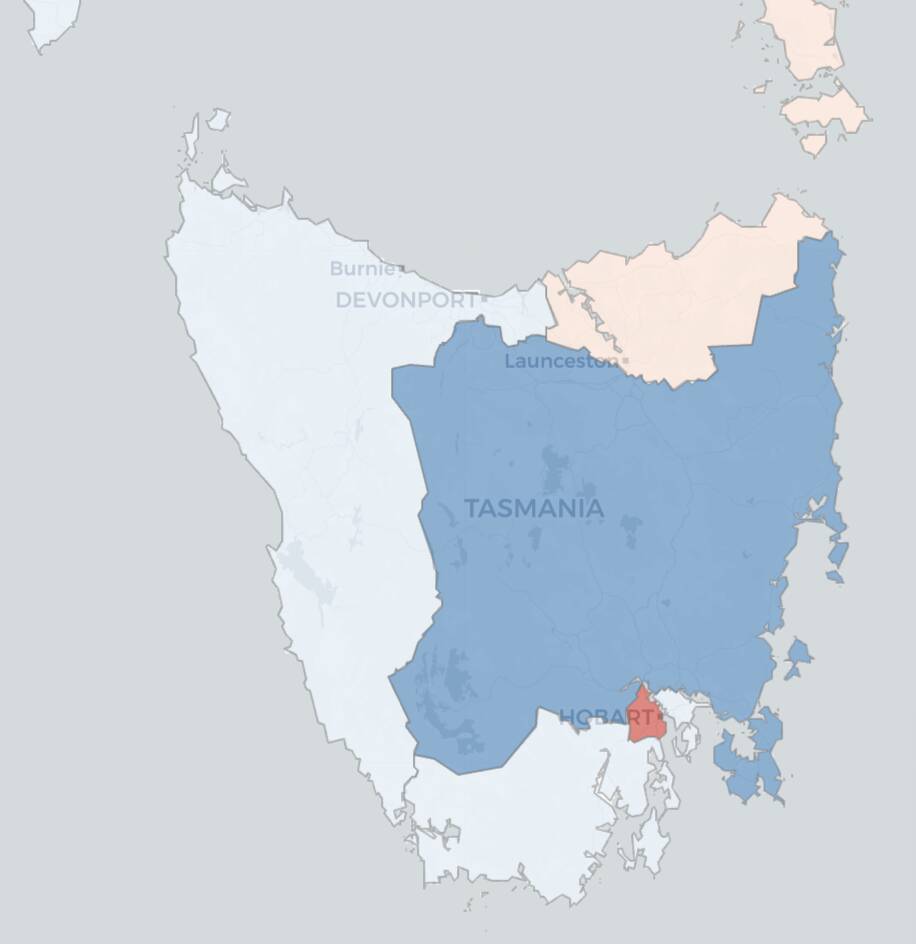
12:58 – I had a request to find a booth map of Clark, specifically Kristie Johnston’s 2025 vote. I didn’t have one but it wasn’t hard to make one in the style of my election guide maps.
As suspected, her vote is most heavily concentrated in the Hobart city centre, even though she was Mayor of Glenorchy. The local government boundary (in green) is conveniently the new federal electoral boundary between Lyons and Clark.
12:28 – I’m gonna wrap up this liveblog here.
The Commission will now begin the process of public consultation, with the chance for the public to make objections and then comments on those objections. There will be an opportunity for public hearings too. You can submit an objection here.
It’s worth noting that the AEC has not proposed any new names but has flagged the option for a new name for Franklin considering the enormous scale of changes. Clark was redrawn even more dramatically, but that seat has a relatively new name, and is named after someone with a deep link to Tasmania and the Australian constitution. Franklin, on the other hand, is named after Sir John Franklin, the Lieutenant Governor of Van Diemen’s Land from 1837 to 1843. Franklin only lived in Tasmania for six years, leaving before it had the name of ‘Tasmania’ and is more famous for his exploration of the Arctic. You can make suggestions about a more appropriate name via the same objection process.
12:23 – This next table compares the percentage and quotas for each group in the four electorates that have been redrawn – no need to look at Braddon.
Prominent independents such as George, O’Byrne, Razay or Johnston understandably don’t have presences across multiple electorates so it’s hard to know how they would perform on new boundaries. But there are some interesting insights nonetheless.
- Labor and Liberal go up slightly in Bass, the Greens go down.
- Liberal goes up slightly, Greens are steady but Labor goes down a lot on the new Clark boundaries.
- Peter George and David O’Byrne both represent Franklin, but come from opposing ends. It looks like George is much stronger in the new Clark and O’Byrne in the new Franklin, and I would expect them to separate along those lines.
- The Liberal and Labor vote jumps up in Franklin while the Greens are steady, but it’s worth noting that the total independent vote is down significantly with the loss of the western half of the electorate. Not great news for the Greens in that context.
- Labor has become stronger in Lyons while the Liberal Party is weaker. It may not be enough for Labor to gain a third seat but it’s a good start. It’s worth noting that about a third of Kristie Johnston’s vote has been moved into this seat. I think this redistribution makes life difficult for her.
| Electorate | Group | Pre % | Pre Q | Post % | Post Q |
| Bass | Liberal | 41.80 | 3.344 | 41.98 | 3.358 |
| Labor | 27.52 | 2.202 | 27.63 | 2.210 | |
| Greens | 16.51 | 1.321 | 16.25 | 1.300 | |
| Others | 4.58 | 0.366 | 4.60 | 0.368 | |
| Shooters | 4.08 | 0.327 | 4.10 | 0.328 | |
| Razay | 3.48 | 0.278 | 3.26 | 0.261 | |
| Nationals | 2.03 | 0.162 | 2.18 | 0.174 | |
| Clark | Liberal | 30.64 | 2.451 | 31.35 | 2.508 |
| Greens | 22.06 | 1.765 | 22.10 | 1.768 | |
| Labor | 27.01 | 2.161 | 20.70 | 1.656 | |
| George | 9.35 | 0.748 | |||
| Johnston | 15.04 | 1.203 | 8.85 | 0.708 | |
| O’Byrne | 4.21 | 0.337 | |||
| Archer | 3.34 | 0.267 | 1.94 | 0.155 | |
| Others | 1.91 | 0.153 | 1.50 | 0.120 | |
| Franklin | Liberal | 34.37 | 2.749 | 36.84 | 2.947 |
| Labor | 22.78 | 1.822 | 27.24 | 2.179 | |
| Greens | 13.54 | 1.083 | 13.45 | 1.076 | |
| George | 17.12 | 1.370 | 8.64 | 0.691 | |
| O’Byrne | 11.26 | 0.901 | 7.66 | 0.613 | |
| Others | 0.93 | 0.075 | 6.16 | 0.493 | |
| Lyons | Liberal | 42.01 | 3.361 | 39.15 | 3.132 |
| Labor | 28.44 | 2.275 | 30.12 | 2.410 | |
| Greens | 13.56 | 1.084 | 12.94 | 1.035 | |
| Others | 5.02 | 0.402 | 10.30 | 0.824 | |
| Shooters | 6.74 | 0.539 | 4.57 | 0.366 | |
| Nationals | 4.24 | 0.339 | 2.91 | 0.233 |
12:01 – Here are the estimates of the percentage vote for each party group per electorate.
| Electorate | LIB | ALP | GRN | IND | NAT | SFF |
| Bass | 42.0 | 27.6 | 16.2 | 7.9 | 2.2 | 4.1 |
| Braddon | 49.8 | 23.7 | 7.4 | 14.2 | 1.6 | 3.3 |
| Clark | 31.3 | 20.7 | 22.1 | 25.9 | 0.0 | 0.0 |
| Franklin | 36.8 | 27.2 | 13.5 | 18.6 | 1.4 | 2.5 |
| Lyons | 39.2 | 30.1 | 12.9 | 10.3 | 2.9 | 4.6 |
And here are the estimates of quotas.
| Electorate | LIB | ALP | GRN | IND | NAT | SFF |
| Bass | 3.3583 | 2.2104 | 1.2998 | 0.6288 | 0.1744 | 0.3278 |
| Braddon | 3.9835 | 1.8971 | 0.5930 | 1.1324 | 0.1272 | 0.2665 |
| Clark | 2.5076 | 1.6557 | 1.7679 | 2.0679 | 0.0000 | 0.0000 |
| Franklin | 2.9468 | 2.1793 | 1.0759 | 1.4840 | 0.1135 | 0.1998 |
| Lyons | 3.1321 | 2.4098 | 1.0350 | 0.8242 | 0.2330 | 0.3656 |
Next up I’ll put up a table comparing pre-redistribution and post-redistribution figures for the main groups in each seat.
11:35 – Looking at the number of voters who have been moved, the story is very different in the north and south. By my reckoning, using current numbers of electors, 27.6% of voters have been moved to a new seat. Not a single voter was moved in Braddon, and just 6.3% of the new Bass is new to the seat (from Lyons). But in the south the story is extremely different. Just 51% of Clark, 55.5% of Franklin and 59.2% of Lyons are continuing in their existing seat.
I testified at the most recent JSCEM inquiry that the AEC is too cautious when there is a need to throw away the old electorate map and draw up something totally new, and it seems in southern Tasmania that is what they have done.
11:28 – Here is a map where you can zoom in and toggle on and off the old and new (draft) boundaries.
11:21 – I suspect the Greens will be stronger in the new Clark than in either the old Clark or old Franklin, but it’ll be better to assess this on the state election results.
11:19 – Okay, so now I have my estimated margins for each seat.
Bass and Braddon experience no changes. Lyons becomes safer for Labor, and Franklin slightly less safe. It should be noted that Franklin had a much closer 7.8% margin against independent Peter George, but with just 55% of the old seat remaining in the new seat, and no similar independent in the areas moved in from Lyons, I’ve reverted to using a classic margin.
As for Clark, this is complex. Just 51% of voters in the new Clark were in the old Clark. I have combined the 2CP for Andrew Wilkie and Peter George in this area. Wilkie did much better than George, and Wilkie has held on to the better half of Clark. On these numbers, Wilkie still has a 9.2% margin. I suspect he would have done better than George in some of those areas as a longstanding incumbent, and he is by far the favourite to retain the redrawn seat, but it will still be a big adjustment.
| Electorate | Old margin | New margin |
| Bass | ALP 8.0% | ALP 8.0% |
| Braddon | ALP 7.2% | ALP 7.2% |
| Clark | IND 20.4% | IND 9.2% |
| Franklin | ALP 19.4% | ALP 18.7% |
| Lyons | ALP 11.6% | ALP 13.1% |
11:06 – Here are my estimates of the 2PP per electorate and the primary vote for the main groups. I’ll put up a table comparing the 2CP margins in a minute.
| Electorate | ALP 2PP | LIB 2PP | ALP prim | LIB prim | GRN prim | IND prim |
| Bass | 58.0 | 42.0 | 39.8 | 31.5 | 12.7 | 5.2 |
| Braddon | 57.2 | 42.8 | 39.5 | 31.7 | 8.4 | 8.2 |
| Clark | 70.2 | 29.8 | 26.6 | 17.0 | 13.0 | 39.0 |
| Franklin | 68.7 | 31.3 | 43.4 | 20.0 | 10.9 | 16.7 |
| Lyons | 63.1 | 36.9 | 33.7 | 21.8 | 10.5 | 21.1 |
10:55 – I’ll go quiet in a minute while I calculate the new margins, but it’s worth noting that at the moment Hobart is almost entirely split between Clark and Franklin, with Clark an entirely urban seat. Under this proposal Hobart would be split in thirds. Hobart City and the sprawl to the south-west would be in Clark, Franklin would cover the eastern shore of the Derwent, and Lyons would cover Glenorchy. So there would be no entirely-urban seat.
10:52 – The actual data and maps haven’t appeared on the AEC website yet, but the press release is out along with this very helpful short video.
27% of voters have been moved which is a lot. It looks like they have completely restructured Clark and Franklin to sit on opposite sides of the Derwent, with Lyons expanding into Glenorchy. More to come.

Braddon: Remains unchanged, reflecting its stable enrolment and strong, clearly defined communities of interest.
Bass: Gains the localities of Blackstone Heights and Prospect Vale from the electorate of Lyons, reflecting the connection these communities have with Launceston’s urban, economic and service networks.
Franklin: Gains the local government areas of Brighton, Glamorgan Spring Bay, Sorell and Tasman, strengthening its south-eastern coherence and resolving its non-contiguity.
Clark: Becomes Australia’s southern-most electorate, taking in the Huon Valley local government area and the remainder of Kingborough local government area, better reflecting how communities connect and travel across the region.
Lyons: Is reshaped to become a smaller, mainly south‑central electorate gaining Glenorchy local government area and losing most of the east coast local government areas.
- Geographic separation within electorates is removed, with the River Derwent forming a clear and recognisable boundary. Every electorate includes an urban or regional centre, strengthening access and representation. Importantly, the proposed changes meet the numerical requirements of the redistribution quota and projected enrolment quota for Tasmania.
9:00 – The draft redistribution of Tasmania’s five federal electorates is due to be published later today. I expect it to come out before midday.
Tasmania is guaranteed five federal electorates even though its population currently only justifies the entitlement to three electorates. For this reason, Tasmania will be unaffected by any parliamentary expansion.
Tasmania’s state parliament also uses federal boundaries to elect their 35-member House of Assembly, with each electorate choosing seven state MPs. The Tasmanian state parliament will separately adopt these new boundaries after the federal redistribution concludes, but there is no doubt that they will do so.
My plan today is to first describe the general changes proposed by the Redistribution Committee, publish a map showing the changes, estimate the 2025 federal results on these new boundaries, and then estimate the 2025 state results on these new boundaries.
It’s worth noting that these boundaries are simply drafts. A four-member redistribution committee, consisting of the Electoral Commissioner, the chief AEC officer for Tasmania and the state auditor-general and surveyor-general have prepared this draft. They will be joined by the two other members of the Commission to form the Augmented Electoral Commission, and that body will put out a final set of boundaries after further public consultation.
I looked at the population numbers for Tasmania in this post. The big question is how they deal with the inner-Hobart electorate of Clark, which is significantly below quota. Will it expand south into Franklin (which would then require Franklin to expand elsewhere) or will it expand north into Lyons (potentially into areas with little connection to the rest of the seat). There have also been suggestions that Franklin and Clark should be completely reorganised, with southern Clark merged with western Franklin while northern Clark is merged with eastern Franklin and some of Lyons.

Good to see that there are finally contiguous electorates in Southern Tasmania!!
Glenorchy going into Lyons is pretty wild and an out there move.
Will the Glenorchy move spark objections??
Big clap to the “iT’s nOn-cOnTiGuOuS” hivemind for likely delivering the worst Tasmanian electoral boundaries in history. 👏