

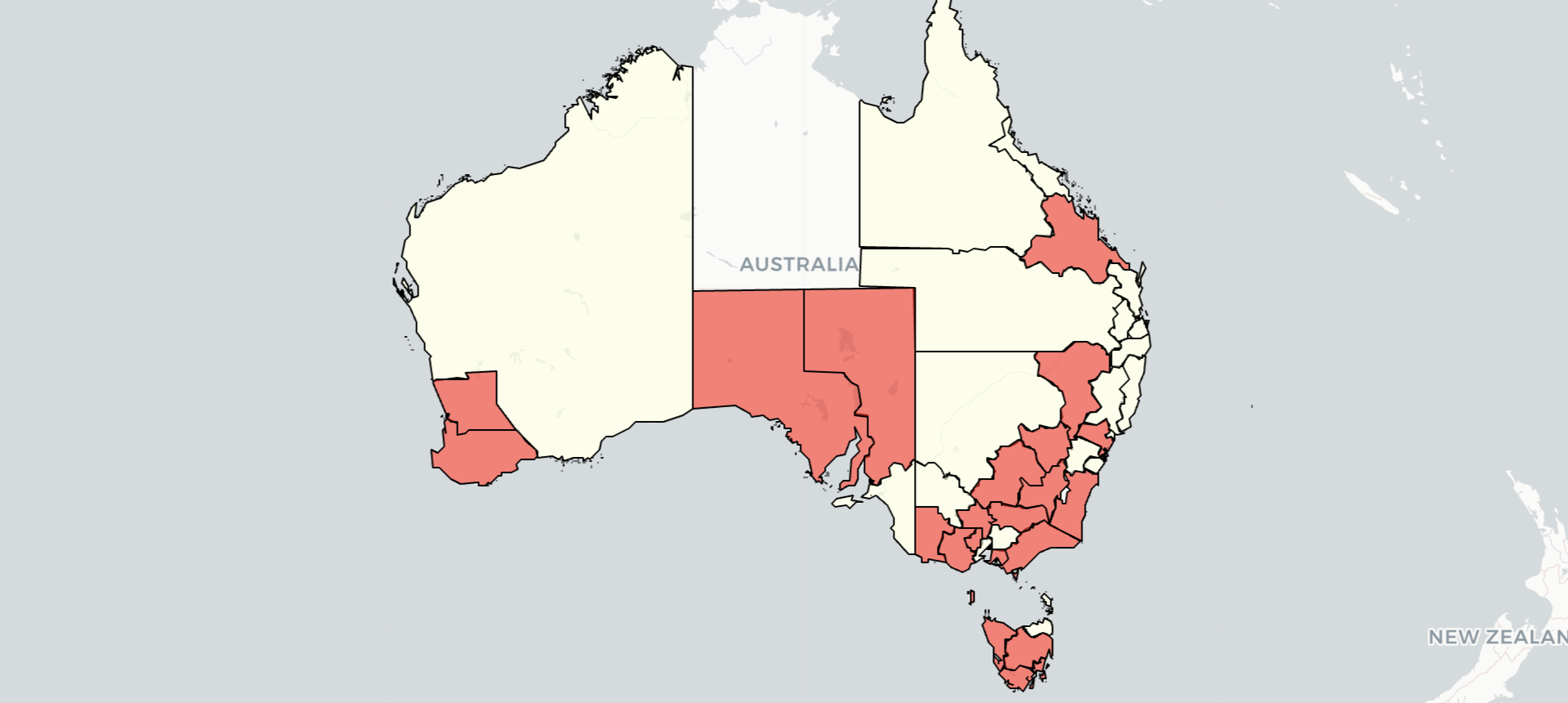
Recent reporting, and my own experience, indicates that the federal Labor government is seriously considering an expansion in the size of the Australian federal parliament, echoing the previous expansions in 1948-49 and 1983-84. But they are yet to commit to the issue.
Conversations with figures in the Labor government suggest that they are hoping to gain bipartisan support for the change, but recent rhetoric from opposition figures suggest that is unlikely to happen, regardless of the merits.
Indeed a recent Saturday Paper story quotes an anonymous Liberal senator as saying that the party would definitely oppose the change, while acknowledging that the change would help the party in the cities.
Looking at history can give us a sense of where the Coalition parties have fallen. If the Labor government is hoping to gain Liberal support, the historical record will undoubtedly be disappointing. But the record of the Nationals is more interesting. I think we can see some significant structural shifts in how we draw electoral boundaries and how population has shifted in Australia which gives the Nationals good reasons to support such a change.
The first expansion of the parliament was accomplished via the Representation Act 1948. This bill was passed into law in May 1948.
The Labor government held clear majorities in both houses of the parliament. Despite the Coalition previously suggesting they were open to supporting an expansion, they opposed the legislation. Amongst other reasons, they were concerned about the bigger states and the big cities becoming more dominant in the parliament. The Liberal and Country (now Nationals) parties were on the same page in 1948.
A major point of concern was that the expansion would be paired with a change to the Senate electoral system, introducing proportional representation. Labor had won 15 out of 18 seats in the Senate in 1946, under the old bloc vote system. A continuation of the bloc vote system would have allowed for the possibility of the Coalition to gain control of the Senate, particularly if a larger number of senators were elected in 1949 (42 members, to bring the Senate to its new size of 60).
In practice, the main complaint was to do with the introduction of PR, since any shift from a majoritarian system to a proportional system would give the party who won the previous election a dominant position until the second PR election, whether or not the parliament was expanded. The Coalition did suggest to Labor that they would cooperate in manufacturing a double dissolution to allow for a clean slate in the Senate, but Labor turned them down.
The 1983 reform came about from the Representation Act 1983, one of a number of electoral reforms introduced following the inquiries of the Joint Select Committee on Electoral Reform (JSCER), a body that evolved into the modern JSCEM. Redistribution processes were overhauled, group voting tickets were introduced for the Senate, and the Australian Electoral Commission was created, amongst other changes.
The Liberal Party predictably opposed the expansion that year, but interestingly the National Party did not.
Paul Davey’s book Ninety Not Out features discussion of the National Party’s position on expanding the parliament. While an opposition discussion paper opposed the reform, he asked the party’s NSW head office to do its own analysis. This analysis predicted the party would increase its House numbers from 17 to 21, and gain an extra Senate seat:
“To the fury of the new Opposition Leader, Andrew Peacock (Kooyong), and the Liberals, the National Party senators crossed the floor to vote with the government, ensuring the Representation Act 1983 was passed on 8 December.”
The National Party did gain an extra four House seats and an extra senator, as their internal analysis had predicted.
Indeed it appears that the National Party’s submission to JSCER, supporting the reform, may have been the turning point which led to the government introducing legislation. The National senators played a crucial role in passing the legislation, as the Democrats voted against the change.
Anyone who pays attention to the redistribution process will be aware of the regular controversy over the size of rural electorates. Nationals MPs and other figures in rural communities will often decry the large land mass rural MPs are required to cover.
For a long time, this dilemma was resolved by drawing rural electorates with fewer voters than urban electorates. At a federal level, electorates could be drawn 20% over or under the average enrolment, and typically rural electorates were drawn to be less populous. In addition, redistributions weren’t completed on a regular schedule, so over time the gap in enrolments grew quite significantly. This gave an electoral advantage to parties that did well in rural areas, as they needed fewer votes to win elections.
So in that context, an expansion of the House in the 1940s would have mostly helped reduce the size of urban electorates. Indeed I looked at enrolment per electorate at the 1946 and 1949 elections for the five mainland states. I compared enrolment for old seats to the enrolment for the seat with the same name after the redistribution. Metropolitan seats shrank 43.9%, while regional seats shrank just 31.5%.
But things were different by the 1980s. One of the bills passed at the 1974 joint sitting reduced the allowance for enrolment differences between electorates at a redistribution from 20% to 10%. And another of the reforms implemented in 1984 required that the mapmakers also aim to draw electorates with equal populations three-and-a-half years down the track, something which encouraged the mapmakers to draw low-population electorates in fast-growing areas (this rule has since been clarified to allow a deviation of 3.5% on that projection data).
The 1974 reforms had still allowed for electorates of more than 5,000 square kilometres to be smaller compared to other seats, but this was abolished in 1984.
So by the 1980s, the malapportionment that had been a big boost to the Country Party had faded significantly, and it was due to be even more diminished. Once this had happened, a rural party like the National Party would benefit significantly more from a parliamentary expansion. Indeed the reduction in land mass covered by an MP would benefit them more than urban MPs.
I think this change in rules around redistribution explains why the Country Party of 1948 was opposed to the reform, but the National Party of 1983 was supportive.
If you are concerned about the vast areas represented by rural MPs, there is one solution that doesn’t value some voters over others: expand the Parliament. I think the Nationals of 2025 and 2026 should seriously consider following the lead of their predecessors in 1983 and supporting a parliamentary expansion, regardless of what the Liberal Party says.

always back self-interest. at least you know it’s trying. if the govt. chooses to expand the parlt. it will succeed.
This is correct. Doug Anthony was National Party Leader and asked me (NSW Nats General Secretary) to provide advice to him on what position the National Party Senators should take, notwithstanding vehement opposition from the Liberals to Hawke’s proposal. My advice was to support the expansion of the Parliament noting, though, that the Party should expect full-throated three-cornered contests in the brand new seats. Both the candidates and the campaigns had to be up to the challenge. Doug took that advice and … the rest is history.
Jenny, if I ever do my big research project about the 1983-84 reforms, we should do an interview.
“a rural part”
The nats are as irrelevant as the crossbench. With the way numbers work atm labor needs either the greens or the whole coalition to pass legislation. Or in an extreme case the entire crossbench. But what are the odds Tammy tyrell lambie pocock Hanson payman and Thorpe all agree on something.
Depending how the redistribution went, this could lead to The Nationals becoming the major opposition party. There’s plenty of marginal Liberal seats where chopped off parts could become Labor held, but in the regions there could be plenty of new National seats. The wild card is One Nation.
Comments are closed.