

There has been a great deal of focus this week on the events of the Dismissal of Gough Whitlam’s Labor government, fifty years ago last Tuesday.
I have been particularly drawn to examining how the role of the Senate has changed since 1975, but also throughout the history of the federation. Changes in electoral systems, the size of the Parliament and a fragmenting party system has produced a Senate quite different to the one that blocked supply in 1975.
There has been a story told this week that the Dismissal had a chastening effect on the Senate, preventing a repeat in the last fifty years. Yet I don’t see anything fundamental that has changed in the relationship between the houses to prevent such an event happening again. Rather I see a change in the party system meaning that the conditions of 1975 have not been repeated. If they were, I think it’s entirely possible we would again see a standoff between the houses.
I should say I am not an expert on the events of 1975. Anne Twomey’s recent video series on YouTube has been very helpful in understanding the events of that year. But I think I know enough to clarify some things about the events that took place.
Most of the focus is on the actual dismissal of Gough Whitlam by John Kerr on November 11, 1975. While this perhaps could have been handled better, or in a different way, the fundamental issue that led to the crisis was that the government faced a hostile majority in the Senate, and faced an opposition that was willing to press their advantage (likely because of the government’s poor polling).
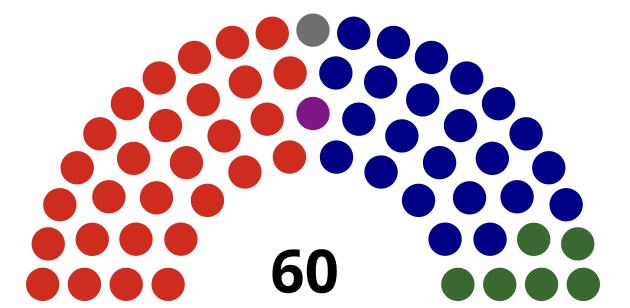
Out of 60 senators, 30 of them were Coalition members (one of whom had been elected as an independent then joined the Liberal Party), along with an independent senator, Albert Field, appointed by Queensland premier Joh Bjelke-Petersen to replace a deceased Labor senator. There was a second controversial appointment of a candidate other than the preferred Labor candidate to replace Lionel Murphy in New South Wales, but that senator, Cleaver Bunton, supported the government on supply, so it’s not relevant here. Field ended up absent from the Senate for the final month of the government’s term while his eligibility was challenged, but this still deprived Labor of a vote, giving the Coalition a 30-29 majority.
My personal outrage is not so much drawn to Kerr’s decision, but Bjelke-Petersen’s decision (and Tom Lewis in NSW) to distort the partisan balance of the Senate. These decisions would no longer be possible today – Australia’s last successful referendum in 1977 required a state parliament to appoint someone who remained a member of the political party who had won the seat at the last election. It was that decision that particularly weakened the Whitlam government’s upper house position.
If you look back at the history of Senate majorities, there have been a handful of occasions where opposition parties have held a majority in the Senate, but it rarely lasts long. Here is a short list:
- Liberal Party won the 1913 election, but Labor maintained a Senate majority thanks to Labor having won every single seat at the 1910 election (and also winning a slight majority of 1913 seats) – Joseph Cook called Australia’s first double dissolution election in 1914 and lost.
- When the ALP split in 1916, the conservative elements who split from the ALP and formed government with the Liberal Party (and eventually formed the Nationalists) did not hold a majority in the Senate, as the remaining parts of the ALP still held a majority. The Nationalists gained a majority at the next election in 1917.
- The Scullin government won power in 1929 at a House-only election, while the Senate elected at conservative victories in 1925 and 1928 continued until the next election in 1931.
- The Curtin government was a minority government when they took power mid-term in 1941, and the conservative Coalition maintained a Senate majority. The next election in 1943 gave Labor a clear majority.
- The 1949 election saw Robert Menzies lead the Coalition back into power. The electoral system was changed to proportional representation. While the Coalition won a slight majority of seats contested at that election, Labor still held the vast majority of seats elected in 1946, so maintained a Senate majority until a double dissolution was called in 1951.
Excluding short-term examples like 1975 or lame-duck examples like the first months of the Rudd government (when the old Coalition majority was still there), these are all the examples I can find.
The first thing to note is that they all ended within a year or two, and in all five cases the resolution came from an election (including Australia’s first two double dissolutions).
But they also were all caused by the old majoritarian electoral system.
From 1903 until 1946, the Senate was elected by one of two versions of a ‘block vote’ system, which (given some basic party discipline) gave every seat in a state to the party with the bigger vote. The preferential variant introduced in the 1920s allowed preferences to play a role, but ultimately the block with the highest votes won everything.
This produced a ‘windscreen wiper’ effect that often led to absurdly disproportionate majorities, far in excess of what you’d see in the House of Representatives. Following the 1946 election, Labor held all but three senators – the Coalition had won just one state in 1946, after not winning a single state in 1943.
From the formation of the two-party system in 1909 until 1955, there was always a majority for either the government or opposition in the Senate. The introduction of proportional representation in 1949 created the potential for multi-party politics, but it was only with the ALP split in 1955 that this became real. From 1955 until 1975, the government only held a majority in the Senate for one term. The gap between government and opposition was often filled by the Democratic Labor Party. But while the Menzies government failed to win a majority at the 1955, 1961 or 1964 elections, they did win 30 out of 60 seats.
Which brings me to my next point – the PR system we have has a tendency to produce results close to a deadlock, which may be preferable to massive unearned majorities, but I think it was a key factor in the Dismissal. This was particularly true of the 10-seat double dissolution elections in 1974 and 1975.
The Whitlam government’s victory in the House of Representatives in 1974 was slim but clear. Labor polled 49.3% of the primary vote to 45.7% for the Coalition, and won 51.7% of the two-party-preferred vote. This produced a 66-61 split in the House.
The Senate result, however, was basically deadlocked in four of the six states. In New South Wales, Victoria and Western Australia, there was a 5-5 split. In South Australia, the Liberal Movement’s Steele Hall won the tenth seat, with Labor leading the Coalition 5-4. In Tasmania, Labor led the Liberal Party 5-4, with ex-Liberal independent Michael Townley winning the fifth seat. Townley rejoined the Liberal Party in early 1975.
Only in Queensland was there a clear skew, with the Coalition winning a 6-4 split in that state.
So overall this produced a split of 29-29-2, which became a 30-29 lead for the Opposition in early 1975 when Townley rejoined his former party.
In a proportional system, it is very difficult to ‘run up the score’. This is particularly true with even-numbered magnitudes. Since you need to gain quite a large lead to gain a sixth seat, a 5-5 split can eventuate even when there is a large gap.
In 1974, Labor had a substantial lead in the two biggest states, yet won the same number of seats:
- NSW – Labor had 49.9%, Coalition had 41.6%
- Victoria – Labor had 46.7%, Coalition had 43.0%
DLP preferences undoubtedly helped the Coalition, but the low DLP vote meant that they didn’t win any seats – their preferences instead boosted the Coalition, basically producing a tied Senate.
This tied Senate was then nudged over into a hostile Senate by the appointment of Albert Field, and the events of 1975 then followed from there.
So why haven’t we had similar problems again? It is still theoretically possible that an opposition-dominated Senate could threaten to bring down a government, even if constitutional change will prevent a repeat of Bjelke-Petersen’s move. But what has changed is the party system. Multi-party politics has made such a scenario far less likely.
The rise of the Democrats and then other crossbench parties in the 1980s and 1990s has made it harder for either major party to get close to a majority. The only time when a major party came close to a majority was in 2004, when the Howard government won a majority thanks to winning three seats in every state at the 2001 and 2004 election, and winning a fourth seat in Queensland thanks to Barnaby Joyce running a separate Nationals ticket. There was a temporary decline in multi-party politics around 2004 with the decline of the Democrats, but it has bounced back since then, and neither major party is close to winning a majority.
But the nature of six-seat Senate elections does create the potential for a major party to win half of the seats with substantially less than half the vote. I wrote about this in 2023 as an argument for expanding the parliament.
Interestingly I recently discovered that the Australian Democrats opposed the expansion of parliament in 1983, and Senator Michael Macklin specifically focused his opposition on his concern about a switch from five to six seats. Specifically he was worried that, if both major parties managed 43% in every state, you would have a perfectly tied Senate, 38-all, with no room for crossbenchers.
By the time we had our first six-seat election in 1990, the major party vote had dropped enough for this to be less of a concern, but I can understand the concern in the party system of 1983.
So what has changed since 1975? The change to the constitution hasn’t removed the potential for such a situation to happen again. It is entirely plausible that a government in the House could again face a Senate dominated by their opponents, and that Senate could use the blocking of supply to force an election. If such a circumstance was to occur again, I think a prime minister in that position would learn a different lesson – that trying to avoid an election won’t work, and ultimately such a deadlock needs to be resolved by the voters.
Thankfully this is not an immediate concern now, but it’s not because of constitutional or norm changes. It’s because we no longer have that strong two-party system. Yet another win for multi-party politics.

Interesting summary. One thing that has confused me about the Dismissal is how relevant was Albert Field? Surely once Townley rejoined the Liberals, they had 30 votes and a blocking majority because, in the Senate, a tied vote fails? So whether it was 30-29 or 30-30 is neither here nor there?
I agree that this could certainly happen again with the current system of 6 up at a time. The Coalition and One Nation, or Labor and the Greens, could easily win half the seats and be able to block supply were they so inclined, and I wonder if the increasingly ideological nature of crossbenchers (cf. the Democrats, Xenophon-type Independents) makes it more likely.
If I recall properly, Field was definitely a factor, just not in the flesh.
His appointment was challenged by Labor due to the circumstances of his resignation from his job prior to becoming a senator. He may have been ineligible as an officer of profit under the crown. In the meanwhile, the Coalition refused Labor a pair, giving them a theoretical one-vote advantage while Field was held up in the High Court.
Therefore, for Labor to pass the supply bills, two Coalition senators would have to buck the party line, rather than one, and vote with Labor in order to overturn the 29-30 or 30-30 scenario articulated by Mstj.
Part of the drama of 1975 was the delay in communicating Whitlam’s sacking to the Labor MPs, who reasonably assumed that the passage of the supply bills by the Senate was due to Coalition senators crossing the floor. Whitlam did not immediately return to parliament to pass on the news, which was ultimately declared in the House by Fraser.
It would be much harder to organise a similar coup now when everyone is in instant reach as well as being alert to the possibility of vice-regal intervention.
I just watched a video interview conducted with Don McClelland, who was an NSW Senator for 25 years and was there for the 1975 events. Interesting perspective as it relates to the topic at hand. He basically said that the biggest thing to come from the events (aside from the change of PM) was that the collegiality of the Senate broke down after that. It was almost unheard of for the Senate to block supply, even when controlled by the opposition party. Of course, at that time, you had had 23 years of unbroken Liberal government, so Whitlam was a new thing. He was a notable departure from prior Labor leaders and quite aggressive in his legislative agenda. You also had a double dissolution election, a joint sitting of parliament to pass bills, among other things. It was a very unusual time.
@Chris Maltby – one of the biggest takeaways that I understood from the behaviours of the Governor General and the Liberal leader was how much subterfuge took place at the very end. It was almost as though they did all they could to conceal it without anyone noticing. Even if one accepts the premise that Kerr has the right and ability to sack Whitlam under these circumstances, the fact that he said one thing and did another was a proper stitch-up.
Ben
You neglect to mention that Steele Hall was elected for the Liberal Movement from SA in 1974 so he should not have been strictly counted as a Coalition senator. I would need to research where he stood on the Supply issue.
Murphy and Millner were elected as alp politicians there was a convention that alp representatives replace them.
Joh and Tom Lewis ignored these principles. This gave the lnp the numbers
To defer the budget. A rort.
Apologies, didn’t read down but should Steele Hall have been counted as a Coalition senator when he was not elected as such and the Liberal Movement ran candidates across several states (with only Steel Hall being elected in 1975)? The Liberal Movement of course dissolved itself in 1977 with Steele Hall and some others going back to the Liberal Party whilst others such as Robin Millhouse were the nucleus of the Australian Democrats. When Steele Hall resigned in 1977 – Janine Haines as a Democrat and successor to the Liberal Movement – filled the casual vacancy. I am not sure if there was any controversy about that at the time as it was prior to the 1977 referendum.
The Democrats always made it a key plank that they would not oppose supply in the Senate. However, I believe (and correct me if I am wrong) that the Greens have never made such an undertaking. On that basis, it is always possible that a Labor / Greens combination could deny Supply to a Conservative government should they have the numbers.
With both Lionel Murphy and Bertie Milliner being elected to six year terms in 1974, am I correct in thinking that there would have been a half senate election for 6 senators in NSW and Queensland if it had gone ahead under the old system in 1975?
“On that basis, it is always possible that a Labor / Greens combination could deny Supply to a Conservative government should they have the numbers.”
Why on earth would Labor do something they have spent 50 years condemning?
Steele hall voted with Labor on the supply
Issue
As well as for one of the electoral reform bills in the joint sitting. If I recall correctly he did so citing his involvement in abolishing the Playmander.
I did not count Steele Hall as a Coalition senator. The coalition got to 31 without him thanks to Townley and Field.
Mstj, Anne Twomey explains that point (which I myself was confused about) in this video: https://www.youtube.com/watch?v=ZlKc4VNlrWg
She says that if the Senate was deadlocked at 30-30, then Fraser would have been unable to guarantee the passage of supply (unless Fraser had been able to secure a promise from one of the two crossbenchers who were backing Labor, which I suppose may have been possible), and the whole point of the dismissal was to secure supply before holding an election.
Assuming there had been a half senate election in December 1975 instead of the Dismissal, it is quite likely that the imbroglio would have dragged on. Using the actual senate results from 1975 and assuming 6 seats up for election in each of NSW and Qld, there would have been a result after the election of 31 Coalition, 27 Labor, Steele Hall and quite likely Brian Harradine. That would have made it worse and the crisis would have just gone on. It is very hard to see what it would have achieved.
Before anybody asks, that is assuming 14 ALP, 13 Coalition and Steele Hall continuing. NSW would have split 3 – 3, Qld 4 LNP to 2 ALP, 3 LNP in each of Vic, SA and WA and Tasmania quite likely two each and Brian Harradine. Though if Harradine had not got up, then 3 to 2 which would have been 32. A What if counterfactual. It is hard to know if Labor would have done better or worse without the Dismissal happening or the 1975 result would have happened anyway.
The Democrats opposition to Senate expansion is quite interesting as they had quite high votes in SA and WA in 1977 – round about 12-13% but were not elected but came up from quite low (about 8% from memory) in NSW when Colin Mason was elected. Again in WA in 1980, the Dems got about 12% but could not get elected. If there had been six senators they would have been elected more easily.
One thing that has changed about Parliament since the Dismissal that is that House of Reps and Senate elections are always simultaneous (excluding challenges, deaths and resignations), there is less opportunity to gain political advantage from a dismissal.
Given Fraser was offering a deal for a May 1976 House and half-Senate election, in exchange for supply, it appears a key motive of his for blocking supply was avoiding the Whitlam Government being able to continue into the next Senate term, so Fraser could avoid having to choose between a first term of only 1-2 years and a half-Senate only election giving his government a worse result that a simultaneous election would.
The other significant change since 1975 is that the ALP is no longer using its preference advice/GTV preferences to defeat senate candidates from a party in the political centre, as it had done in 1974 and multiple previous occasions with the DLP, enlarging Coalition Senate numbers.
Tom
In 1975, ALP preferences to the Liberals definitely delivered the last seat to the Libs rather than the DLP – a last revenge for all those years since 1955. However if you go back to 1974 and prior then the ALP definitely delivered seats to the DLP. ALP preferences saw the DLP elected above the Australia Party in NSW in 1970. In 1974, there was not a strong flow of preferences from Labor to DLP seeing the last seat go to the Libs. However, if you go several counts back the final ALP vote flow was very similar to their vote at that count. After that there were flows from the Australia Party and former Liberal George Hannan – which seemingly went ALP then LCP.
About 30 years ago I was lucky enough to be able to discuss the dismissal with a conservative Senator. He personally hated Whitlam and would have voted against supply until hell froze over. He also had an equally strong view that one or more of the liberal Senators would have broken ranks before 30 November (being the day supply ran out). There were, to use his words, a lot of nervous nellies asking “what are we doing”. The fact that Fred Cheney (I believe Uncle of Kate) and Reg Withers had managed to keep all the Liberal Senators together to the 11th of November was the most surprising part of the entire blocking of supply.
The fact that he thought some liberal Senators would break ranks and pass supply basically meant that his vote was irrelevant. The delaying of supply made the Whitlam Government look even more chaotic that what it was and when the next election came in 1976 the Coalition would win.
Interestingly, on the afternoon of the 11th, my friend did not know that Fraser was PM when he voted to pass supply. The message from Withers was (or words to the effect) “its over we have decided to let supply through”.
Following this discussion, I have held the view that Kerr should have let the politics play out to the last moment before pushing the nuclear button on the ultimate reserve power.
It is hard to imagine the Senate blocking supply today but I am sure that it will happen again. Times change people don’t…..
What supply did they block? I assume we’re not just talking DD triggers?
Also yes Fred was Kate’s uncle.
Pollster
Fred Chaney entered Parliament at the May 1974 DD election. I doubt that he, as a backbencher, was instrumental in persuading any of the other Senators to hold firm.
There is a strong argument that November 11 was the last possible moment. The money had run out, and AEC had advised Kerr that this was the deadline for a pre-Christmas poll
It’s an interesting footnote but prior to 1950 there was no effective convention that Senate vacancies should be filled by a member of the same party. In the era of the infamous “block majority” Senate there were 10 instances of usually a deceased Senator being replaced by the opposing Party that controlled the relevant State Parliament. Because Senate majorities were often disproportionately large this did not create outrage. The change to PR Senate voting and tight numbers led to an ‘honour system’ where State Governments accepted the nominee of the same Party, that broke down in 1975.
The Senate Opposition in 1975 needed a majority to defer Supply and not a blocking half that could have rejected it – taking it out of the Senate and back to the Reps.
Comments are closed.