

Incumbent Senators
| Term expires 2011 |
Term expires 2014 |
| Kim Carr (ALP) | Jacinta Collins (ALP) |
| Stephen Conroy (ALP) |
David Feeney (ALP) |
| Steven Fielding (FF) |
Mitch Fifield(LIB) |
| Julian McGauran (LIB)* | Helen Kroger (LIB) |
| Michael Ronaldson (LIB) | Gavin Marshall (ALP) |
| Judith Troeth (LIB) |
Scott Ryan (LIB) |
*McGauran was previously a Nationals senator, and was re-elected on a joint Coalition ticket as a National in 2004. McGauran defected to the Liberals in 2006.
History
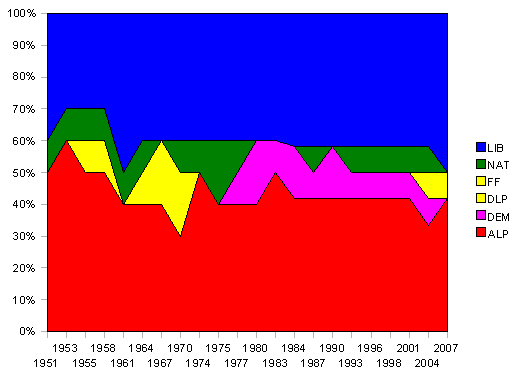
The 1951 election, which was the first to result in a Senate entirely elected by proportional representation, gave an overall result of 5 ALP senators, 4 Liberal senators and one Country Party senator. The 1953 election saw the ALP gain a seat off the Liberals, giving them a 6-4 majority. This was the only time the ALP, or any party, won a majority of Victoria’s Senate delegation under PR.
The 1955 election saw the party that became the Democratic Labor Party win a seat off the ALP. At the 1961 election, both the DLP and the ALP lost a Senate seat, with the Liberals winning two, giving them five seats, with three ALP and one each for the DLP and Country Party. In 1964, the DLP regained their single Senate seat from the Liberal Party. In 1967, the DLP gained a second seat off the Country Party, who were left with no Victorian senators. The 1970 election saw the Country Party regain their seat, off the ALP. The ALP was reduced to three seats, with four Liberals and two DLP senators.
The 1974 double dissolution saw the ALP regain ground, with both DLP senators being defeated, and the ALP gaining two seats, bringing their contingent to five out of ten senators. The 1975 double dissolution reduced the ALP to four seats, with the National Country Party gaining a second seat.
The 1977 election saw former Liberal minister Don Chipp elected to the Senate for the newly-formed Australian Democrats. The National Country Party lost one of its senators to the Democrats. The 1980 election saw the NCP lose its other seat to the Democrats. In the 1983 double dissolution, the ALP gained a fifth seat at the expense of the second Democrats senator.
At the 1984 election, an increase in Senators saw the Liberals and Democrats each gain an extra seat. The Democrats again lost their second Victorian senator at the 1987 double dissolution to Nationals candidate Julian McGauran. The 1990 election saw McGauran defeated, and the Democrats again regain their second seat.
The 1993 election saw the Democrats lose a seat yet again to the Nationals. This produced a result of five each for the ALP and Liberals, and one each for the Nationals and Democrats. This status quo was maintained until the 2004 election, when the ALP lost one of its five senate seats to Family First’s Steven Fielding. The 2007 election saw the ALP regain a fifth seat at the expense of the Democrats, who lost their last Victorian senator.
2007 result
| Group | Votes | % | Swing | Quota |
| Labor | 1,327,076 | 41.70 | +5.58 | 2.9191 |
| Liberal/Nationals | 1,257,149 | 39.50 | -4.60 | 2.7652 |
| The Greens | 320,759 | 10.08 | +1.28 | 0.7055 |
| Family First | 80,100 | 2.52 | 0.64 | 0.1762 |
| Democrats | 52,596 | 1.65 | -0.21 | 0.1157 |
| Democratic Labor Party | 32,930 | 1.03 | -0.91 | 0.0724 |
| Others | 111,759 | 3.51 | 0.2460 |
The ALP and the Liberal Party each won two seats on primary votes. After the distribution of most candidates’ preferences, the race was reduced to the third Labor candidate, David Feeney, the third Liberal candidate, Scott Ryan, the Greens candidate, Richard di Natale, and the Family First candidate, Gary Plumridge.
At this point the candidates had the following number of votes:
- Feeney – 0.9857 quotas
- di Natale – 0.9313
- Ryan – 0.7766
- Plumridge – 0.3053
Plumridge was excluded, and produced this final result:
- Ryan – 1.0487
- Feeney – 1.0162
- di Natale – 0.9336
Candidates
The ALP ticket consists of Kim Carr, Stephen Conroy and Antony Thow. I’m not certain who is #1 or #2, but Thow is clearly #3 on the ticket.
The Liberal Party has preselected Michael Ronaldson to run in the first position and former National Julian McGauran to run in the third position. The Nationals have preselected Bridget McKenzie to run in the second position, which was held by McGauran in the 2004 election.
The Greens have preselected 2007 candidate Richard di Natale to run again. It’s safe to assume Steven Fielding will run again at the head of the Family First ticket.
The Socialist Alliance has preselected Margarita Windisch. The Democrats are running Roger Howe, and the Democratic Labor Party is running John Madigan.
Political situation
If this result were to change, the likeliest scenario would see the Greens win a seat off one of the major parties. In this scenario, the result would be achieved by either ALP+Greens reaching four quotas or Liberal+Greens reaching four quotas. In 2007, these groupings had the following result:
- Liberal + Greens – 3.9823 quotas
- ALP + Greens – 3.9498 quotas
In this scenario, a swing of 0.72% from the Liberals to the ALP would give the Greens a seat at the expense of the Liberal Party, while a swing of only 0.26% would give the Greens a seat at the expense of the ALP. When you examine it this way, you see the Greens were extremely unlucky to miss out in 2007, as there was less than a 1% window in which the ALP and Coalition votes would be exactly right to give them three seats each.
On top of that, assuming the same preferences from minor parties, a 0.95% swing to the Greens on primary votes or on preferences from minor parties would give them the seat without any need to rely on major party preferences.
You would have to give Steven Fielding no chance of winning a seat in a half-senate election without major party preferences and a whole lot of luck. Family First managed to reach 0.57 double dissolution quotas in 2007, which could put them in with a shot, particularly if Fielding can gain a swing towards him and a solid flow of preferences from other microparties.
According to the Poll Bludger, http://blogs.crikey.com.au/pollbludger/2009/04/03/morgan-61-39-5/, the Victorian Nationals have endorsed Bridget McKenzie, McMillan candidate in 2004 and local school teacher, for the number two spot. Hope this helps. (Love these profiles, by the way.)
Thanks, I’ve updated it.
What do you mean ‘extremely lucky to miss out’? Don’t you mean ‘unlucky’?
Your second chart here says “NSW” where it should say “Victoria”
The margins here are so tight. A situation where _every_ vote counts, unlike the lower house.
The margins are very tight. A small swing in votes either way would result in a different candidate being elected. It seems to me in this situation there 3/4 possibilities, each one of them with as much hope as the other.
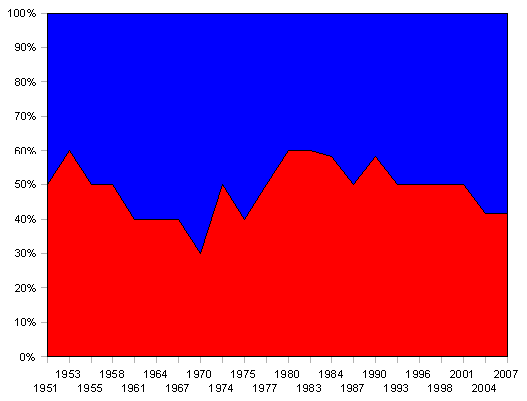
Maybe I misunderstand what the second graph is meant to show, but shouldn’t it be blue and red at 50% (as per 2001)?
Assuming a half senate election again I find it hard to see either the ALP or Greens (one of them) not gaining a senator in comparison to the 2004 result – probably at the expense of Family First, but in any case, a shift of 1 senator from ‘right to left’.
@Fargo61,
The second graph shows the overall number of Senators for the left and the right. At the moment there are 7 right-wing senators and 5 left-wing senators from Victoria.
What a prospect – Richard di Natale losing again, this time to Julian McGuaran !
As a dedicated Democrat, I’ll be thrilled if Richard Di Natale is elected – an admirable, humble, genuine humanitarian.
There certainly seems to be a real chance that Victoria will go 4 ALP/Greens to 2 Coalition in a half-senate election – which would see both Senators Fielding and McGauran lose their seats. It seems reasonable to expect that the Greens can increase their primary vote on their 2007 result, and quite possibly the ALP will too. 2007 was a government-changing election, whereas even if it’s a half-senate election rather than a DD, there will still be more focus on the senate, given the current balance of power situation, and the polls consistently pointing to an easy win for the ALP. It’d be interesting to look at how all minor parties poll in the senate when the government is changed compared to how the they poll when the government doesn’t change.
I have used the 2007 results from http://www.abc.net.au/elections/federal/2007/results/senate/ and the registered preferences from the 2007 group voting tickets http://www.aec.gov.au/Elections/federal_elections/2007/candidates/gvt.htm with the figures from Possum’s “Swing States” article of January 11th http://blogs.crikey.com.au/pollytics/2010/01/11/swing-states/#more-6815
to do simulations on a spreadsheet to get an idea of the potential Senate outcomes in each state (based on those figures).
In Victoria the ALP get a quota of 3.0107, the Coalition 2.3388 and the Greens 0.9647 with the Greens comfortably gaining the sixth senate position.
I also did a Double Dissolution simulation with the quotas being ALP 5.5914, Coalition 4.3436, Greens 1.7917, and Family First 0.3687. In this simulation the Greens gain far more preferences than the ALP and gain a second position (11th spot). The fifth Coalition candidate is eliminated before the first Family Fist candidate, who is ‘elected’ on on the Coalition and other ‘right wing’ preferences, but by less than 1000 votes ahead of the sixth ALP candidate. Realistic outcomes appear to include therefore either ALP 5, Coalition 4, Greens 2, Family First 1 or ALP 6, Coalition 4, Greens 2.
My simulations in other states show the coalition potentially losing up to 5 senate spots overall to ‘minor right wing parties’ in a Double dissolution election, and being reduced to 27 overall, with Family First 3, Christian Democratic Party 2, the Greens 11, ALP 31, and Xenophon Group 2.
According to this report Margarita Windisch will be running for the Socialist Alliance.
Reports about another new party, the Parents Carers and Families Party, intending to contest the Senate in every state. The convenor, Vern Hughes, may be remembered as one of the main figures behind the People Power party at the 2006 Victorian state election, and he subsequently ran for the DLP at the last federal election.
Its good to see Vern still active.
He’s a very dedicated worker and with a very short campaign in 2007 in ended with just under 4%.
http://www.abc.net.au/elections/federal/2007/guide/gort.htm
Many of the policies he is presenting are DLP and I wish him all the best.
http://richarddinatale.com.au/bio
He is a good candidate this man. I don’t always think that the Greens pick the right candidates, but Di Natale is the most intelligent, pragmatic, clear-thinking and approachable candidate you could find. He would richen the Senate and political debate in Australia more than any other candidate I know.
Vern Hughes was a Communist once in the very distant past, I wonder is there some connection between his various organizations and Dignity for the Disabled in SA?
The Democrats have pre-selected Roger Howe, State President.
Geoff, If it sounds like a loaded question and looks like a loaded questions, is it a loaded questions?
I think Geoff was linking it to Vern’s new party, the ‘Parents Carers and Families Party’, which, just going by the name, could have links to D4D or the Carers Party just to name a couple. Of course it may not.
I’m pretty sure that Geoff wasn’t saying that D4D are communists. 😛
Not trying to be, somehow I am on the mailing list for Hughes’ Federation of Parents and Carers and note that it has enthused about D4D, People Power in Victoria in 2006 was linked to him also.
Fair enough.
Whilst we are on D4D, I think they have a decent chance to win seats in the SA and NSW upperhouse in the future. I think in all other states, the electoral systems are not as advantageous to micro parties.
The Victorian DLP have announced three of their Senate Candidates with
John Madigan (State President and Federal Vice President) as the lead Senate candidate. John is a very well known activist in the Ballarat district.
Supporting him in number two is well known Dandenong councillor Geraldine Gonsalvez. http://geraldinegonsalvez.com
and John Kavanagh Councillor from Moreland and brother of Peter Kavangh. (MLC Western Victoria) http://www.moreland.vic.gov.au/about-council/councillors/north-west-ward-councillors/cr-john-kavanagh-north-west-ward.html
John was well known for his stance along with the greens is ousting the ALP leadership.
http://www.crikey.com.au/2010/03/26/labor-burns-the-witches-of-moreland-as-phil-cleary-watches-on
More and more it’s looking that the DLP are putting up their biggest and best campaign since 1975
Tony,
Any comment on the article in the Age today “State DLP on brink of collaspe”?
http://www.theage.com.au/victoria/state-dlp-on-brink-of-collapse-20100619-yo28.html
The headlines don’t make much sense.
Some of the smaller State Branches would be happy to have $10,000 in the bank at this stage. Most donations etc come in when an election is called for or just prior but Mr Mulholland has certainly been a strain on what traditionally has been our wealthiest state branch. With an election imminent it’s better that some of our regional members are aware of his antics now before he attempts to disrupt the election. The DLP have also fought campaigns on a shoe string so the headlines certainly don’t reflect the state of moral held by all around the country.
The Victorian’s are standing more candidates in both the upcoming State and Federal elections then they have done for many years. Some with good credentials. I believe the Senate ticket will be announced on Wednesday down there and 4 prominent candidates will also be added to the Victoria upper house contest.
The former Secretary John Mulholland has been a big hindrance in the expansion of the party and has been requesting membership and donations on behalf of the party (and stands accused of ) using it for his own or legal battles against the party. John was a great worker for the party and it’s sad to see him act in this way. Made worse when the party had to expel him earlier this year for a number of reasons. It probably would have been cleared up 12 months ago and John appointed in a position of respect but for the problem caused by couple of NSW members that encouraged him.
It was hoped that the 2009 Federal conference (of which he was invited) would have been the place to air any grievances. John and his small group of dissenters failed to front the party at that conference.
The Victorian DLP Senate has been named.
http://www.dlp.org.au/index.php?page=victoria
John (the man of steel Madigan) leads the ticket.
Very well known in the Ballarat Districts and is backed up by two well known and supported councillors who hold large majorities in the seats.
With Julia and Tony both beating up on refugees, I think I’ll pencil this one in for the Greens.
Oopps … That post was meant for Melbourne.
I wouldnt be surprised if there is a small backlash against Conroy.
There is a website filter-conroy.org that is encouraging people to put him last in labours bracket.
The censorship issue (secret blacklists) is one that a lot of IT savy people are particularly incensed about.
Sen Judith Troeth (Lib) is retiring but the boofheads at Liberal HQ (104 Exhibition St, Melbourne) won’t say who their 3 other Senate candidates are (4th, 5th and 6th spot on the ticket). Apparently these three people want minimal recognition because of work issues which begs the question why they were pre-selected in the first place after all as a Canberra Liberal source said to me recently “they are only going to lose anyway” – sounds like the Chaser at the Royal Children’s Hospital but I think its the HQ that needs oxygen or a brain transplant. The Chaser starts tonight too.
I’m with you Glenn – my main hope in the senate results is that Steven Conroy get kicked out. Elections are all about parties/people losing rather than opposition winning and Conroy’s doing a fine job of making this happen
@Jean – Conroy is number 2 on the ALP senate ticket in Victoria, so the ALP senate ticket would have to drop below 28.6% for him to lose – even the way they’re going at the moment, there’s no way that’s going to happen.
Please, could somebody lead me to a Webpage that gives me ALL the Senate candidates in Vic. AND what they stand for?
The full list of candidates is available on the AEC website. As far as what they stand for, you’ll have to work that out yourself.
I voted on 04 Aug 10 and put Stephen Mayne (Crikey founder and share holder activist) and wife Paula (RACV Board member) 1st and 2nd. I put Michael Ronaldson last (60th)
Did you check to see if there were any JOOOOOOS on the ballot first Adrian?
MDMConnell (13 Aug 10) Senator Ronaldson is a supporter of the Israeli Zionist (apes and dogs) enemy.
Looks like Victoria is really heating up.
I really love these adds on regional stations.http://www.dlp.org.au/
I think history is about to be made in victoria,
On the close of counting Sunday the DLP are poised to take their first Senate Seat since
1974.
Congratulations to John (the man of steel) Madigan
http://www.abc.net.au/elections/federal/2010/guide/svic-results.htm
I wonder if Julian McGauran has any regrets? If he was a National, he would have been elected.
Victoria with a Full Quota, even South Australia, the ACT and the NT with a higher percentage of the Senate vote for the Greens!!!!! What happened to NSW????? I am pondering on this?????
Lee Rhiannon is a pretty divisive figure. The NSW Greens are also generally considered (though I’m sure there’ll be some disagreement) as the most left-wing of the state Greens, which may also have come into play. Just anecdotally, I know several people who say they would be far more inclined to vote Green in other states.
Certainly NSW is one of the more progressive states with a historically high Green vote, so it was not a great result. That it was on an upswing has hidden much of this though.
Hamish – there is a limit to the Green vote and I think NSW has reached it! Mind you, I think they are a good chance of picking up lower house seats in the NSW election in March given the different preferencing rules. There is actually an outside possibility that the Greens could end up with more lower house seats than the ALP in the NSW election.
I’d love to see that!
people have been saying there is a limit to the Green vote for the past decade – but generally with little analysis to explain what the limit is and why the limit exists.
To be a devil’s advocate let me offer some suggestions as to why the limit for the Green vote might not have been reached.
1. there is evidence that there is a much stronger Green vote amongst the under 30’s.
2. people’s pattern of voting tends to be set in the first few times they vote so that a similar profile for this age group over the next couple of elections would tend to lock in a higher level of Green support significantly higher than their existing level of support in older age groups.
3. the issues the Greens are hgihglighting are not being tackled confidently by the major parties so people who are concerned about the issues may shift their votes
4. Greens voting levels seem to be linked to increasing levels of education across the community
5. As the level of support increases people may be more willing to support them on the grounds that they are not just a small minority
Detailed analysis of patterns of Greens voting over the past decade and the spatial pattern of support at both the House of Reps and Senate levels might give us some clues – along with analysis of patterns of voting in Tasmania and more recently the ACT might throw some light on this question and enable a more nuanced answer to be given.
Tasmania gives you a chance to analyse trends over time and the interaction between state election patterns and the Federal election voting levels.
ACT over the past decade suggests the possibility of a ratcheting effect whereby an increased level of support at the territory level generated greater visilibility that facilitated a high level of voting support at the Federal level.
DB: How does NSW optional preferential voting help the Greens? Do you think most Liberal voters would preference Labor over the Greens? This didn’t seem to happen in Melbourne.
answer: it doesn’t help the Greens and more to the point it doesn’t help the ALP as Greens votes exhaust so they can’t help ALP candidates get ahead of Liberal candidates on their preferences
Clinton – if you look at Federal seats such as: Lindsay, Roberston, Banks, Greenway, I think you will find the Liberal Party outpolled Labor on primaries in all of these seats. Given OPV in NSW, unless Greens preference Labor on their ticket, the ALP vote is going to be fractured again (as it was in the Federal election) and therefore they could lose seats they have never lost before.
The Greens are terrible news for Labor in a state poll given OPV and the fact that the Greens are a third force, but basically disillusioned ALP voters.
Mr Zegenhagen,
Your post on 20th June is wrong. Mr Mulholland is of good fame and character. Furthermore, no members in NSW encouraged him in anything you suggest.