

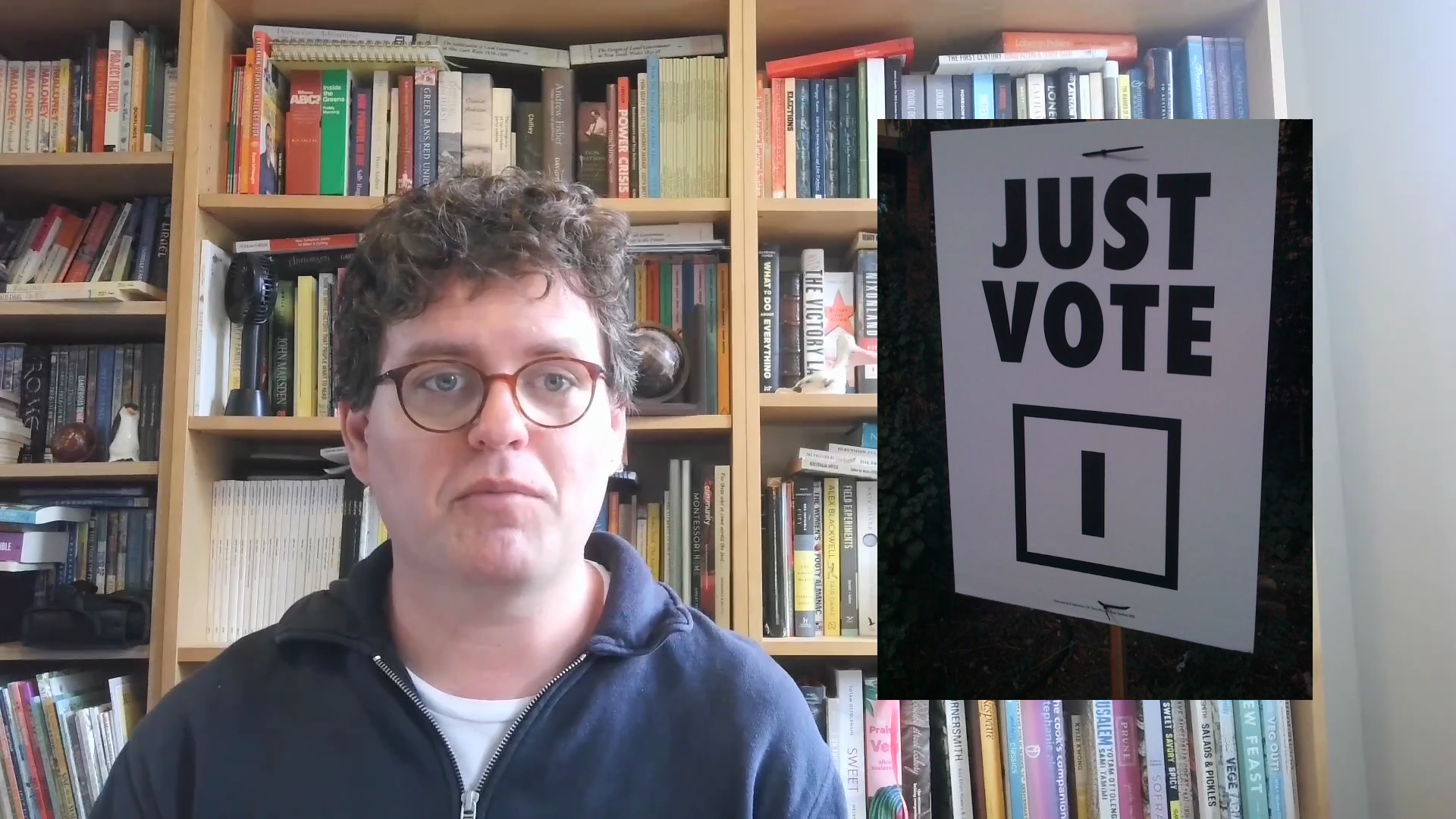
In the final part of ‘Just Vote 1’, Ben runs through how parties encouraged voters to not number preferences to get a political advantage as first One Nation and then the Greens became major sources of preferences.
Ben also considers who might benefit from OPV today, and possible solutions that blend the best parts of optional and compulsory preferential voting systems.
This podcast is supported by the Tally Room’s supporters on Patreon. If you find this podcast worthwhile please consider giving your support.
Buy your Tally Room merch now.
You can listen to an ad-free version of this podcast if you sign up via Patreon for $10 or more per month. And $10 donors can now join the Tally Room Discord server.
Welcome to the Tally Room podcast, I’m Ben Raue.
This is the final part of a series looking at the history of optional preferential voting in Australia – Just Vote 1. In today’s episode, I’ll be looking at the rise of One Nation, and the first attempts by parties to discourage voters from using their preferences.
Then I’ll look at the rise of the Greens, and how preferences became helpful to Labor again. We look at how resistance to OPV held up reform of the Senate voting system, and how the recent fragmentation of the party system makes it harder to know who would benefit from optional preferential voting.
The story ends with the Queensland government’s impending decision on reintroducing optional preferential voting for Queensland state elections, and I suggest a compromise that could achieve the best of both worlds.
But first, I have just launched the first range of merchandise for The Tally Room. You can now buy a hat that says ‘Waiting for the pre-polls’ and a bag that says ‘Single Transferable Tote’. These items are only available for a limited time. Pre-orders must be in by Monday November 2, so if you want to order something, please do so now. I don’t want you to miss out.
Independent federal MP Pauline Hanson founded the One Nation political party in 1997, after winning a seat in parliament as a disendorsed Liberal candidate at the 1996 election.
The first major electoral test of this new political force was the 1998 Queensland election, held in June of that year.
National Party leader Rob Borbidge had formed a Coalition government with the Liberal Party in 1996, after a by-election loss tipped Labor out of office mid-term. But his time in office was to be short.
Like in 1995, the Liberal and National parties mostly avoided running against each – there were just two seats where the two parties both ran. But this time, the right-wing vote was split with One Nation.
Controversially, the National and Liberal parties decided to preference One Nation ahead of Labor, and it made a difference.
One Nation ended up winning eleven seats. In eight of those seats, the final count was One Nation vs Labor, and in all but two of those seats, Labor was leading on primary votes. Labor preferences mostly flowed against One Nation, but the Coalition’s preferences made a big impact. Labor’s seat count was steady at 44, but there was a lot of churn below the surface – Labor losing seats to One Nation and gaining others from the Coalition.
The reaction to the Coalition’s preferencing decisions led to a change of policy for the federal election in October of the same year – the Coalition put One Nation last on their how-to-vote cards, and the party didn’t win a single seat in the House.
One Nation ended up outpolling both of the Coalition parties separately. One Nation polled 22.7%, with the Liberal Party on 16% and the Nationals on 15%. The National Party still won more seats than either of the other two parties, but with One Nation winning eleven seats, the Coalition had no prospect of governing without One Nation. Between the three parties, they held 43 seats out of 89 – two short of a majority.
Labor’s seat count stayed steady, but in the last parliament they faced off against a united block of 44 Coalition members – now they faced a scattered mess of right-wing members who were unlikely to be able to govern together. Crucially, the newly-elected independent MP Peter Wellington decided to back Labor, giving them 45 seats and government.
Despite the chaos of One Nation’s entry to the contest, exhausted votes remained relatively low, if higher than in 1992 or 1995 – in seats where it ended up as a race between Labor and the Coalition, just over 30% of preferences exhausted.
Following the election n, Labor figures noticed that preferences tended to flow against the party, with parties of the right relying on preferences to construct a united front against Labor. A change to first-past-the-post was out of the question, but there was potential to encourage voters to act in a way that was more like first-past-the-post.
The first chance to test this theory came at the New South Wales state election in the following March.
Exhaustion rates at previous NSW state elections had been relatively low. Looking at preference flows to the major parties, it was usually around 25-30% at the 1988, 1991 and 1995 elections.
It is hard to find much evidence about what campaign tactics were conducted at the 1999 election that shifted how people filled out their how-to-vote cards, but the data is clear. In 1999, the exhaustion rate jumped from 31% to 53.7%.
In other, more recent, elections, we’ve seen tactics that encourage voters to “just vote 1”, with posters, flyers and advertising encouraging that message without centring the campaign on the party spreading the message – ideally the goal is to convince voters who are not voting for you, to weaken your opponents’ preference flows by exhausting.
Of course, you would only follow such a strategy if your party doesn’t expect to do particularly well out of preference flows. In 1999 in New South Wales, the party in that position was Labor.
One Nation did not poll anywhere near as well in New South Wales as they did in Queensland, but still polled a respectable 7.5%. The two Coalition parties suffered a swing of about 10%, with Labor’s primary vote increasing slightly.
The Liberal and National parties had found themselves running against each other in seven seats, sometimes creating space for Labor to win.
In the seat of Clarence, Labor polled just 36.9% compared to a combined vote of 54% for National, Liberal and One Nation, but high rates of exhaustion led to the National Party falling short and Labor holding the seat.
The Legislative Assembly was cut in size by six seats, but Labor still gained five, while the Coalition lost thirteen and One Nation failed to win a single seat. A very slim Labor win in 1995 turned into a landslide re-election.
The far more famous example of Labor pursuing “Just Vote 1” tactics took place in Queensland in 2001.
The first-term Labor government of Peter Beattie had learnt from the experience of 1998, when Liberal, National and One Nation preference flows were crucial to defeating Labor candidates.
Labor used the slogan “Just Vote 1 Labor” for their campaign. The “just” was an important addition to the traditional “Vote 1”.
I haven’t been able to find the campaign ad Labor ran to encourage voter exhaustion, but I did find a description:
“Labor’s Just Vote 1 slogan was already part of Premier Beattie’s mantra at the start of the campaign and it was reinforced by a skilfully constructed ad which involved two voices talking about their voting options in general terms and deciding they could just vote 1 for their candidate. Only in the last seconds does it become clear that it is an ALP ad. While technically only advising Labor supporters on what to do with their preferences, the ad was equally persuasive to conservative and minor party supporters. In the final week of the campaign, the ALP spent 40% of its TV advertising budget airing the Just Vote 1 ad alone.”
The campaign was devastatingly effective. Preference exhaustion in Labor vs Coalition contests jumped from 30.3% to 52.4%, and the Coalition only had a slight advantage on preferences compared to Labor, despite the much larger pool of right-wing minor party votes.
Labor’s primary vote also surged by 10%, while the Coalition parties lost further ground compared to their devastating 1998 results, and One Nation pulled in 8.7%. Labor won 66 out of 89 seats, leaving the right-wing parties as a small rump.
This was the last Queensland state election where the original incarnation of One Nation was a major factor. By 2004, the party polled under 5%, and by the time the Liberal National Party, as it became, began to rebound, One Nation was mostly out of the picture.
Labor had been the beneficiaries of OPV during the One Nation era, but that was about to change.
The number of candidates nominating for parliament continued to grow during the 1990s – it peaked at just over 1100 candidates for the House in 1998 – almost seven and a half candidates per seat.
At the following election, in 2001, the rate of informal voting in the House of Representatives surged to 4.8% – the highest since 1987. The informal rate dropped down to 4% in 2007, but has remained between 5% and 6% since 2010.
Australia tends to have high rates of informal voting compared to other countries and there are two main causes: compulsory voting and compulsory preferential voting.
Some people who don’t want to cast a vote respond to compulsory voting by submitting a blank ballot, or writing an angry message. It is usually obvious that these people have not attempted to fill out their ballot paper.
The other main kind of informal voting involve people who have failed to fulfill the requirements for a formal vote – they have just voted 1, or they have skipped a number, or in some other way failed to mark a preference for every candidate. Most of these votes are formal under an optional preferential voting system, although not all of them. Someone who marked a ‘1’ for multiple candidates would still be informal under OPV. It is usually obvious whom these voters intended to vote for, but the rules of CPV prevent them from being counted.
One of these two types of informal voting also exists in an OPV system like New South Wales, but not both. Looking at the 1999 and 2003 state elections in New South Wales, they produced an informal rate of about 2.5%, compared to around 5% at recent federal elections.
In the early years of the new century, the Australian Electoral Commission regularly conducted surveys on informal votes after the election. They found that roughly half of all informal votes appeared to be deliberate, and the other half appeared to be accidental. It is the latter half that can be caused by CPV rules. In 2025, the AEC conducted another similar survey – it suggested that accidental informal votes have grown to be a larger part of the total.
One solution to this problem is to allow for ‘savings provisions’ that allow certain votes to count, even if they technically don’t follow the rules. In particular, Australian election law in 1984 was changed to allow for some numbering errors on a ballot paper, as long as every box is numbered. This was originally intended as a solution to the problem of Senate informal votes, but the rule also applied to the House of Representatives.
A particular method of voting became known as ‘Langer voting’, named after political activist Albert Langer, who had advocated for people to vote in a way that produced optional preferential voting through a backdoor. The voter could number their boxes 1, 2, 3, 3 – their vote would count up until the point where there would be a skipped or duplicated number, and would then exhaust. Langer campaigned for people to vote this way at the 1987 and 1990 federal elections. In 1992 , legislation was changed to make it an offence to encourage people to vote this way – but the savings provision remained.
At the 1996 election, Albert Langer suggested he would again encourage voters to use the savings provision to avoid marking every preference. Langer published an advertisement which led the AEC to obtain an injunction. Langer defied the injunction and ended up in prison for contempt of court.
Prior to the 1998 election, this issue was resolved by eliminating the savings provision, and also eliminating the offence that was no longer relevant. Because of Langer’s campaigns, the CPV rules have ended up becoming less forgiving of mistakes.
Analysis of informal voting has also shown that rates of informal voting tend to be higher in Labor-voting electorates – in particular amongst voters with lower levels of literacy or from a non-English speaking background. This has been known for a long time – Mick Young pointed out how informal votes for the Senate in 1974 were much higher in Labor-voting areas when he argued that compulsory preference requirements had likely prevented Labor from electing a sixth senator in New South Wales that year.
In the early 2000s, the growth of support for the Greens meant that Labor found itself more reliant on their preferences to win elections. Greens voters have continued to be more likely to preference Labor over time, and grew to be a much larger share of the vote.
We know from New South Wales state elections that preferences don’t flow as strongly under OPV – not as many of those Greens votes would flow to Labor under that system.
This created a dilemma for Labor: CPV ensures strong flows of preferences from the Greens, but it also causes more Labor votes to be informal. Perhaps this explains why neither party was advocating for OPV during the early 2000s – the benefits and costs were spread around between Labor and the Coalition.
Labor did look at savings provisions as a possible solution – in 2013, in the last year of the Gillard federal Labor government, the government drew up plans for legislation that, amongst other things, would have allowed votes to be counted, effectively following OPV counting rules. But, most importantly, it would be illegal to advocate for voters to vote in a way that would be formal under OPV but not CPV – basically parties would need to campaign based on CPV, but votes would be counted as if it is OPV.
There were concerns about how this would play out – would it lead to people advocating for an OPV vote, and then ending up in court, as Albert Langer did in 1996? The bill did not end up going anywhere after Julia Gillard was replaced as prime minister by Kevin Rudd.
Part eleven – Labor and Coalition positions solidify
 As One Nation faded away and the Greens became the main minor party in Australia, the Coalition no longer benefited much from preferences. Contests between the Liberal and Nationals parties had become rare – and in Queensland the two parties merged, making a three-cornered contest impossible.
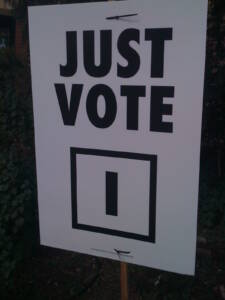
At the 2009 Queensland state election, the Liberal National Party put up posters advocating for voters to ‘Just Vote 1’, but with miniscule identification. A voter could very easily mistake the poster for official instructions from the electoral commission. I photographed one of these posters myself at that election.
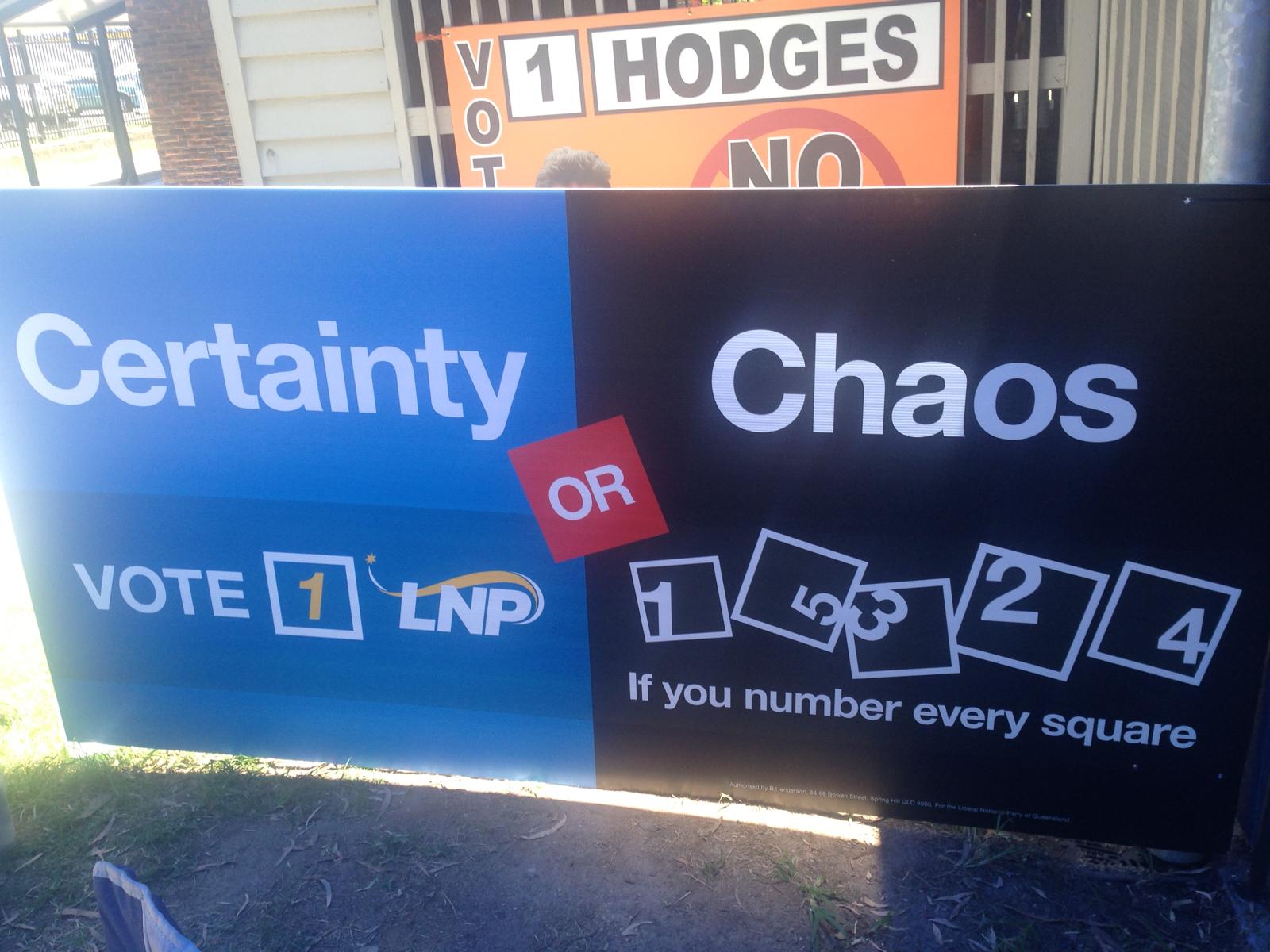 Another LNP poster from 2015 didn’t hide its political agenda, but it tied marking preferences in with potential hung parliament chaos if the left were to win. Those watching on video will be able to see both of these posters.
This second poster was divided in two: on the left it says “Certainty – Vote 1 LNP”. On the right it says “Chaos – If you number every square”. This is illustrated with a bunch of jumbled up ballot paper boxes and numbers.
As of the 2010s the traditional positions had flipped entirely – the Coalition was more likely to be supportive of OPV, although this wasn’t a unanimous position. And Labor had become strong supporters of CPV – the complete opposite of the positions of the Whitlam government and the early Hawke government.
In 2013, Coalition shadow minister for electoral matters Bronwyn Bishop expressed support for optional preferential voting, although Nationals leader Warren Truss rejected the push – the Nationals remain the part of the Coalition most likely to be supportive of preferencing.
In 2020, the Joint Standing Committee on Electoral Matters, with a Coalition majority, issued a recommendation for optional preferential voting, with Labor and the Greens issuing dissenting reports strongly rejecting the recommendation. The South Australian Liberal government also proposed OPV in 2020.
By the early 2010s, there had been no expansions of OPV around Australia for twenty years. But in February 2016, the governing Country Liberal Party changed election laws in the Northern Territory, switching the territory from CPV to OPV.
The subsequent territory election, held six months later, produced a very low informal rate, but was also a disaster for the CLP. They were reduced to just two out of 25 seats, with Labor winning 18.
The Country Liberal Party had even engaged in some of the same ‘Just Vote 1’ tactics we’d previously seen in Queensland. The governing party put up very plain posters that said “Important Election Information: Just Vote 1. You only need to number one box”. The posters had no obvious CLP branding and could have been mistaken for official advice.
The new Labor government brought the territory back to compulsory preferential voting for the 2020 general election, and it remains the system today.
The ‘Just Vote 1’ campaigning showed that it is possible to reduce the number of people who fill out their ballot paper, but there is also evidence that campaigning can also drive up preferencing rates in particular circumstances.
Arguments against OPV have long suggested the system is “tantamount to first past the post” – seemingly based less on practical experience and more on a theoretical assumption that voters won’t fill in preferences if they aren’t forced to do so.
In the early 2010s, Labor experienced two different elections where the party was at a very low point in states using Optional Preferential Voting: in New South Wales in 2011, and in Queensland in 2012. Both elections saw landslide victories for the conservative opposition. And in both elections, there was a notable drop in the proportion of preferences that flowed to Labor. For Greens voters in particular, the party chose not to bother with a preference deal with a party so obviously on track for defeat, and there was a big increase in vote exhaustion.
In 2015, however, there was a big organised effort to encourage voters on the left to mark their preferences at the Queensland election, after three years of Campbell Newman’s LNP government. The rate of vote exhaustion dropped to the lowest level since the ‘just vote 1’ campaign of 2001, and Labor gained 44.9% of preferences – the highest proportion they’d received during the OPV era.
OPV can look like first past the post, but it doesn’t have to be that way. Voters, political parties and campaigners have agency. Voters have a choice, and they can use it if they wish.
A year after that election, Queensland Labor decided it was done with optional preference voting, and they dispatched it quickly.
With a redistribution expected soon, an LNP bill progressed through the hung Queensland parliament, to add extra seats to the Parliament. The Labor government proposed a surprise amendment to switch counting rules from optional to compulsory preferential voting. These changes gained the support of the crossbench, and were passed within hours.
An opposition MP, Ros Bates, described the change as “the most disingenuous act of corruption and bastardry that I’ve ever witnessed in this Parliament”. The LNP’s leader promised to reverse the change if the party won the next election.
The Attorney-General, Yvette D’Ath, argued that the change was necessary to reduce informal votes. While there have been concerns that using OPV at a state level can increase informal voting in that state for federal elections, there would have been no doubt that the change would have increased the informal rate at the state level. And that is what happened. At the 2017 state election, the informal rate doubled to 4.3%.
With no preferences exhausting, the rate of preference flows to both Labor and the LNP went up. But the flow of preferences to the LNP went up a lot more than Labor. One Nation surged back into Queensland politics, polling 12.8%, and their preferences were a valuable addition for the LNP.
Once again, the political parties held positions that had once aligned with their self-interest, but that self-interest was changing once again.
Group voting tickets were first invented in 1983 as a solution to the dilemma of how to reduce informal voting for Senate elections without using optional preferential voting. But by the 2000s, there was an increasing push to get rid of those tickets.
Group voting tickets made it easier for parties to swap preferences and make deals, without having to hand out millions of how-to-votes to voters. As the vote for small parties increased, they were able to use preference deals to allow a party on a small vote to pile up votes and potentially win.
In 2004, Family First won a Senate seat in Victoria thanks to preferences snowballing until they had enough to overtake Labor. Victorian Labor preferenced Family First ahead of the Greens as part of a reciprocal preference deal, and Family First then defeated the Greens. It was generally agreed that this didn’t reflect how those voters would have marked their preferences if they chose their own preferences.
The Greens had supported reform for a long time – the NSW branch of the party had supported reform of a similar system for the NSW Legislative Council following the 1999 election.
But there was a dilemma. Ballot papers had continued to grow since the early 1980s. It wouldn’t be any easier to number every single candidate box than it had been in 1974. At the 2004 federal election, the field of New South Wales Senate candidates reached 78, exceeding the 1974 candidate count.
The New South Wales solution was to allow voters to vote above the line for individual parties, with the vote flowing to all of the candidate in that party, before flowing to all of the candidates in the party marked with a ‘2’, and so on. But New South Wales didn’t require voters to number more than one box.
To properly implement above-the-line voting for individual parties with compulsory preferential voting, it would be necessary for voters to mark numerous boxes – in New South Wales in 2004, twenty-nine groups nominated.
There really didn’t seem to be a solution to the dilemma, and for a while it was something that helped protect group voting tickets from abolition.
In December 2004, just two months after the election that saw Family First defeat the Greens in Victoria on Labor preferences, Greens senator Bob Brown introduced legislation that would have introduced NSW-style preferencing above the line but with compulsory preferential voting.
The bill wasn’t debated in parliament, but it’s hard to see how it could have worked. While voters had gotten used to voting just ‘1’ above the line, they’d need to number dozens of boxes in most states to cast a formal vote.
The Joint Standing Committee on Electoral Matters considered the issue in its routine inquiry into the 2004 federal election.
Amongst a broader conversation about possible electoral reform, it was also suggested that one possible reform to the Senate would be to make it easier to vote below the line – voters were unlikely to use that option when it required numbering over 50 boxes, as in some of the bigger states. The report references some submissions suggesting that a voter following the party’s ticket implied agreement with the party’s preference order – but considering the difficulty in lodging a vote that didn’t follow the ticket, this couldn’t be assumed.
While the report did raise the possibility of optional preferential voting above the line in the Senate, the general consensus remained strongly against OPV. The committee recommended a reform along the lines of Bob Brown’s bill, introducing compulsory above-the-line preferencing above the line.
As the issue dragged on into subsequent elections, pressure continued to build up, and the need to find a practical solution began to weaken the opposition to OPV.
Another bill from Bob Brown in 2008 had abandoned the concept of numbering every box above the line. Instead the bill proposing above-the-line voting with a minimum number of preferences, equivalent to more than half of the seats up for election: four in the case of a half-Senate election and seven for a double dissolution.
Momentum for reform built up after the 2013 federal election, and Nick Xenophon presented a bill that only required a single preference above the line, or as many preferences as there are seats up for election below the line.
The inquiry following the 2013 federal election seriously considered Senate reform as one of the main issues.
The longstanding resistance to OPV had finally broken down, with widespread support for rules that would allow voters to just number one box, or at least number a small number of boxes.
The Liberal Party, Labor and the Greens all supported optional preferential voting above the line, while the Nationals still insisted on compulsory preferences.
Others advocated types of limited preferential voting, where voters would be required to number more than one box, but not all of them. This was a common opinion as a way to improve below-the-line voting.
The Labor submission proposed to require that ballot paper instructions and how-to-votes tell voters to number a certain number of boxes above the line while counting a single 1 above the line as formal.
The committee eventually recommended OPV above the line and preferencing below the line for as many boxes as there were Senate vacancies.
The report was handed down in May 2014, but the government sat on the issue for some time, finally bringing forward legislation in February 2016.
The legislation largely followed the recommendations, with an innovation first suggested by Labor in their submission to the 2014 inquiry – while voters would be asked to number six boxes above the line, one would be enough for a vote to count.
Labor opposed the legislation, as did many of the crossbench senators who had benefited from the old electoral system to win their seats.
But once the legislation was passed, reform of group voting tickets gradually spread across the remaining states who used the system: in every case the state reform was passed by a Labor state government: South Australia before the 2018 election, Western Australia before the 2025 election and Victoria very recently.
Until recently, the conventional wisdom was that OPV benefited the right. The large Greens vote meant that Labor missed out on preferences from Greens voters, while the right-wing vote was more unified.
But in 2025, the Coalition’s collapse in support showed the beginnings of a change – almost 13% of voters cast a vote for a minor party or independent and then preferenced the Coalition over Labor.
Since 2025, the rise of One Nation has muddied the picture even further. A One Nation vote around 10% would’ve caused problems for the Coalition under OPV, but at current polling levels One Nation would begin to push the Coalition out of the top two in many seats, and the preference dynamic would become very different.
In races between Labor and One Nation, preference flows could favour either side, or largely even out. The Coalition would expect to do better on preferences in a race against One Nation, with voters of the left favouring the Coalition.
And in a traditional Labor-Coalition contest, there would be an increasing number of right-wing preferences at play, erasing Labor’s preference advantage.
But more importantly, a lot of these assumptions would vary from place to place. In urban seats, Labor would likely have a preference advantage over the Coalition, while the opposite would be true in more rural areas.
So while a particular party might have a preference advantage in a particular kind of seat, that can’t be applied to a whole state or the whole country.
With over a century of parties determining their positions on the electoral system based on how it might help them, where do they land now?
At the 2026 South Australian state election, One Nation state leader Cory Bernardi announced a policy of supporting optional preferential voting. Bernardi, like Whitlam before him, made the argument on the grounds of personal freedom, arguing that under OPV “people don’t have to, or are not forced to, vote for a party that is against their values”.
It does seem like preferences generally are unfavourable to One Nation now, so such a policy is consistent with a century of self-interest driving political principles.
The Queensland LNP took power in 2024 with a promise to restore OPV to state elections, after Labor changed the system with no notice in 2016. Queensland premier David Crisafulli continues to insist that the policy has not changed, but the government has not yet moved, almost two years into the term.
As the party that sits between One Nation and Labor, the LNP would likely benefit from preferences from either of those other parties if they drop into third. And those preferences would be diluted if OPV was introduced.
But this would not be the first time that a party’s self-interested policy persists after the self-interest has faded away.
Putting aside the question of self-interest, it seems that there are upsides and downsides to both systems.
Optional preferential voting gives voters more freedom to mark as many boxes as they want, and ultimately the power to not mark preferences if they don’t want to. It is also a protection against needing to number the boxes of candidates who they have no opinions about, which could lead to their vote being informal.
Compulsory preferential voting also has its advantages – sometimes a voter may think they don’t want to bother to mark preferences, but genuinely have a preference and miss out on a say in the decisive pairing. And OPV can lead to misleading campaigns to drive down preference flows.
Preferences matter more now, because a lot more of them flow. In an era where most people voted for the two main parties, preferences were a minor part of the system and only decided a few seats. Based on current polling, preferences have the potential to shift the vast majority of seats.
And preferences matter more because of the single-member electoral system. When we elect 21 or 37 members in a single electorate, as we see in the upper houses of New South Wales and Western Australia, preferences play a minor role. At the last New South Wales election, preferences did not change a single seat in the upper house.
For proportional elections in Tasmania and the ACT, where 5-7 members are elected in each district, preferences do matter but less than they do in a single-member election.
This is partly why it was easier to resolve the OPV-CPV conflict in proportional elections – both because there are more candidates on the ballot, and because preferences play a less crucial role.
Short of moving to a proportional system – which is a story for another time – I suggest that we can take a lesson from the Senate reforms of 2016 to find a way through the OPV-CPV split.
Under the Senate legislation, voters are told to number at least six boxes above the line or twelve below the line – but that is not how the votes are counted. Any single ‘1’ above the line or six boxes below the line is enough for a vote to count.
I don’t see why we couldn’t do something similar for the House of Representatives or other single-member systems around Australia. The ballot paper should instruct voters to number a certain number of boxes. There’s no point telling someone to number ten or fifteen boxes, and there would be a certain elegance in copying the six boxes of the Senate system. This would be backed up by an AEC advertising campaign, instructions from AEC staff in polling booths and written instructions on the ballot paper.
But any single ‘1’ vote would count as formal. OPV rules would apply at counting time.
The Senate experience suggests that if voters are told to number six boxes, they will do so. In most cases, that will be enough to keep high numbers of votes in the count, while giving voters the freedom to opt out of the final contest if they prefer, and avoid excessive informal votes.
One extra complication would come in preventing ‘just vote 1’ campaigns as we’ve seen in New South Wales and Queensland.
In Senate elections, preferences flow in all different directions depending on the exact breakdown of the vote. So no party has an incentive to encourage a single ‘1’ vote, particularly with the House of Representatives ballot still requiring a full numbering. But in the House, parties may calculate an advantage in advocating for a single ‘1’ in particular seats or more generally.
Perhaps we shouldn’t go as far as the Langer law of 1990 which criminalised advocacy of a particular method of formal voting. But I don’t think that is necessary to minimise careless voter exhaustion.
In a number of states, parties are required to register how-to-vote cards in order to hand them out near a polling place. If how-to-votes need to be registered, it would then be possible for the Electoral Commission to require all how-to-votes to be consistent with the requirement to number six boxes. It would not force parties to specifically recommend who those preferences should go to, but it would at least mean they would tell voters to number six boxes.
I think a system like this would work pretty well – informal votes would be much lower, and we wouldn’t see the rates of exhausted votes we see in New South Wales. Yet voters would ultimately still have the right to not vote for someone if they don’t wish to.
I don’t think we’re about to see this change in federal elections, but I think the time is right for Queensland to experiment with this reform. The Queensland LNP has promised to restore OPV, but is anxious about missing out on crucial preferences in close races. The ‘just vote six’ hybrid could be the answer.
That’s it for episode three of ‘just vote 1’, and the end for this series. If you liked this turn into electoral history, please let me know. I would like to do more historical research for the podcast, particularly outside of election time.
Thank you to a number of people who helped with historical research including Chris Monnox, Chris Salisbury, Andrew Bartlett, Todd Farrell and a bunch of people on the Tally Room discord.
The podcast will be back next week with coverage of the Victorian and New Zealand elections. So stay tuned for that.
You can find this podcast on your podcast app of choice. If you like the show, please consider rating or reviewing us on Apple Podcasts or Spotify. You can follow me on Bluesky at www.benraue.com. You can now also follow the Tally Room on Instagram, TikTok and YouTube at @thetallyroom.
This podcast is made possible thanks to the generous support of our donors on Patreon. Sign up at patreon.com/tallyroom.
Ad-free versions of this podcast are now available for Patreon subscribers. And if you sign up for $10 or more per month you can join our Discord, where we’re having great conversations about elections.
If you’re a Tally Room member, you can also now access election guides for the next federal election and state elections in New South Wales and Queensland.
Information about this podcast is available at tallyroom.com.au, and you can email questions or feedback to podcast@tallyroom.com.au. Thanks to Chris Dubrow for writing the music you hear in this episode.
Once again, thanks for listening!