

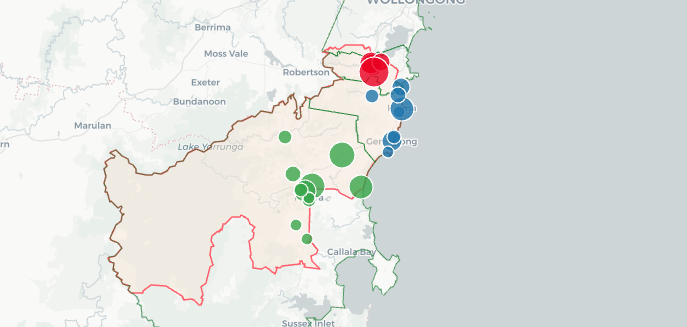
My attention has been drawn to a story from Kiama Council in southern New South Wales, where the council has attempted to avoid filling a vacancy on the council with more than two years left on the council’s current term.
The council is elected at large, with nine councillors representing the entire council area.
In New South Wales, councils can opt in to using countbacks instead of by-elections to fill vacancies, but that process can only be used for the first eighteen months of the council term. Vacancies can also be left vacant for the final eighteen months of the term. This means that by-elections must be used for the middle year of the four year term, and that’s right where we are.
By-elections aren’t a great way to fill vacancies when multiple members represent a district. All of the voters get a chance to vote again, but only one portion of the district has lost their representative. There can be absolutely no change in the partisan make-up of voting patterns yet you can get a quite different result.
In the case of councils where all councils are elected at large (which otherwise has a lot going for it) the scale of the by-election can be far in excess of the value. Every voter in Kiama will need to vote again to replace 1/9 of the council. When there was a by-election for the City of Campbelltown in 2017, a population roughly the size of a federal electorate needed to vote to replace a single councillor.
Which is why I’m an advocate for using countbacks much more extensively, not just for the first eighteen months of the term. I would use them for all vacancies except for the last six months of the term, for all councils, and candidates should be aware of this process when they nominate.
But Kiama Council’s solution to the problems of by-elections is much worse, and shows a shocking disregard for democracy and representation.
Councillor Mike Cains resigned from council in June 2026, triggering a requirement for the council to hold a by-election.
Kiama Council is in the middle of a budget crisis, with the council needing to close a significant budget deficit with cost and service reductions. I experienced this myself when visiting Kiama on New Years Eve last year to discover that their regular fireworks had been cancelled. With this in mind, and the cost of a full council by-election estimated at $200,000, the council has instead suggested that they simply opt out of filling a vacancy.
The council decided on June 30 to ask the minister to allow the council to operate with just eight councillors for the remainder of the term and thus negate the need for a council by-election. The minister has quickly dismissed this idea as not possible. It is worth emphasising that these councillors were elected in September 2024 for a four year term. Cains resigned about 44% of the way through his term.
I think this is a disturbing reflection of how a lot of local government looks at their role of democratic representation – if councillors are simply a board of directors it makes perfect sense to just leave a seat vacant. But councillors represent different political interests and vacancies should be filled.
$200,000 may seem like a lot, but I think it is a pretty important part of local government. Without democratic representation, local government might as well be fully integrated into state government. For a council like Kiama, which is relatively small and is struggling to demonstrate its ability to financially stand on its own, it would be nice for them to show that they value their connection to their voters.
It also demonstrates the flaw in having councils directly pay for their own elections. Councils struggle with a limited revenue base and an ever-increasing demand for them to use their resources, with state and federal governments in a far more powerful position financially. It is understandable that councils would skimp on proper democratic processes. It would be far superior for the base-level costs of running elections to be covered by the state government outside of council budgets as a guarantee of democratic excellence.
Thankfully Kiama hasn’t succeeded in their push to cancel local democracy, but it is a good reminder of the problems with using local by-elections when a countback would be far superior. There is legislation sitting before the NSW parliament which would change how councillor vacancies are filled. The proposed process is convoluted – instead I would urge a change to simply make countbacks universal where they can be applied.

Could “gambling reform” announced today, be the beginnings of a Grand Coalition CDU-SPD German style?
Interesting democratic outcome.