

Readers will be aware that I have long advocated for proportional representation methods to be used when electing Australia’s parliaments, and I have extensively laid out the issues with the use of single-member electorates.
The recent South Australian election was off the charts for disproportionality, with a government winning an enormous majority with less than 40% of the vote. Two right wing parties split the vote between them fairly evenly, and won very few seats from that vote.
From today’s post, I am going to look at how that disproportionality compares historically, and look at what the result could have looked like under some kind of proportional representation (PR) system.
The most widely-accepted method of calculating disproportionality is the Gallagher index of least squares. This method compares each party’s share of the vote and share of the seats and adds up the differences. A score of 0 would indicate precise proportionality between seats and votes. Say, every party received exactly 100 votes per seat. I have previously analysed the Gallagher index for a number of Australian jurisdictions and you can find those posts here.
South Australian elections have been steadily increasing in disproportionality in recent decades with occasional spikes. The previous high of 20.65 took place in 1993. The Liberal Party polled just over 50% with Labor just over 30%, but won 37 seats to 10, with 9% of the vote going to the Democrats for no seats.
But the 2026 result is off the charts, with a score of 28.4. By comparison, the 2025 federal election produced a score of 23.1 if the Coalition is treated as separate parties, or 22.1 if the Coalition is treated as a single party.
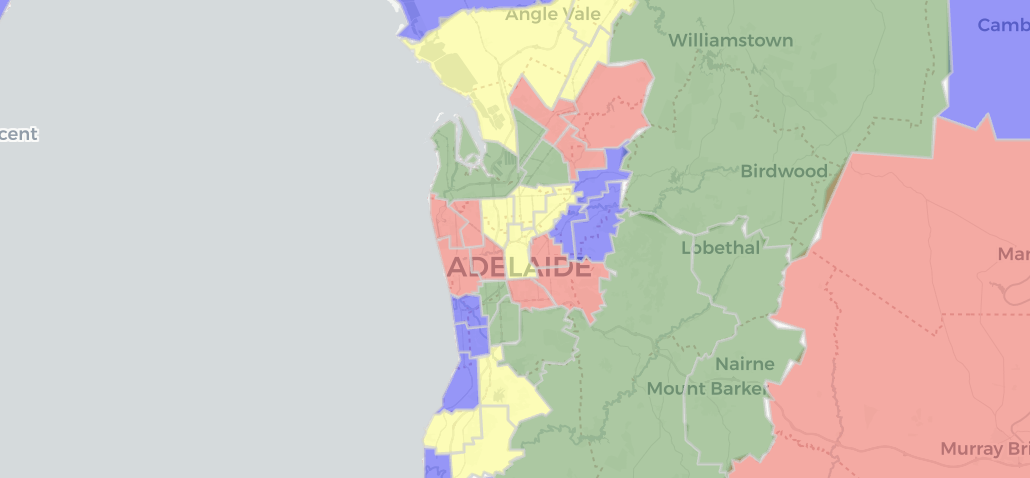
To give a sense of what could be possible under a proportional system, I have split up the 47 existing electorates into three maps based on different magnitudes (the number of members per electorate) – three, five or seven. Unfortunately 47 is a prime number so it’s not possible to make every seat the same magnitude, but I made them as close as possible. I refer to those maps as M3, M5 and M7, while the actual electorate map is M1. I have then taken the actual 2026 results, and the 2022 results matched to the current boundaries, merged them into the multi-member electorates and estimated who would have likely won each seat.
Now I should note that this is just a simulation. A different electoral system would undoubtedly lead to changes in the party system and how people vote. But still, it is interesting to see how a given vote spread produces different results under different systems.
I would also ask you to not put too much importance on the specific electoral boundaries or the names. I have tried to draw them in a sensible way, but if real electorates were drawn they would be drawn afresh, not just merging existing electorates, and there would be opportunity for those with local input to feed in.
Having said all that, this map shows the three maps I drew. Adjacent seats in the same colour are merged into the same multi-member electorate. You can click on any seat to see the result for that merged electorate at the 2022 and 2026 elections.
I conducted a similar exercise using the results of the 2019 and 2022 federal elections.
One thing that jumped out was that fragmentation goes up as the average magnitude increases. Under an M3 model, the result is reasonably proportional, but does give a small winners bonus to larger parties, compared to a purely proportional result.
This chart shows the results of the three models in 2022 and 2026, compared to the actual result and a purely proportional result.
The scale of Labor’s victory beyond their vote share in 2026 really stands out. Their proportional share of seats would have been 18 seats, but they actually won 34 seats – almost double. The disproportion was much less in 2022, when they won eight more seats than their proportional share.
The M3 model in 2026 still leaves Labor with a slim parliamentary majority, but in every other proportional scenario the Labor government usually ends up slightly short of a majority. Yet there is always a progressive majority.
Meanwhile, on the right, One Nation would have won more seats than the Liberal Party under any 2026 model. Once there is even some basic proportionality, the higher One Nation vote means they win more seats. One Nation piled up a lot more votes than the Liberal Party in seats they didn’t win, but once there are 3-member electorates, there’s usually at least one right-wing seat in each electorate.
The performance of One Nation is particularly notable. You see a lot of anger at the electoral system from One Nation supporters, but pretty much none of it seems to be directed towards improving proportionality. Instead it is usually focused on preferences. A wide variety of parties would benefit from a more proportional system. At these recent elections, it would have benefited all parties other than Labor. The Liberal Party has a lot less room to fall if results are proportional, and the Greens and One Nation can win their fair share.

Thanks Ben,
I too have always been a supporter of PR and it does seem as we are coming close to the end of the current electoral system. As your analysis of the SA result shows it does mean permanent coalitions of Left and Right as compared to Labor/Liberal rotation.
The irony is that many of us thought Pasokification would come for the ALP first but it appears to be happening with the Liberal Party first. The recent decline in the ALP primary vote suggests it will ultimately happen to both of the “major” parties though.
A grand coalition in the future between Labor and Liberal cannot be ruled out to stave off a future change to the voting system to PR.
Ben
I am assuming that all Independents are lumped together so that there is a sort of “Independents Party”. In that case, is the number of seats for Independents actually overstated as it is hard for independents to be elected when geographical areas and voter pools are much larger. Do you agree with that hypothesis?
@Redistributed, yes that is what I had to do. It’s imperfect but I don’t think I’m necessarily overstating the independent vote. Some of those independents could have gained votes in neighbouring seats, and some of them do have some ideological similarities. Tasmania does demonstrate that independents can thrive in multi-member electorates.