

Last night’s election was truly remarkable. Preferential counts had little value, as we grappled with a truly astounding number of three-cornered or even four-cornered contests.
By this morning, we have a fairly good sense of what is going on, but there is still quite a bit that is unclear. Some pre-polls have reported, but others are yet to report, which could shift some seats. This post is based on early on Sunday morning – some of these statistics will change as the pre-poll and postal votes are added.
In this post I’m going to run through some summary statistics about what happened last night, along with some maps, and then run through the seats where is serious uncertainty about who has won.
This result was truly disastrous for the Liberal Party. By my count, the Liberal Party has won four seats and is leading in a fifth. That would be less than a third of the seats they won in 2022.
The party failed to crack 10% of the vote in 15 seats (almost a third of the state).
There were two seats where the Liberal candidate came fifth, and seventeen others where they came fourth. The party only reached the top two in seventeen seats.
Labor topped the primary vote in 35 seats, and I also have them currently likely to win 35 seats. One Nation was first in seven seats, but right now it looks like they are more likely to end up on about 3-4 seats. So I suspect preferential voting will be shown to have a slightly negative effect on the party.
This first map shows the primary vote for the four biggest parties across the state.
The Labor vote was unsurprisingly highest across Adelaide, while the Liberal vote in northern and southern Adelaide hit extreme lows. As expected, the One Nation vote was highest across regional South Australia, and then encroached into the outer suburbs of Adelaide. Central Adelaide still looks a bit more like a conventional Labor-Liberal contest.
This next map shows the primary vote swings for Labor, Liberal and Greens. I haven’t bothered with One Nation since there were many seats they didn’t run in last time – safe to say they got big swings everywhere that is calculable.
Labor had slight backwards swings across most seats, but did slightly increase their vote in most seats in the central third of Adelaide.
The Liberal Party suffered swings in every single seat. The biggest swings are shown in pale colours – they were in regional South Australia and on the eastern side of Adelaide.
We didn’t get much useful preference data last night, but there is still a lot of interesting information in who is in the top two in each seat. By my reckoning, these are the number of seats with a given 2CP pairing:
- ALP vs ON – 18
- ALP vs LIB – 9
- LIB vs ON – 4
- ON vs IND – 2
- Unknown – 14
That is 14 seats where we can’t say who is in the 2CP for now. Some of those may well end up being classic Labor-Liberal contests, but it’s still remarkable that just nine seats fit that conventional classic seat mould.
Of those unknown seats, it includes nine seats where Labor has won but we don’t know who will come second. In those seats, it is mostly of academic interest who comes in the top two. But in the other five, it will matter a lot. I will get to that further down.
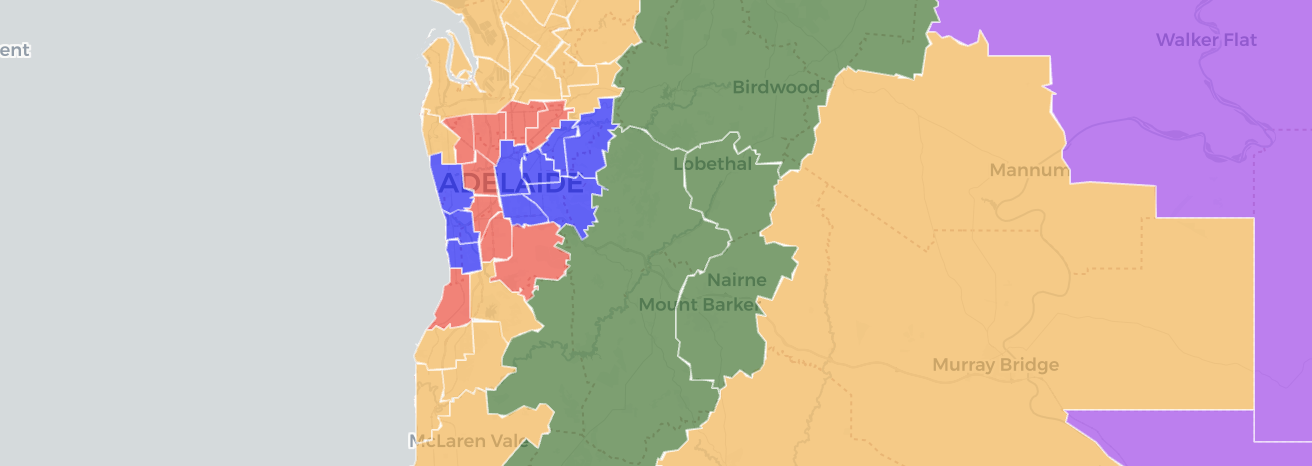
This map shows which of these 2CP pairings applies in each seat. You can also toggle to see the (likely) winner in each seat. Where the result isn’t called, the likely winner is in a lighter shade.
The classic Labor-Liberal contest is now solely present in the central third of Adelaide, although even here there is a number of seats that may not fit that category. In West Torrens, for example, the Liberals have come fourth and the Greens and One Nation are in a close race for second, with Labor way out in front.
Labor-One Nation contests dominate northern and southern Adelaide, plus Hammond and Giles. The Liberal vote is so depleted in many of these seats that there is no prospect of them making the final count.
The Liberal-One Nation and One Nation-Independent contests are all in deep regional South Australia.
And then the seats where we don’t know the 2CP – the nine where Labor has won are all in central Adelaide. These are seats where Labor has a clear lead, but the Liberal Party may fall behind the Greens, One Nation or both. The five where the result is unclear all lie in a band in regional South Australia immediately to the east of Adelaide.
So what seats are still in play?
By my reckoning, these are the seat counts by party:
- Labor – 30 + 5 leading
- Liberal – 4 + 1 leading
- One Nation – 3 leading
- Independent – 4 leading
This is not precisely the same as the ABC or Poll Bludger but not far off.
That leaves 13 seats that are uncalled. They fall into three types. There is just one seat where we have a clear 2CP count that is simply too close. There are another seven seats where we need the ECSA to conduct a different 2CP count, but it’s clear who the top two are. There are then five seats where we would need a 3CP or even a 4CP to clear things up, and probably will need to wait for a full distribution.
In Morphett, Labor is on 55% of the 2PP, but we don’t yet have the pre-poll vote, so it’s possible the Liberal Party could catch up.
There are four seats where Labor and One Nation are in the top two and we have no 2CP count:
- Elizabeth
- Hammond
- Light
- Mawson
The ABC and Poll Bludger have called Elizabeth and Mawson for Labor and they are probably right. On my system I have them as “likely” rather than “leading”. One Nation are favourites in Hammond and Labor in Light, but we really could do with real preference data.
We need an Independent vs One Nation preference count in Stuart and Mount Gambier. The independent is the favourite in both. Geoff Brock is a strong favourite in Stuart. But I’d like to see a preference count.
And we need a Liberal vs One Nation preference count in Narungga. Poll Bludger has called this seat for One Nation, and ABC has Liberal ahead. I just don’t think we have enough data to call it either way.
Then we get to the five most complex seats.
In Finniss and MacKillop, we need a 3CP between Liberal, Independent and One Nation. In MacKillop, One Nation is well out in front and are the favourite, but Labor and the independent could feasibly overtake the Liberal. In Finniss, there is a close race for first between Liberal and One Nation, but independent Lou Nicholson isn’t far behind and should benefit from Labor preferences.
In Heysen, we need a 3CP between Labor, Liberal and Green. This seat resembles seats like Ryan, Macnamara and Prahran. If the Greens can get into the top two they will likely win narrowly, but right now they’re behind Labor, who are winning narrowly.
In Ngadjuri, we need a One Nation, Labor and Liberal preference count. The primary vote has a close three-way split with One Nation leading. If Labor falls into third, the Liberal could win. I would expect One Nation to win if the Liberal falls into third.
And finally Kavel is still the hardest to pick. I don’t think a 3CP would solve this seat. We are still waiting for the pre-poll, but right now Labor is leading, an independent is second with One Nation and Liberal not far behind. The independent is the favourite if he can stay in the top two.
That is enough for now – I will probably put up some new posts early next week when we have more complete numbers and hopefully some fresh preference counts. And when we have the final preference counts, there will be a lot of fresh data to analyse which should hopefully help in future elections.

Labor winning a second term with an increased majority was expected and unsurprising.
Labor scored their biggest swings in marginal Labor and marginal Liberal seats. There were 2PP swings of >8% in their 2022 and 2026 pickups in middle Adelaide. It’s striking that the Liberals came 4th or 5th on primary votes in seats that they held pre-2022 or were once Liberal heartland e.g. Black, Davenport. The Liberals also suffered the biggest swings in Waite and Davenport – both seats of former Liberal leaders.
Regarding northern Adelaide (Elizabeth, Light and Taylor) – they are traditionally safe Labor seats but there was mention on Tally Room pre-election that One Nation could make big gains. I knew that the Liberal primary vote would collapse and One Nation would take over. However, I underestimated the drop in the Labor primary votes and so I didn’t see the close 2CP counts coming. I’d say the strength of the Labor brand and the premier’s popularity likely saved Labor. Light is probably too early to call.
What saved Labor in the southern suburbs (Kaurna, Reynell, Hurtle Vale) was that the Liberal primary vote got smashed harder than Labor’s. Labor’s primary vote was dented but not as much as in the outer north. Labor suffered double-digit primary vote swings in Elizabeth, Taylor and Light and even greater swings than the Liberals.
Comments are closed.