

There has been a lot of conversation recently about implementing fixed four-year terms for the federal Parliament, with Anthony Albanese indicating support and some reporting that Don Farrell, the special minister of state, is considering whether to move on the issue.
For this blog post I want to look at one particular fact that has been presented in this debate: the average length of parliamentary terms. While the quoted figure of two years and eight months is technically accurate over the entirety of Federation, recent political history (say, over my lifetime) paints a very different picture.
In reality, most parliamentary terms now last for roughly three years, with only a handful of exceptions in the last three decades.
For this report I will only be looking at the time between House of Representatives elections. When Senate elections were held separately from House elections in the 1950s and 1960s the regularity of federal election events were far more regular, but that’s not the point of this exercise. It is also consistent with how others have measured term length.
I have seen this statistic quoted in a few places, but most regularly by Marty at 4 Year Terms Australia. It is referenced on page 8 of this report.
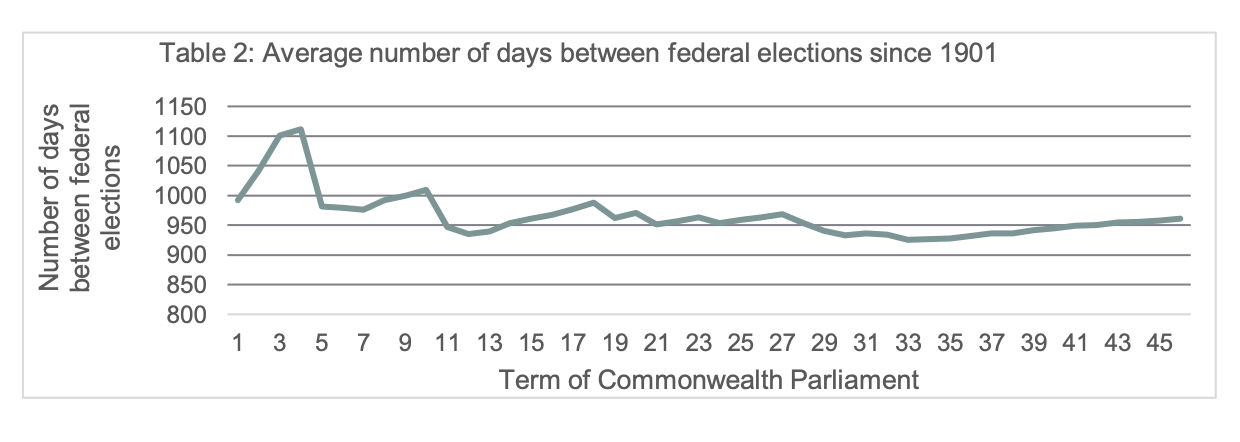
The issue with this graph is that it is cumulative, so the early data only covers a short time period while the later data covers the entire period. So the most recent data is weighed down by one and a quarter centuries of federal politics. Despite this, you can see that the line has been climbing ever since the 33rd parliament (1983-1984) – that means most parliaments have had terms above the long-term average.
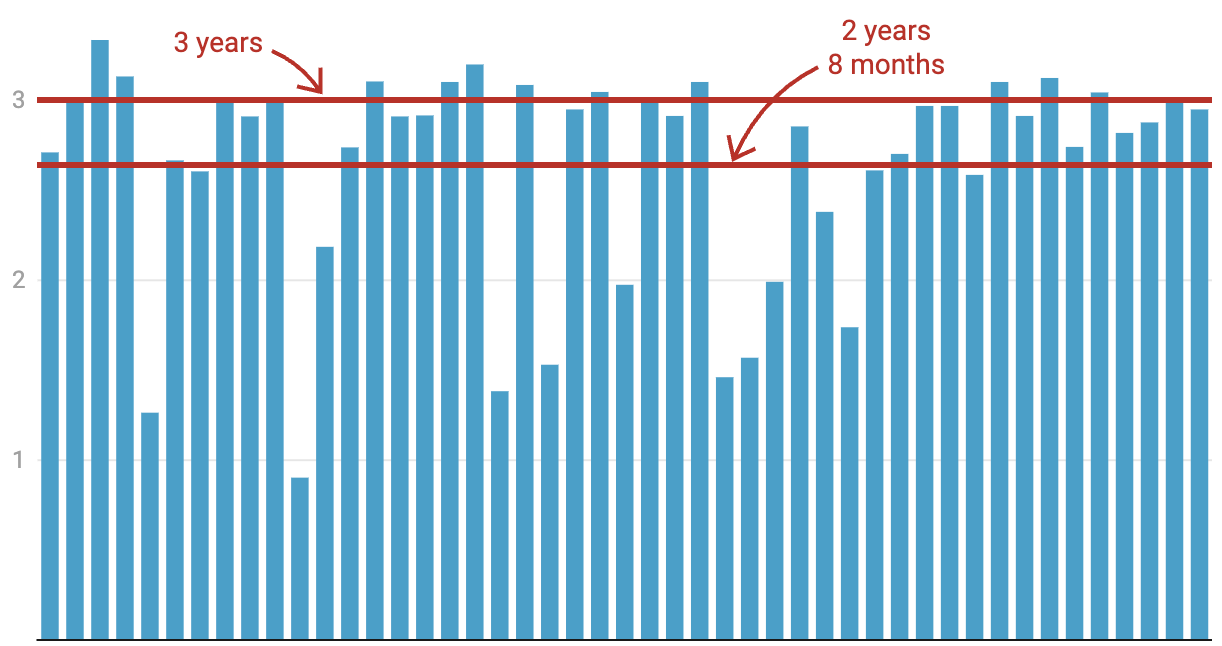
I’ve calculated the length of parliamentary terms myself, and this next graph shows each individual case. I’ve also marked the 2 year 8 month mark and the 3 year mark.
There are lengthy periods throughout federal history when parliamentary terms are consistently close to three years. Indeed, prior to 1949, only three parliaments ended up being notably short: 1913-14, 1928-29 and 1929-31.
There was a number of short terms in the 1950s and 1960s, and then in the 1970s and early 1980s full-length terms became the exception.
Yet in my lifetime, every parliament has lasted at least two-and-a-half years, and most quite a bit longer. The 1984-87 and 1987-90 parliaments were ended a few months short of three years, but since then only the elections of 1998 and 2010 were significantly short. Even still, they would have been considered close to full term by the standards of the 1970s.
Putting aside the 1998 and 2010 elections, which brought forward the election schedule in a way that future elections couldn’t catch up, other elections since 1993 have averaged out to pretty much exactly three years. Some are slightly early, but some are slightly late.
The length of terms are also much longer if you look at the median rather than the average. The chart above makes it obvious why: while there are some outlier terms which are much shorter, it is impossible to have outlier terms on the longer end. Over the entirety of Federation, the average term is 2.64 years, but the median term is 2.91 years.
Since 1990, the average term length is 2.91 years, but the median is 2.95. Most elections are held roughly on time.
This shift in election timing is even more obvious if you divide the 125 years of Federation into five 25-year periods.
The second half of the twentieth century was a particular period of parliamentary instability and short terms. Perhaps this explains the increased interest in fixed terms which led to so many states introducing fixed terms around the turn of the century.
So next time you hear someone say that parliaments only last two years and eight months, stop and think. This is based on parliamentary instability that had ceased about forty years ago. Anyone who is actively involved in federal elections has a lived experience that elections generally take place about three years after the last one.
Now I am not an active opponent of reform in this area.
I am agnostic on the question of four-year terms for the House, and my position would probably be decided by what the reform would mean for Senate terms.
On the question of fixed terms, I think the main issue is the annoying period of speculation as we wait for the Prime Minister to announce the date. They generally go for a predictable date close to three years after the last election, but hold their cards close to the chest. It produces a tedious media speculation window, but it also creates significant uncertainty for political campaigners and policy-makers. I hear from public servants that new activity usually dries up as the theoretical election window opens up.
I am not necessarily opposed to fixing terms, but I think there’s more we can do short of constitutional reform. In particular I see no reason why prime ministers can’t just announce the date as a political promise that they can be held to.
New Zealand has had a tradition since 2011 of the prime minister announcing the election date near the start of the year, with the election usually held in September-November. This started in 2011 as John Key wanted to make clear that the election would not clash with a home Rugby World Cup, but people liked it enough that it stuck around.
Every subsequent election has been announced no later than March. Typically the PM announces the date when they return from their summer break. This is not taken to be the start of the election campaign, but rather a choice by the prime minister to let go of their prerogative to decide the election date as late as possible.
Julia Gillard did try something similar in 2013, announcing on January 30 that the election would be held on September 14. This triggered a wave of commentary that treated this announcement as kicking off the “longest campaign ever” when it was nothing of the sort. When Gillard was replaced as prime minister, Kevin Rudd called an election one week earlier, if only to make the point that Gillard’s announcement did not bind him.
While Gillard’s defeat seems to have led to this idea gathering dust, I think it’s worth dusting off and trying again.
Next time the Prime Minister says he’s a fan of fixed terms, journalists should ask him “why not just tell us the date now?” It is entirely in his power, and he can do it when he wants. Or he can set a schedule to announce an election date in the second half of 2027.

Great post, Ben.
Such a good point re median V average, and I agree, the reality is the speculation (and the effect this has on the political class and public servants) makes it ‘feel shorter’.
The uncertainty for business, and the effect on consumer confidence are also extended as a result of the election speculation.
Is it worth Australia moving to fixed three year term via legislation – Wouldn’t need a referendum, and gives more certainty on the election date? Of course, can always be un-legislated so perhaps not effective.
Loved your question at the end for Albo at the next presser.
Yes, the longer terms are caused by the revolving door of Prime Ministers this century.
We haven’t had a Prime Minister serve even 8 years this century so far, and we’ve had 8 Prime Ministers in fewer than 25 years!
While i support Fixed terms i dont think think there is any appetite for a referendum this decade to change the length of the term to 4 years.
It’s not clear to me if legislation could bind a prime minister. But it would certainly send a strong signal that would be harder to ignore.
@Julian only three Prime Ministers this century have served a full term from one election to the next; Howard twice from 2001-2004 and 2004-2007, Morrison from 2019-2022, and Albo from 2022-2025.
In NSW state politics, it’s far more dire; no Premier has served a full term since Bob Carr from 1999-2003. That’s why I like to joke that the position of NSW Premier is like the Defence Against the Dark Arts teaching position at Hogwarts; both are cursed.
CJ, Chris Minns if he leads Labor to the next election in 2027 (which is highly likely) will join Bob Carr and become the first one to break the ‘curse’ of NSW Premiers only serving partial terms in office.
We could pass a Law banning elections in May, freeing that month up for the Federal budget, so that Supply is always passed before end of FY. This would mean that elections would generally be in March (my preferred date – see 1990, 93 & 96) or less likely in October. The problem with half senate elections in the 2nd half of the calendar year is that the winning party needs to wait until the following July for the new Senate to take office.
Hopefully Albo calls the election for March 2028 (and perhaps he could hint at that in late 2027) and then we will be back to having March elections on a regular basis. Howard stuffed it up by calling 1998 about 5 months early for no good reason….
The problem with March elections is that we now have quite a few state elections fixed in that month – WA, SA, NSW. I don’t see a problem with May elections. They just need to permanently move the budget to fit around that.
I’d note the conflating of ‘4 year terms’ with ‘fixed length terms’. These are completely separate issues; it would be perfectly valid to propose to legislate a fixed three year term.
In fact, what’s actually going on is a quid pro quo deal. The proposal is for the Prime Ministers to get something (a 33% increase in the time in which they avoid an election and the possibility of losing power). To get this, they are offering to give up their ability to call an election early. The fact that they feel it’s necessary to offer a quid pro quo indicates, to me, that they feel the gain is substantial.
And you have noted that they are giving up something relatively minor – modern parliaments effectively go full term and there are only a limited number of days on which an election can practically be called.
3 year terms are a compromise between the 2 year Terms of the US HoR and the 4 year term of the Executive, to suit a system where the executive is drawn from the majority party in the Legislature.
Fixed terms would deny the legislature being able to force an unpopular government to an election, as happened in 1929 or change government without an election, it happened in 1941.
Then there’s the issue of 8 year Terms for Senators, not many would vote for that, apart from Senators.
To be clear, I am not conflating anything. But they are related, because if you think 3 year terms don’t really translate into 3 years, you might think extending the term length is a solution to that problem.
Gympie, I don’t think fixed terms necessarily prevent a government falling and a new election being called. NSW and other states have ‘baton change’ provisions which give the opposition a chance to call an election if the government loses a confidence vote, but if that doesn’t work they can go to an early election. But if you’e talking about a government with a clear majority being forced to an early election, well that can’t happen anyway.
Perhaps 3 years is the ideal length of time to elapse before a government asks for a new mandate?
There’s been 17 British GEs since 1959, average length 3.82 years.
Carr being the only NSW premier to survive in the job a full term could indicate that Governments get into the doldrums after less than 4 years there and the caucus turfs the leader as a way of kicking the can down the road. 4 years suits an Andrews type, he governed as a dictator anyway, would work for Albanese, he is similar.
Agree Ben, I think May elections are a good compromise with having the budget released early in the year (Feb/March) as an alternative.
My concerns with the current system are:
1) I don’t see any reason a priori that we can’t go back to the old normal of more variable term lengths, even if they’re currently stable.
2) I don’t see any real political function for ruling parties being able to choose the election date. It just adds a slight and unnecessary extra incumbency bias (if the ruling party is competent).
3) Uncertain term lengths lead to economic uncertainty. I know for a fact that this uncertainty has a non-trivial (albeit not massive) effect on equity price, for example.
I found 4 Year Terms Australia’s evidence before the JSCEM quite overblown. They seem tremendously concerned about Prime Ministers setting election dates but what this debate hasn’t in my experience engaged with is the way in which the constitutional requirements actually bind governments in so choosing. We do have fixed terms already in one respect: Senate terms are fixed. A half-Senate election can be held at any time in the final year of a Senate term but the terms of the Senators then elected do not start until the 1st of July. And despite frequent tedious speculation of the House and Half-Senate electoral cycles falling out of sync in the future, the incentives are firmly against this as it is generally assumed (correctly, I think) that any government that attempted such a thing would be harshly punished by the voters for daring to send them to superfluous elections.
So we’re actually splitting hairs over a handful of months. It sounds very ominous to say that the government sets the date of their own election but they’re significantly restricted by the timing of the Senate, by public holidays and other major events (go ahead, call an election on Grand Final Weekend and see how that works out for you), and by the logistics of completing the count in time (which rules out the month of June entirely). And as a practical matter, when whispers of opportunistic timing of elections spread it is invariably that the election was “too early” which brings in some elements of the Hangman’s Paradox: it can’t ever be a surprise because it will always be left too late to allow for any other option.
https://www.tallyroom.com.au/63707#comment-863396
Under the current system there are chances for the House of Reps and Senate elections to fall out of sync with each other:
A government loses a no confidence motion and is forced to a House-only election early.
A government holds a DD election (where the gap between the 1st of July and election day is significant, shortening the Senate terms) and then polls very badly towards the end of the following term of the short-term senators and so decides to take the hit and have separate elections to stay in office months longer.
Oh I’m well aware that there are chances for it to happen, it has happened in the past and there’s nothing structurally preventing it from happening in the future. I’m arguing that you don’t need anything structurally preventing it. It’s a consequence of flexibility, and some amount of flexibility still exists even in many fixed term models.
For example, suppose a government does lose a no confidence motion. Does the fixed term model insist that we persist with an unworkable House? Does it require the commission of an alternative government? What if that government fails to command the confidence of the House? Does it require that the Senate be dissolved (or half of it?) even though there’s no issue with the Senate in this scenario? You have to resolve it one way or another, and the way the existing system chooses to do so is not even necessarily incompatible with some models for “fixed terms” that permit exceptions in cases such as no confidence motions.
Your second example is honestly what I meant by “tedious speculation” because it is the situation we currently find ourselves in. Since the 2016 double dissolution, the Parliamentary terms have been such that half-Senate elections must be held by May at the latest but the House election may be held by the following September. All three elections since have accordingly been held in May. I categorically disbelieve that any government, of any political stripe, would under these conditions actually attempt to stay on for the four additional months and I feel this view is bolstered by the evidence of both Coalition and Labor governments not doing so. If any future government were so foolish to attempt it, they would doubtless be kicked out by wide margins in September, and their successors would have no great difficulty in resyncing the cycles by calling the next election to coincide with the half-Senate election. And, 4 Year Terms Australia would doubtless claim this as further evidence of shorted Parliamentary terms.
Comments are closed.