

For the final blog post of 2025, I wanted to look at a question that has come up regularly in the comments, and on psephological websites: how meaningful is the two-party-preferred vote, particularly in “teal” seats where Labor isn’t locally competitive, yet is either winning or coming close to winning the two-party-preferred vote.
In this post I am going to examine a number of different ways of considering whether voters who mark Labor ahead of the Liberal Party in these seats where the Liberal Party and ‘teal’ independents are competing, and thus the Labor preference does not impact the result. In general I find that the evidence suggests similar 2PP voting patterns in similar areas, whether they are classic Labor vs Liberal contests or Liberal vs independent contests.
For this blog post I am mostly focusing on the ‘teal’ seats which I define as Bradfield, Curtin, Goldstein, Kooyong, Mackellar, Warringah and Wentworth. Six of these seven seats were won by independents in 2025. Goldstein is a classic teal seat and had a sitting MP in 2025, so I’ll include it even though the Liberal Party won the seat. At times this blog post may also include Mayo and Indi in the analysis. These regional seats are also held by similar MPs, but as large regional seats have some significant differences.
All of these seats were, until relatively recently, strongholds for the Liberal Party. Labor had not seriously challenged these seats, but in recent years the rise of independents nicknamed ‘teals’ has seen the Liberal Party lose most of these seats. It has also produced a big increase in the two-party-preferred vote for the ALP.
This first chart shows the Labor two-party-preferred vote in the teal seats compared to the national 2PP, and there is a sudden uptick in 2019. It seems like the two-party-preferred vote first rose in seats with sitting crossbench MPs or a strong independent campaign in 2019: Mayo, Wentworth and Warringah.
There was discussion prior to the 2025 election about the meaning of the ALP gaining such a high two-party-preferred vote in these seats. The issue came up around Mayo MP Rebekha Sharkie’s discussion of her intentions in the case of a hung parliament. Sharkie did not seem to be aware that a majority of voters in her electorate had ranked Labor above Liberal.
This data could be used to argue about whether voters in a particular electorate would prefer a Labor government over a Coalition government in a hung parliament situation, and they have broader implications around where these electorates sit in Australia’s evolving political divisions.
But there has been scepticism from some psephologists around whether these numbers mean anything. I have heard this scepticism from Malcolm Mackerras and Antony Green amongst others. It can be hard to believe that places that were once so crucial to the conservative coalition could have moved so far so fast. I also saw some scepticism particularly focused on the idea that Labor won the 2PP in Bradfield, but that does appear to be true.
So what is the theory I am trying to test here? I think this is the best way to state the case.
In electorates where the main contest is between a Liberal and an independent, that is the focus of the voters’ choice. Thus they devote less thought to their remaining preferences, and a high Labor two-party-preferred vote does not reflect voters’ genuine intentions.
Of course we can’t know how people would vote in different circumstances, but I think we can test this hypothesis in a number of ways.
First of all, I want to examine two seats where a redistribution combined areas previously contained in a teal seat with neighbouring areas contained in a classic seat (in both cases, one won by the ALP in 2022 off the Liberal Party). These two seats are Bennelong and Kooyong.
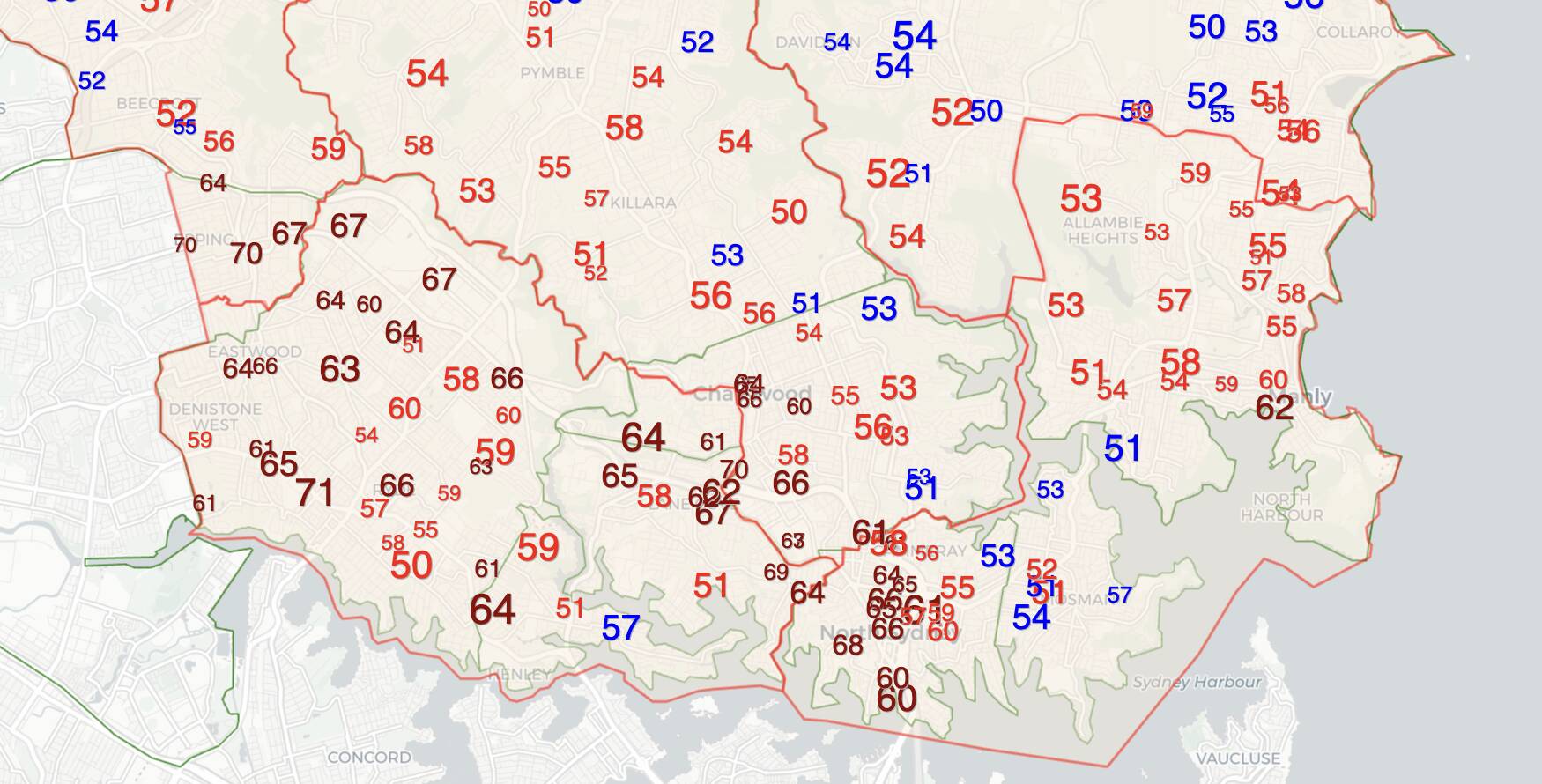
Firstly, in the seat of Bennelong, this map shows the two-party-preferred swing in each booth in the electorate (you can also toggle to see the result).
The redistribution in Bennelong is quite easy to understand. The seat’s eastern border used to follow the eastern border of the City of Ryde, with the neighbouring Hunters Hill and Lane Cove council areas contained in Kylea Tink’s seat of North Sydney.
Labor did quite well on the 2PP in North Sydney in 2022, polling 48.7%. If the above theory was correct, you would assume that some of those voters who put Labor above Liberal on the 2PP did so in an unthinking way. You would then assume that when these areas were added to Bennelong (a seat with a sitting Labor MP) and they changed their focus to the Labor-Liberal contest, those areas would swing by less than the areas that were already in Laxale’s electorate. Yet that is not at all the case. The booths in Lane Cove fall well within the range of booths in the pre-existing part of the electorate. It is also very evidence in this scatterplot, where I have highlighted newly-added booths.
Next we turn our focus to Kooyong. The change was in the opposite direction: Kooyong took in a big chunk of Higgins. Both Kooyong and Higgins were demographically similar prior to the latter’s abolition, and you could have easily imagined a teal candidate winning in Higgins in 2022, but they did not run, and it was won by Labor’s Michelle Ananda-Rajah.
If the above theory was right, you could imagine that voters in those parts of Toorak would not focus so much on the Labor-Liberal contest, and would be free to preference Labor over Liberal. Yet that is not what happened. There was a swing to the Liberal Party in these booths, while the Labor 2PP went up across the rest of Kooyong.
Now there are other reasons why this might make sense – the sitting Labor MP did not run in the area after her seat was abolished, instead switching to the Senate. So the Labor campaign in that area would have been much diminished without a winnable contest. But still, it does show that two-party-preferred figures in teal seats do have a relationship with reality.
Next up, I am going to examine demographically-similar areas on either side of the border between a teal seat and a classic seat, in three areas.
Firstly, let’s go to the eastern suburbs of Sydney. This next map shows the two-party-preferred figures across Sydney, Wentworth and Kingsford Smith. You can also see the swings but I am now focusing on the absolute 2PP, since these are all areas where the independent has been present for at least two elections.
I’d like to draw your attention to the border of Wentworth and Kingsford Smith, which runs through the suburbs of Clovelly and Randwick. On the Kingsford Smith side of the border, the Labor 2PP is in the low 70s. On the Wentworth side, it is in the 50s. Now this is not surprising – Labor would have been far more active in Kingsford Smith and hold the seat. But this is not consistent with the above theory! Labor is winning a 2PP majority in Wentworth despite such a big drop-off in these areas!
Heading back to Kooyong, the south-eastern suburbs of Boroondara council are split between Kooyong and the classic seat of Chisholm, yet the 2PP is similar across this whole area.
And then returning to the northern suburbs of Sydney, you see similar trends cross the Bradfield-Berowra border around the Hornsby area. And there is a belt of strong Labor 2PP results (over 60%) stretching across the lower north shore from Lane Cove to the western half of North Sydney council. These booths were all previously contained in the teal seat of North Sydney, and are now split between three seats: two teal and one classic. Yet the 2PP is similar across the region.
Finally, I wanted to examine the Senate. We don’t have an easily-accessible equivalent to 2PP for the Senate, and I obviously can’t just compare Labor 2PP to Labor’s Senate primary. So I have grabbed the primary for both Labor and the Greens as the two main left-leaning parties running for the Senate.
There is a very strong relationship between these two metrics, outside of the ACT.
The teal seats are within the normal range of results, although they are at the lower end of the band.
The same is true for a handful of select neighbouring seats like Bennelong, Berowra, Chisholm and Kingsford Smith.
Interestingly, if the above theory had any truth, you’d expect these seats to be at the top of the band or higher, but they tend to have a relatively low Labor 2PP compared to the combined Labor-Greens two-party-preferred vote. Perhaps this does show that the lack of a strong local Labor sitting MP in those teal seats (as well as others like Berowra) is pushing the 2PP down, rather than it being inflated by another contest.
Another example to consider is the seat of Berowra. This seat is adjacent to Bradfield, and did experience a challenge from a teal independent in 2025. Tina Brown came fourth, with 11.4%, but Labor came surprisingly close to winning. They ended up on 48.4% of the two-party-preferred vote. This is entirely consistent with the Liberal Party losing ground to everyone to their left, Labor or independent, across northern Sydney.
Now, none of this is to say that I think Labor is about to win these seats. I think the independents are a more effective local opponent to the Liberal Party in those areas and will continue to win. But I do think that voters in a seat like Warringah, Wentworth or Bradfield are indicating something about their broader political leanings when they give a 2PP majority to Labor. These areas are becoming more progressive, it’s not just an artefact of an independent campaign. Analysts and politicians would be foolish to ignore this shift. I think local MPs should also be aware of the changing political make-up of their areas when they consider the wishes of their voters.

Interesting but means?
I don’t think anyone could have believed that Labor could win this federal seat (Mackellar) in 1000 blue moons or 1000 pink fits.
I still think they can’t. Although the Liberals have been doing their best to encourage it. It’s a new world now that the Libs could lose their heartland like that and seemingly not care.
People bad-mouth teals, but that discounts the local word of mouth impact (it’s strong, eg the kids of my Mum’s hairdresser’s friend play soccer with Sophie Scamp’s kids) and the non-politician aspect. Labor can’t get that. There is amongst the oldies a residual fear/resentment of unions stills that tarnishes Labor (hi Mum!).
Perhaps some strange collective mind quirk of the electorate that means if you shift from Liberal to teal, you put Liberal lower. Or somehow you are protesting Dutton or Morrison more? Many people don’t understand voting that well – the Greens primary vote goes down with a high profile independent/teal even though it doesn’t have to given preferences.
And that’s federal. Labor preferences are far more relevant for NSW state elections with optional pref voting. And materially so here wrt a teal.
At the last state election, the Liberals were telling all and sundry ‘you only need to number one square’. Verbally with very HTV card where I was, signs everywhere. This is irrelevant for primary Liberal votes. Their preferences would never be used.
The gambit clearly was to restrict the preferences of Labor and Greens voters. Enough of them exhausted to give the Liberal a narrow win (0.66%). Notional 2PP for Labor/Liberal was 63−37%.
The Lib MP resigned. At the byelection, Labor and Greens didn’t contest. Only an irrelevant Libertarian. There was no ‘you only need to number one square’ push although there was a teal-looking Liberal candidate. Teal Scruby won 54-46%.
I live in the middle of Bennnelong but campaigned for Jerome around Lane Cove and Greenwich. I was struck by how popular he was. Even a dyed-in-the-wool Liberal said he was good.
I was one of those that thought the Labor 2pp was overstated in those Teal seats but to me it was what happened in the booths that went from North Sydney to Bennelong that basically confirms that the Labor 2pp is quite likely sound. The Liberals lost the voters largely to Kylie Tink in 2022 – no candidate in 2025 but those voters did not go back to the Libs – they basically went straight to Labor. If you look at the Longueville booth – Labor won it on the 2pp in 2025 – there has been a swing of 20% from Liberal to Labor since 2019. One booth – but not unusual. The magnificent achievement of Scott Morrison and Peter Dutton is that they have killed off the Liberal Party in their heartland.
The 2pp is not meaningless…each time shows Labor goes close but would have lost to the liberal.
The teals win by stealing approx 10% from the lib vote
Let’s call the Teals Internationalists and see if the result makes more sense?
The original Spender won Warringah in 1937 from the UAP sitting member on that basis [imo].
“The magnificent achievement of Scott Morrison and Peter Dutton is that they have killed off the Liberal Party in their heartland.”
A Dutton Government would’ve been just as wishy washy as Turnbull’s, Morrison’s and Abbott’s but 25% of the Liberals voters in those seats couldn’t work out where he was going and walked away.
Thanks Ben – brilliant analysis. I am glad I donate to the site.
@Mick – not every time champ. As Ben provides a link, Labor very likely got >50% vs Liberal in Bradfield, so would not have lost in a head to head match up
Labor made huge gains in teal-ish areas including those in ex-teal seats. There were double digit 2PP swings in these areas in NSW:
– Hornsby and Epping in Berowra
– Drummoyne in Reid
– Lane Cove and Chatswood West in Bennelong
– Como and Jannali in Hughes
@Ben, your last paragraph is interesting. I do agree that Bradfield and Wentworth are becoming progressive. A generation ago, most people would put a Liberal as their 1st choice.
There is a question of who would’ve captured the non-Liberal vote better – a teal candidate, who is independent on paper and is often part of a teal brand, or Labor – an actual party with its own brand and leader and can get more air time.
Ben, the only part I was seriously question is this:
“It seems like the two-party-preferred vote first rose in seats with sitting crossbench MPs or a strong independent campaign in 2019: Mayo, Wentworth and Warringah.”
There is a big shift in 2019 in just about all the seats, even those retained by the Liberal Party. Indi was the massive outlier for its own specific reasons in 2019 and is significantly bringing the average data point in 2019 down. Yes, Warringah had a large 2PP swing in 2019, but so did Bradfield (and North Sydney) and also Curtin, which I had not twigged to before. Even Mackellar had a pretty large swing. Most of the rest of the nation swung AWAY from Labor at that election.
It’s as if a straw broke the camels back in 2019 and I think it is a bit of a under reported and under analyzed feature of recent political history. When the Liberal party room decided they preferred Morison or Dutton over Turnbull, many Liberal voters said “Ok – that will do me. I’m off”
@High Street 2019 was arguably the start of the Liberals’ bleed in the inner city. Even despite Queensland swinging hard to the Coalition in 2019, there were three seats in inner city Brisbane that swung to Labor. All three would be won by the Greens in 2022.
Turnbull managed to hold onto much of the Liberals’ Inner City seats in 2016, gaining Chisholm, but losing three seats; Cowan (a controversial Liberal MP helped Labor), Hindmarsh (a well known Labor MP stood again), and Solomon (a precursor to the NT election landslide). Turnbull himself held Wentworth on a staggering 17.75% margin. Much of the Coalition’s losses in that election were through outer suburbia and regional seats.
“I don’t think anyone could have believed that Labor could win this federal seat (Mackellar) in 1000 blue moons or 1000 pink fits.”
To be clear, Labor did not win the 2PP in Mackellar.
They did, however, win it in Bradfield, Warringah and Wentworth.
Also worth bearing in mind that Labor won the election in a landslide – none of those 3 seats ranks in Labor’s top 76 seats on 2PP.
“The 2pp is not meaningless…each time shows Labor goes close but would have lost to the liberal.
The teals win by stealing approx 10% from the lib vote”
This was the classic logic behind supporting teals but at this point it’s clear that this is not always true. Sometimes the Labor 2PP is actually stronger than the teal 2CP (like in Bradfield) and Labor may have actually won some seats if they had made the top two.
Agree CJ, in fact there were three seats (Longman, Lindsay and Herbert) that fell to Labor in 2016 that the party did not win this time round.
I guess it showed that Morrison/Dutton did have particular appeal to the white working-class demographic who make up most of the outer suburban and regional seats but conversely, they did not appeal to the affluent, tertiary educated demographic who occupy the inner suburban seats.
It could indicate that enough Liberal voters in affluent areas will vote Labor when the spectre of Populism is raised.
Seeing that atm with Barnaby’s switch to ON, ex Senator Ron Boswell talking up the danger of the lure of The Far Right.
It doesn’t matter that there is no Far Right in Australia and ON might best be described as a Centrist [but incoherent] cult.
Ben, I do think Labor would’ve won Bradfield in 2025 by a much larger margin than Nicolette Boele did if there weren’t a teal running. Labor better connected with urban voters and middle and upper-class white collar professionals and CALD communities. Labor also had a stronger anti-Dutton campaign in my view. There were some booths where Labor came first on primary votes and Boele came third e.g. in Chatswood.
Just looking at Kooyong, the Liberal/Labor TPP shows more clearly the electoral landscape than the Teal/Liberal TPP does. This may also be the case in other Teal seats, and, if we compare the Liberal/Labor TPP from 2016 and 2025, you can clearly see a large drop-in support for the Liberal Party. Some of it can be explained by demographic change e.g. growth in Chinese population and population shift from Boomers to Millennials/Gen Z.
It seems to say more about the Liberal Party disconnecting itself from the electorate than solely demographics. If we look at Toorak, the main booth returned a Liberal TPP 62% (66% TPP against Labor), that looks until we look at back to Peter Costello and Kelly O’Dwyer were winning the same booth 80% TPP plus. This is a booth covering Melbourne’s poshest streets.
Besides the growth in Chinese population, another possible issue that doesn’t get much attention is a change in investment taste, the Teal seats are home to Australia’s capital class, and there has been a substantial shift in investment taste towards sustainable investing and newer industries e.g. tech. Turnbull was the last Liberal leader to show any interest in tech, innovation and sustainability. This may also explain something about Kooyong, the Liberal Party didn’t just run a millennial, they ran a candidate with a background in tech investing.
It’s not confirmed whether Labor won the 2PP in Bradfield. And we are unlikely to ever know, either.
The claim I made was partly incorrect..as shown by real on the ground results.
Maybe I should qualify it with most times ….then my post.
I do not however think that the seat of Bradfield would vote Labor.
Indeed CJ, but the AEC will not count the necessary votes to remove this doubt and seem determined to remain with their estimate. Ben and Kevin Bonham have both performed detailed calculations on a reasonable basis that leads them to conclude that Labor did win the 2PP in Bradfield. So I think its reasonable for them both to include in future work that Labor indeed did. The AEC website doesn’t say this can’t possibly be the case, just that their estimate said it wasn’t.
It would he helpful for all if the AEC publicly stated how they went about the estimate. Ben has explained how they did it in a detailed blog, but that was because certain media reps were told it directly – it is not on the AEC website for everyone to see and appreciate
Why not Mick? Do you disagree with Ben’s analysis?
It’s not the old Bradfield, you know. Its the redistributed version that was pretty significantly affected by the redistribution.
Affluent people can vote for Labor too you know – it happens in a lot of places….
Bradfield being similar to Bennelong and Menzies, both went to Labor.
Thank you Ben such an interesting question – if a little irrelevant to us in the Illawarra/Shellharbour.
One point for Votante, Como is not tealish, Como West has only not voted Labor once, in 1946 when it voted communist. For many years until 1968 it had a functioning and active CPA branch. In some years in this century, Como West was the only Labor booth in Hughes. It’s a minor point but the reason can be found half way between the Como Pub and the Como-Jannali JRLFC clubhouse ie in the middle of Scylla Bay oval.
Also Wentworth is not so straightforward. Its boundaries have changed over time moving south and sometimes west. One year in the 1990s Labor candidate Steve Rothman (now Supreme Court judge) narrowly lost the seat (to his relief) & another barrister David Patch (now Public Prosecutor – shame on him) has gone close for Labor too in the naughties. I would suggest that despite her beautiful name Allegra, Spender would be wise to shift a little left herself if she wants to stay longterm.
Unlike respected others above, I don’t view the decay of the Liberal vote in these Sydney coastal seats around personalities of recent leaders but around big social changes in Australia. Home owner/occupiership is in steady decline from 70% in 2000 to close to 50% in 2025 in these coastal seat – probably faster than in western Sydney. If they don’t ever buy a home, then no voter will ever transition from ALP voting humanism/self interest to Liberal voting selfish/self interest. The macro reason is of course John Howard’s GST discount which has turned real estate (especially in these seats) into the big sound profitable investment commodity sought by all IT innovators after they successfully float their flakey businesses on NASDaQ.
Liberal politicians with any brains know this but Howard has saddled them with an immoveable obstacle to change aimed at improving their prospects – Liberal Party members. & why should Labor not silently rejoice at a society of renters? retrieving Chif’s big dropped catch of the post war.
@Ben
“To be clear, Labor did not win the 2PP in Mackellar. They did, however, win it in Bradfield, Warringah and Wentworth.”
No doubt! But I suspect not many/no one thought Labor could win in those seats before the teal upheaval either, which isn’t disputing any figures. And Labor did do better in Mackellar, something for the stalwart candidate up every time to lose at least. But no teal and would the voting be the same?
Roger Roughead
Wentworth isn’t left wing, so what do you mean by left wing?
Trying not to deviate off topic too much, all of this just shows how fractured the non Labor vote has become. If in fact the once Teal Liberal vote flows to Labor in 2PP that’s bad bad news for the Liberals. They are bleeding mighty on the right to ON and to the left in situations like this. Preferences may help in the future if the tide turns Federally for Labor due to economic conditions or other some such but it’s not so simple.
The question for Labor is do they try and compete in these seats and effectively try and make them 3 cornered contests or do they be content at preferencing the Teal to pull the Liberals down. Smart politicians don’t leave opportunities on the table but with Labor sitting on 94 seats it’s basically a cross bench seat is better than an opposition seat.
Case in point Kooyong – with the move away from Net Zero did the Liberals just effectively cede the seat to the Teals ? In a minority situation would a Teal bring down a Labor government or prop up a Liberal government?
That’s the zillion $ question, Craig. Who would they vote for were a vote of no confidence ever to swing on them? Who would they advise the GG they would support to form Government??. My fear is that the media still views these seats as “Liberal Heartland” and thus would use the history of the seat to castigate any Teal that doesn’t side with the Liberals. The Teals would be quickly painted as ” voting against their constituents interests” and as being “traitors to their heritage”.
Not to mention that several of them are anti union and anti any tax policy that displays any sign of being redistributive
@ Pencil thanks. I can’t see where I used the term left wing in my post? When I said “I would suggest that despite her beautiful name Allegra, Spender would be wise to shift a little left herself if she wants to stay longterm” I had in mind that she might focus less on increasing GST and reducing company tax and reducing income tax as “her mojo” and get more interested in social housing and social welfare issues for example? Which is not to say that she is not so interested because I no longer live in Wentworth so I don’t know; but I am reflecting on her AFR/media image.
“What is left wing” is too big a topic for here but if you have a view happy to arrange a debate/discussion sometime.
@Roger Roughead, thanks, and that is a fair description of Spender’s priorities. I don’t see any of the Teals talking about social welfare, however, that may reflect their background and an inherit conservatism.
Of the teal seats where Labor won the 2PP, how many would’ve been won by Labor and how many by the Greens? Hard to say I guess but I suspect it may have been the Greens in Wentworth and Warringah and Labor in Bradfield. Pre teals the Greens outperformed Labor in Kooyong. Tealish areas like south of the river in Melbourne swung from Greens to Labor though.
@ Adam
I feel the Greens would have gone down post 2022 in Tealish areas. I think their behaviour in the parliament such as delaying housing reforms and enviromental laws has damaged them in Centrist areas. So if Higgins still existed on the 2022 boundaries i dont think Greens would have outpolled Labor in 2025. A bit like how Greens crashed in places like Albert Park, Port Melbourne, South Melbourne etc.
I think in 2022 if the Teals did not exist it is possible that Greens would have made 2CP in seats like Warringah, Wentworth and Mackellar,
I am doubtful that Greens would have made 2CP in Bradfield, Curtin and Goldstein in 2022.
In the 2022 Wentworth thread i did a What if the Teals did not exist scenario.
https://www.tallyroom.com.au/archive/aus2022/wentworth2022
“One point for Votante, Como is not tealish”
@Roger, When a teal candidate ran for Hughes in 2022, her best result was the Como booth. I believe it is the highest income-earning suburb and has more degree holders per capita than anywhere else in Hughes. I do agree that Como generally votes more left-wing, at least compared to most of the Sutherland Shire.
For these reasons, I classed Como as teal-ish. It is not an inner-city or young professional teal but more like a suburban, waterside teal like in Mackeller. BTW Como Hotel is quite nice.
I’m not sure that white working-class voters were voting on the leader. I think it was more that they won in a landslide in 2013 so Labor naturally gained back ground in 2016 but lost it again in 2019 when they basically gave up on the working-class.
Had the Turnbull government have lasted until the 2019 federal election I think both the white working-class seats would’ve come back and the inner-city seats would’ve stayed, and possibly the Liberals may have held on to the Melbourne seats they lost. They probably would’ve still lost in 2022 but teals may not have existed, meaning Josh Frydenburg keeps his seat and becomes leader then the Liberals do better in 2025.
2019 was quite a generationally divisive election. According to the AES, Gen X, Boomers and the Silent Generation swung strongly to the Coalition. Franking credits, negative gearing, coal mining (Adani Carmichael) among others were pivotal election issues. Millennials swung away from the Coalition and to Labor and the Greens, presumably because they were more likely to be concerned by climate change and getting onto the property ladder.
Turnbull was quite popular with millennial and inner-city voters. Once he was toppled, such demographics moved to Labor in 2019 whilst the working class vote (made up of older generations) swung to the Coalition.
I think the teal movement, at least in metro areas, started with Zali Steggall in 2019. It was mainly in reaction to small-l liberals looking for a new political home in a post-Turnbull world as well as contempt for Abbott. Climate change featured as an election issue in Warringah.
@Votante – well this Millennial is/was a Turnbull fan and when ScoMo rolled him I was done. I tend to view that event as when the Coalition jumped the shark. They managed to squeak back into government in 2019 primarily due to older voters dragging them over the line in several key seats. The problem is the same as the ON problem now you are trading votes to declining groups from groups that are ascendent long term.
It is almost amazing how stark the divide really is with the generations. The voter pool radically shifts if you were born after 1980. Almost as dramatic as CALD groups.
“voters in a seat like Warringah, Wentworth or Bradfield are indicating something about their broader political leanings when they give a 2PP majority to Labor. These areas are becoming more progressive”
The second statement is not demonstrated by evidence that the areas are closer to Labor on a 2PP, unless we circularly define progressive as “supports Labor on a 2PP”. Where are the parties on the political spectrum, and relative to voters? I think most reasonable observers would say at least that the Coalition has moved to the right. Alienation from the Coalition does not necessarily mean the electorate has themselves become more progressive or moved closer to Labor (two different questions). Furthermore, party preference is not always ideological. Perhaps for example voters in the last election were seeing Lab/Lib in terms of recklessness vs caution, less than alignment on a left/right axis.
Maybe the electorate has become more progressive, I don’t know. But the evidence given should not be relied on for that conclusion.
@Craig agreed. In hindsight, the Liberals probably would’ve benefitted from losing 2019 instead, as it would’ve said “Ok, switching out Turnbull for Morrison wasn’t a good idea”. The Teals also wouldn’t have existed and it’s likely Zali Steggall would’ve been a one term MP.
Instead, the Liberals won as a result of going further right, and it doomed them in their crown jewel seats.
I’m not trying to argue anything about how voters are behaving in terms of their underlying ideology or policy preferences. I’m just talking about where they stand relative to the party system. And in that regard, these seats are voting more favourably for parties of the left.
@Craig,
AES showed that Turnbull was the most popular (post-Howard) Liberal leader amongst millennials.
I believe Kos Samaras mentioned that the Voice referendum would be the last election where boomers would be the most influential voting bloc. The boomer demographic was huge due to a baby boom post-WWII and also due to migration of families which included children and young adults.
The boomer demographic is shrinking as a proportion due to deaths and also Gen Z are joining the electoral rolls. Also, Gen Z and Millennials are now a part of the political system. Boomers once loyal to the Liberals have recently been switching to alternatives such as teals or One Nation.
So long as the sky doesn’t fall in, Liberal voters will become comfortable about voting Labor in these seats. There’s not much difference between Liberalism and Labor policy on Immigration, Climate and Renewables anyway.
Effectively, the Liberal Party is a victim of it’s own success in molding Australia over 80 years.
“There’s not much difference between Liberalism and Labor policy on…….. Climate and Renewables anyway”
LOL!!!
Funniest thing I have heard in yonks!
Some people are speculating that Jacinta Price may be thinking about jumping to ON herself, letting Joyce settle in, and seeing how that goes. Although with the current situation, I believe everything is frozen for a while. I think she is hanging around to see if Hastie or someone from the Right takes over, but she has burned enough bridges with the Country Party, the Nationals, and much of the Liberal Party, so she is effectively boxed in.
Labor the default Party now Liberalism has run it’s race and Nationalism is a no go area for any Party. I’d say there’s a vacuum in those 3 seats and the Teals will be swept away in ’28.
@Gympie Teals swept away by whom?
Comments are closed.