
LIB 2.9%
Incumbent MP
Andrew Southcott, since 1996
Geography
Boothby lies in the southern suburbs of Adelaide, stretching from the coast to the bottom of the Adelaide Hills. The seat covers suburbs such as Brighton and Marion in the western part of the seat, Blackwood and Flagstaff Hill in the south-east and Hawthorn in the north-east.
The eastern parts of the seat cover the entirety of Mitcham LGA. The majority of Marion LGA runs through the western part of the seat as well as a majority of Holdfast Bay along the coastal strip. There are also small parts of Unley and Onkaparinga LGAs.
History
Boothby has almost always been held by conservative parties, with a few exceptions in periods of Labor dominance. The ALP held the seat for most of the first decade-and-a-half following federation, as well as during the depression years, but in both cases lost the seat through a defection to a new conservative party. The ALP also held the seat for six years in the 1940s, with the seat remaining in Liberal hands for the last sixty years.
The electorate of Boothby was created for the 1903 election. The seat was first held by the ALP’s Lee Batchelor, who served as Minister for Home Affairs in the Watson government and Minister for External Affairs in the first two Fisher governments. He took responsibility for the Northern Territory when it was ceded to the federal government in 1911 and died in office the same year.
While the ALP lost the seat to the new Commonwealth Liberal Party in the 1911 by-election, the seat was won back in 1913 by George Dankel, who joined the new Nationalist Party in 1916. He retired in 1917 and was replaced by William Story, a Senator and another former ALP member in the Nationalist Party.
Story lost his seat in 1922 to John Duncan-Hughes of the newly-formed Liberal Party, made up of Nationalists disenchanted with Billy Hughes’ leadership, and Duncan-Hughes entered the Nationalist fold upon Hughes’ retirement as Prime Minister and held the seat until 1928.
John Price won the seat for the ALP in 1928, was re-elected in 1929 and then followed Joe Lyons across the floor in 1931 to join the newly founded United Australia Party. He held the seat until his death in 1941, when Grenfell Price won the seat and held onto it for one term.
The ALP won the seat in 1943 at the depths of the UAP’s ill-fortunes and held it for six years until the 1949 election, when the seat was won by the Liberal Party’s John McLeay. The ALP has never won the seat since.
McLeay served as Speaker of the House of Representatives from 1956 until his retirement in 1966, and still holds the record for the longest-serving Speaker. He was succeeded by his son John McLeay Jr in 1966. McLeay junior held the seat until 1981, and served as a minister in the first two terms of the Fraser government.
McLeay junior’s resignation in 1981 saw the seat won at a by-election by former South Australian Premier Steele Hall. Hall had been Premier from 1966 to 1970, when he lost office. He had resigned from the Liberal and Country League in 1972 to form the progressive Liberal Movement, and was elected as a crossbench senator in 1974 and 1975 before rejoining the Liberal Party in 1976 and resigning from the Senate in 1977.
Hall held the seat until his retirement in 1996, when Andrew Southcott defeated Liberal Senate leader Robert Hill in a preselection contest. Southcott has held the seat ever since.
The seat has trended away from the Liberal Party over the last two elections. While the Liberals maintained a majority of the primary vote and a two-party-preferred vote of approximately 60% from 1984 until 1996, the 1998 election saw them fall below 50% for the first time. They remained steady in 2001, before Southcott suffered another swing against the national trend in 2004, falling to 55.4% of the two-party-preferred vote.
In 2007 the ALP preselected “star candidate” Nicole Cornes, who was generally considered to have performed poorly by the media and the ALP, but still managed a swing of another 2.5%, bringing the seat closer to falling to the ALP for the first time in six decades.
Candidates
- Annabel Digance (Labor)
- Ray McGhee (Independent)
- Stephen Skillitzi (Climate Sceptics)
- Andrew Southcott (Liberal) – Member for Boothby since 1996.
- Meredith Resce (Family First)
- Thomas Salerno (Democrats)
- Michael Noack (Liberal Democrats)
- Fiona Blinco (Greens)
- Avi Chapman (Secular Party)
Political Situation
The margin of 2.9% is clearly marginal in an election where the Liberal Party is facing a swing against them. While Boothby has not fallen to the ALP for over 60 years, and South Australia, including Boothby, has swung strongly to the ALP for the last two elections, the ALP campaign in Boothby was deeply troubled in 2007 and could be improved upon in 2010.
2007 result
| Candidate | Party | Votes | % | Swing |
| Andrew Southcott | LIB | 41,343 | 46.25 | -4.37 |
| Nicole Cornes | ALP | 30,501 | 34.12 | -1.72 |
| Jodi Kirkby | GRN | 9,137 | 10.22 | +3.11 |
| Ray McGhee | IND | 4,390 | 4.91 | +4.91 |
| Andrew Cole | FF | 2,183 | 2.44 | -0.54 |
| Craig Bossie | DEM | 1,380 | 1.54 | -0.49 |
| Barbara Pannach | ON | 309 | 0.35 | -0.32 |
| David Humphreys | LDP | 154 | 0.17 | +0.17 |
| Others | 0 | 0.00 | -0.75 |
2007 two-candidate-preferred result
| Candidate | Party | Votes | % | Swing |
| Andrew Southcott | LIB | 47,322 | 52.93 | -2.44 |
| Nicole Cornes | ALP | 42,075 | 47.07 | +2.44 |
Booth breakdown
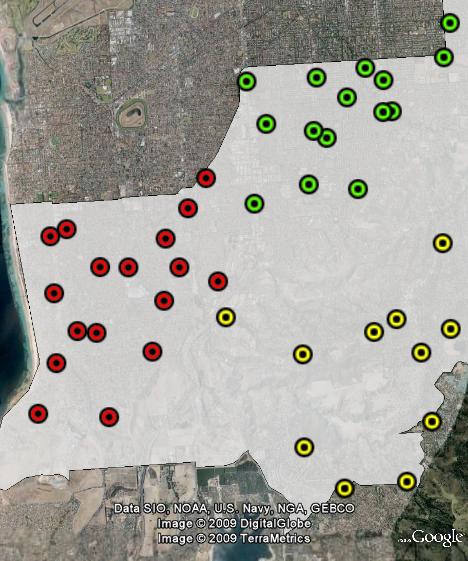
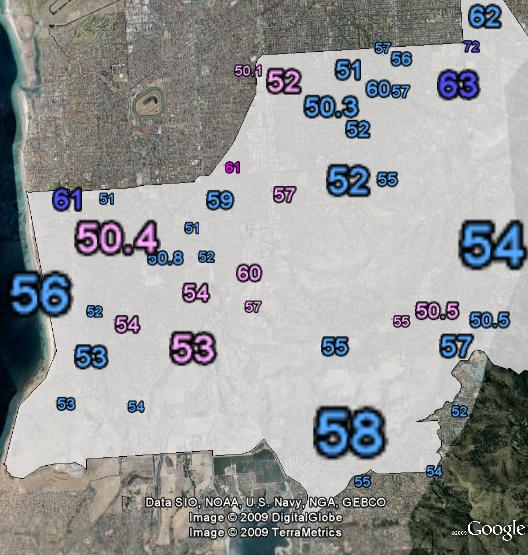
I have divided booths into three parts of the seat. The western booths are those that lie west of Main South Road, which bisects the seat from north to south. In the eastern half of the seat, I have broken up booths into the northeast and southeast, as is shown on the following map.
| Voter group | GRN % | LIB 2CP % | Total votes | % of votes |
| West | 8.76 | 49.98 | 28,295 | 31.65 |
| North-East | 10.12 | 55.01 | 25,139 | 28.12 |
| South-East | 11.78 | 53.83 | 19,368 | 21.67 |
| Other votes | 11.05 | 53.72 | 16,595 | 18.56 |
“It wouldn’t be surprising if there is not much more swing left in Boothby.”
I disagree, I think that Cornes cost Labor at least a couple of percent (and thus probably the seat). She just got hammered by the media over there.
If you look at the other swings in SA – http://www.abc.net.au/elections/federal/2007/results/stateindex.htm#SA – the next lowest swing is Kingston at 4.5% with the state average (estimate) up around 6.5-7%. I would put Boothby odds on to fall to Labor if they can dig up a decent candidate; I’ll also make an early tip that Boothby will be the greatest SA swing to Labor at the next election.
Maybe. I do think Cornes under-performed, but I’d tend to agree with Ben that there’s not much swing left here. Boothby is ‘small-l liberal’ territory, not really a strong Labor area. Boothby, along with Mayo, are the areas that were the heartland of support for the LM, and subsequently the Democrats. In mid-2001, along with Mayo, many people were tipping the Dems would win this seat.
I concur with Hamish. The tepid swing in Boothby in 2007 suggests that Labor underperformed in Boothby last time. The most obvious explanation being the negative publicity surrounding Cornes’s candidacy.
When referring to the seat’s history, it’s worth remembering that Boothby is a different electorate to what it once was. Prior to the 1993 election, Hawker (generally a Labor seat) was abolished with much of it added to Boothby. Since that time Labor has generally performed pretty poorly at the federal level in South Australia, with the exception of 2007. Perhaps the true nature of Boothby has been disguised?
Here’s what it looked like in 1984:
http://www.atlas.sa.gov.au/images/4sa9politics1.jpg
Local identity Mark Ward(Mitcham Councillor)would be the prime canditate to represent Labour for the seat of Boothby.
And Annabel Digance has got the Labor preselection.
The Greens candidate is Fiona Blinco, and the Democrats are running Tom Salerno.
Is Ray McGhee standing again?
God bless Fiona Blinco! My vote goes to her! The suburb of Hawthorn will vote Green!
peter – on the basis of local advertising, Ray McGhee is standing again though I haven’t seen the formalities yet. Personally I’d expect a small swing against him on the assumption that he was a beneficiary of the “Cornes factor” in 2007.
Curious thing about Boothby – I agree that it is “small-l liberal” territory, yet the Lib member Andrew Southcott is (as far as I have seen) from the conservative faction. If Annabel Digance can tie him to Tony Abbott she may yet eek a bit more swing out of it … and enough to win the seat IMO once you account for the Cornes factor.
In this regard the ALP have I think chosen cleverly for 2010 – Digance does not come from a union background, and is billed as a small business owner and board member to appeal to the small-l liberal professionals but with a background in health and nursing which should play fairly well to the Labor core.
Southcott certainly is from the conservative faction. And no one does factions quite like the SA Libs.
I agree with Iain. This should be a Liberal seat, but a big chance of going to Labor. I think it will genuinely come down to how the two parties campaign over the next few weeks. I would have Liberals as favourites given the history here, but would not be overly surprised of a Labor victory. If Labor win this, the Liberal’s can’t win the election.
Lodged my vote for the seat of Boothby at an early poling station two days ago.
As a first time boothby voter, I was surprised by the number of candidates considering we had only four contestants for the state seat, even if it is a lot smaller. I’d be interested in seeing the stats on the percentage of candidates who lose their deposits. In Boothby, the dems, ldp, sec, ray and the sceptics have no chance of having their $500 returned. I would expect FF poll around 5% and the Greens, ALP and LIBS of course will get their deposits returned.
Tell me about it!
According to Antony Green’s summary of nominations, Boothby is one of only 11 seats nation-wide with 9 or more candidates. 68% of electorates have between 4 and 6 candidates, so Boothby is well above the average.
I would be surprised if FF get their deposit back, though.
My info is that all polling – internal party and otherwise, has the ALP ahead in this seat. Despite this history, I now expect the ALP to win this seat and therefore the election.
Tony is in Adelaide today to prop up Boothby and to a lesser extent Sturt. Don’t let the margins fool you, last time the ALP ran an incredible campaign with Handshin in Sturt and it isn’t quite as strong this time. Similarly, Cornes was smashed from pillar to post in 07′ and that LPA margin should be 1 or 2% less. While I will go against DB and tip Southcott to get home on postals, you have a real point – SA is not out of play at all – in fact the absolute opposite. Any loss of seats for the coalition here will make the task impossible elsewhere
Peter – agree with the sentiments entirely. I do hope you are right.
My prediction: Won’t be surprised if Labor win, but I’ll say they’ll just fall short – 1.5-2% swing to them.