

IND vs ALP 1.2%
Incumbent MP
Andrew Wilkie, since 2010.
Geography
Denison covers the suburbs of Hobart on the western shores of the Derwent River. The seat covers Hobart and Glenorchy LGAs as well as northern parts of Kingborough LGA. The seat includes the Hobart CBD and is by far the most compact seat in Tasmania.
History
Denison was first created for the 1903 election. The seat was first held by Sir Philip Fysh, a former Premier of Tasmania and minister under Edmund Barton and Alfred Deakin. His retirement in 1910 saw the seat fall to the ALP, with the ALP member William Laird Smith joining the new Nationalist party in 1916. He lost the seat to a Labor candidate in 1922, and for the next twelve years the seat changed hands every three years, with the Nationalists winning it back in 1925, the ALP winning it back in 1928 and retaining it in 1929 before the new United Australia Party won the seat in 1931.
In 1934, the ALP regained it yet again, and held it for two terms until the 1940 election. A new UAP member of Parliament won the seat in 1940, and again only held it for three years, before the ALP’s John Gaha won the seat at the 1943 election. For the next half-century, Denison was a bellwether seat, going to the party that won federal government at each election.
Gaha lost the seat in 1949 to the Liberal Party’s Athol Townley. Townley held the seat for the next fourteen years, which was the longest term of service in Denison up until Duncan Kerr’s time. Townley served as Minister for Defence under Robert Menzies, before dying in December 1963 shortly after being appointed as Ambassador to the United States.
He was succeeded by Adrian Gibson, who retired in 1969 to be replaced by Robert Solomon. Solomon was defeated after one term in 1972 by Labor’s John Coates, who himself was defeated by Michael Hodgman in 1975. Hodgman served in a variety of junior ministerial roles under Malcolm Fraser and held the seat until 1987. Indeed, his victories in 1983 and 1984 were the only times Denison had gone to an opposition candidate in decades.
Hodgman was defeated in 1987 by the ALP’s Duncan Kerr. Kerr held the seat from 1987 until 2010, by far the longest term in Denison in the seat’s 106-year history.
In 2010, Kerr was replaced as ALP candidate by Jonathan Jackson. He was challenged by independent candidate Andrew Wilkie. Wilkie was a former analyst at the Office of National Assessments who resigned in protest over the Iraq War. He ran against John Howard in Bennelong for the Greens in 2004 and then ran as Bob Brown’s running mate for the Senate in Tasmania in 2007. After the 2007 election, Wilkie had a falling-out with the Tasmanian Greens and became an independent. He came close to winning a seat in Denison at the 2010 Tasmanian election. At the federal election, Wilkie came third on primary votes but overtook the Liberal Party on Socialist and Green preferences, and narrowly defeated the ALP on the two-party-preferred vote.
Candidates
- Tanya Denison (Liberal)
- Andrew Wilkie (Independent)
- Anna Reynolds (Greens)
- Wayne Williams (Democratic Labour Party)
- Bob Butler (Sex Party)
- Brandon Hoult (Stable Population Party)
- Trevlyn Mccallum (Family First)
- Debra Thurley (Palmer United Party)
- Jane Austin (Labor)
- Graeme Devlin (Rise Up Australia)
Assessment
Denison is one of the most interesting seats in the country. In 2010, Andrew Wilkie was the only candidate to get elected from third place on primary votes. The Greens will be pushing hard to overtake Wilkie, which would kill off his chances and likely turn the seat into a Labor vs Greens race.
It is most likely, however, that Wilkie will benefit from a personal vote as a sitting MP, and will increase his vote. If he does, this seat will likely be a race between Wilkie and the ALP, and will depend on Greens and Liberal preferences. A 2012 ReachTel poll had Wilkie well out in front on 40% with the Labor and Greens votes both dropping and the Liberals coming second. While this should be taken with a grain of salt, it is plausible that Wilkie’s presence as a progressive independent will take a large chunk out of both Labor and Greens and give him a strong lead.
2010 result
| Candidate | Party | Votes | % | Swing |
| Jonathan Jackson | ALP | 23,215 | 35.79 | -12.37 |
| Cameron Simpkins | LIB | 14,688 | 22.65 | -7.34 |
| Andrew Wilkie | IND | 13,788 | 21.26 | +21.26 |
| Geoffrey Couser | GRN | 12,312 | 18.98 | +0.40 |
| Mel Barnes | SA | 856 | 1.32 | +0.56 |
2010 two-candidate-preferred result
| Candidate | Party | Votes | % | Swing |
| Andrew Wilkie | IND | 33,217 | 51.21 | |
| Jonathan Jackson | ALP | 31,642 | 48.79 |
Booth breakdown
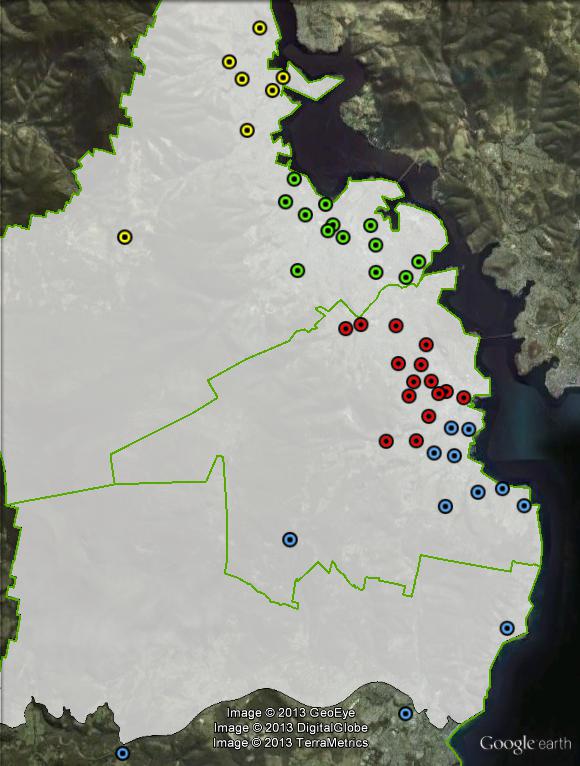
Booths have been divided into four areas. Most of the population of Denison lie in Glenorchy and Hobart local government areas. Booths in Glenorchy have been split between Claremont (north) and Glenorchy (south). Booths in Hobart have been divided between Hobart and South. The handful of booths in Kingborough council have also been included in South.
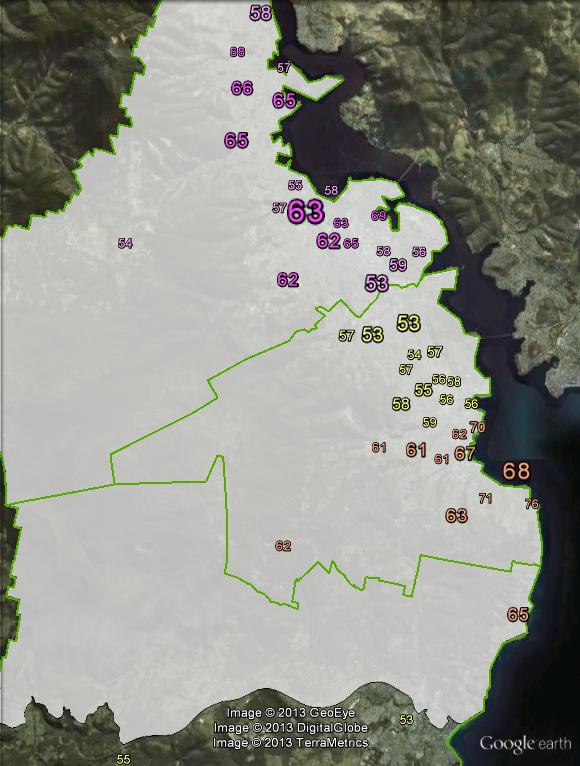
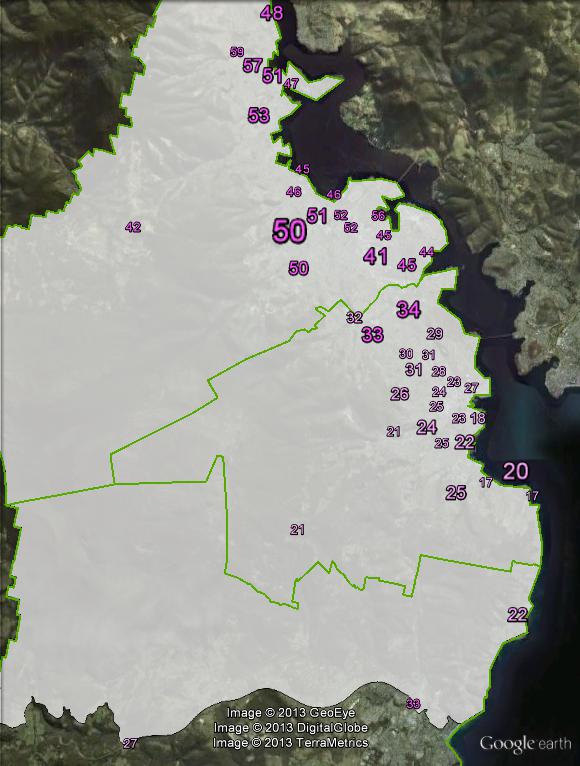
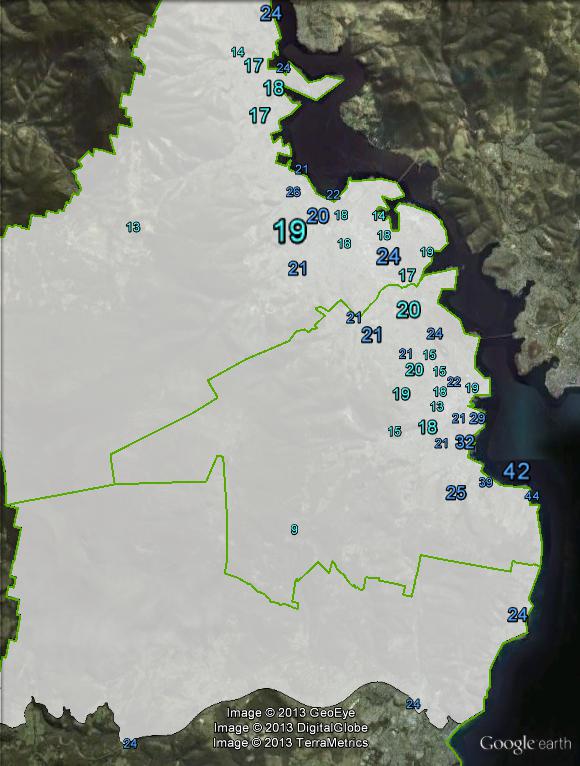
The 2010 federal election results revealed a very sharp divide between booths north of the Glenorchy-Hobart council boundary and those south of it.
In the north, the ALP polled 49% of the primary vote and over 60% of the vote after preferences, and the Liberal Party came second. In the south, the four main candidates all polled between 23% and 26%. While Labor still led the pack, they polled only 0.9% more than Wilkie and much less once preferences are factored in. After preferences, Wilkie polled 60.4% in the south of the electorate.
| Voter group | ALP % | LIB % | IND % | GRN % | IND 2CP % | Total votes | % of votes |
| Hobart | 28.81 | 18.75 | 24.66 | 26.33 | 56.52 | 16,284 | 25.11 |
| Glenorchy | 47.81 | 19.83 | 17.70 | 13.16 | 40.13 | 14,189 | 21.88 |
| South | 21.98 | 29.47 | 25.41 | 22.09 | 65.48 | 12,215 | 18.83 |
| Claremont | 51.38 | 19.01 | 17.57 | 10.53 | 37.39 | 7,876 | 12.14 |
| Other votes | 35.03 | 26.05 | 19.40 | 18.40 | 51.61 | 14,295 | 22.04 |
| Total South | 25.88 | 23.35 | 24.98 | 24.51 | 60.36 | 28,499 | |
| Total North | 49.09 | 19.53 | 17.65 | 12.22 | 39.15 | 22,065 |
Click on the following maps to enlarge them to full size.
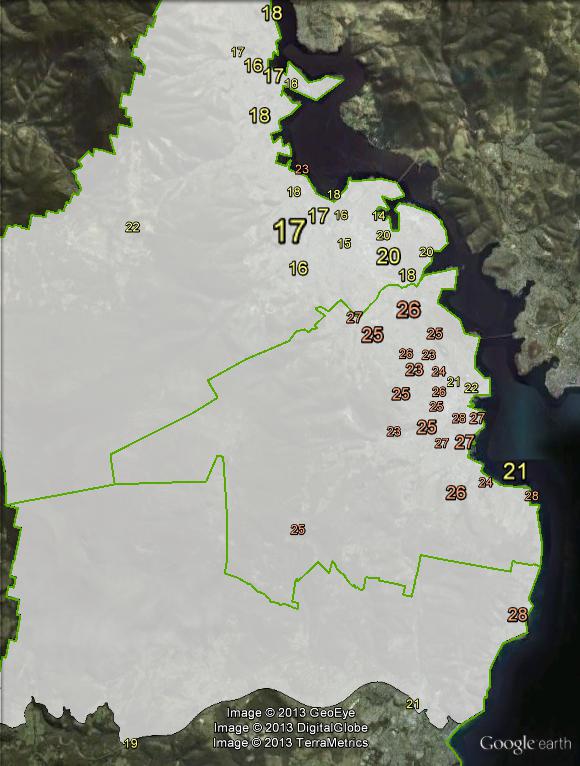
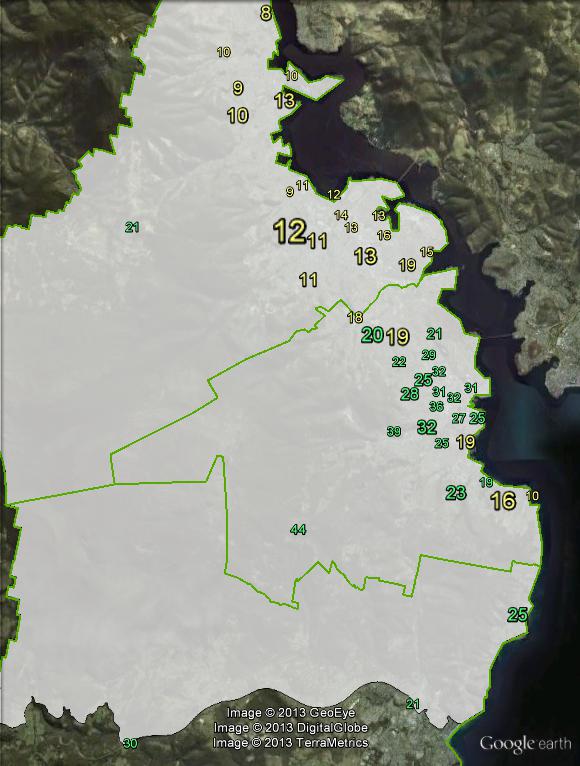
I think that Wilkie will hold.
He was lucky to win from third on the primary vote count in 2010, and arguably should be no chance. But last year I saw a story in the OZ (part of the so-called “hate media”), saying that he was predicted to hold. The year before, Wilkie told the ABC program INSIDERS that most of the criticism directed at his backing of Gillard came from outside his electorate, and most of his constituents were telling him that they were happy with that. And I’ve heard anti-Gillard Tories giving him a rap for withdrawing his support for Gillard after she dumped his pokie reforms, albeit only after the departure of Slipper from the LNP enabled her to dump them in the face of ferocious opposition from the clubs industry.
If Wilkie holds, he’ll probably hold with preferences, which he’ll need. And because he’s on speaking terms with Abbott, the Liberals will probably give him their preferences.
I agree, Wilkie should finish second this time on primary votes, and receive a decent preference flow from both the Liberal Party and the Greens, enough for Andrew Wilkie to leave Labor for dead.
Andrew Wilkie can’t rely on Liberal preferences t oget him over the line as the Liberal candidate is likely to be one of the last two left standing… Which means that if Labor direct their preferences to Liberals, Wilkie may well be out.
Interesting thought – that would require Wilkie to outpoll the Greens (probable), and Liberals to outpoll Labor (in Denison???), along with preferences going Greens to Wilkie (probable) and Labor to Liberal (???).
Re Ben Peelman’s suggestion, for the Liberal and Wilkie to be the last two left standing, this means that the Labor candidate must have less than 33% after Green preferences (unless Labor is out first which would require a primary of <25%). That requires Labor to be down more than 10% on last time at that same point. It also requires the swing from Labor and the swing to Liberal to average nearly 10%.
I'd say that both these things are quite possible based on swings elsewhere in the state, if enough Labor voters switch to Wilkie as well as those swinging to the Libs. The seat could be either Wilkie vs Labor 2CP or Wilkie vs Liberal. Very hard to see Wilkie not making the final two unless he brings down the government in the meantime.
But I think Labor would have rocks in their heads to preference the Liberals ahead fo Wilkie anyway.
I think it’s quite possible the Liberals will come second.
Wilkie won last time from a very low primary vote – as a sitting member from the centre-left he is likely to gain votes from the Greens and Labor. It’s less likely he’ll gain votes from the Liberals.
Labor is also likely to lose votes to the Liberals as they will do in most seats. If they do I think the most likely outcome is Wilkie first, Liberal second, Labor third, Greens fourth.
I agree with Kevin’s comments about rocks in Labor heads re preferencing Liberals ahead of an independent who has supported them in government (if done so in a way that has probably produced a few grey hairs along the way).
I’m not convinced it is in Wilkie’s best interests to run in this seat again. A move to the Senate would probably give him much more power in the next Government as another hung HoR is extremely unlikely. If he runs in Denison he will win comfortably and the Libs will finish second. If he doesn’t run anyone can win this.
On expected voting numbers it is becoming likely that the Coalition will be able to control the Senate without relying on the Greens. That could make a switch by Wilkie to the Senate a critical move for him and all Tasmanians. The Libs will pick up 3 Senate seats in TAS if Wilkie doesn’t run but probably only 2 if he does.
Libs have name Tanya Denison for Denison.
http://www.abc.net.au/news/2013-06-21/liberals-name-denison-candidate/4771072?section=tas
A quick google came up with her Linked In account – a lifelong Queenslander who moved to Tassie 9 months ago to set up a “short-term cash flow solutions” (i.e legit loansharking) franchise.
Unless the Libs are deliberately playing dead (which they may well be), surely they could do better. Tasmanian’s can be pretty parochial about who is and is not a local.
This seat is interesting. I think we Wilkie’s vote will rise however it will probably come mostly from the greens and to a lesser extent from the other parties. A labor plus Coalition preference deal may however bring him down.
1. For the coalition to preference Labor ahead of Wilkie Labor would have to give the Coalition something such as preferences in the Senate. In short it is very unlikely to happen.
2. This leaves Labor preferences going to the coalition ahead of Wilkie. I disagree Labor would have rocks in their heads to preference the Liberals ahead of Wilkie anyway. It may even be in there long term strategic interest. If Wilkie is replaced my a weak liberal candidate he would be much easier to bring down in 2016. It would remove a thorn in Labor’s side in one of there safest Tasmanian electorate. If 2013 goes the way most polls expect it to go what does one extra seat mean anyway? Its not like the coalition is going to need an extra seat in Tasmania to govern. There are obviously two major risks to Labor doing this. One is people may be enraged with such a despicable deal between the 2 major parties and swing overwhelmingly to Wilkie. The other risk is that the electorate my grow to like their sitting member. The seat has been liberal in the past and may opt to keep a sitting liberal member, since at the end of the day Tasmania’s electorate are smaller and personal relationship built in the electorate may very well defy the electorates natural political leanings.
The Libs and Labor will preference Wilkie before each other, I’m 100% certain of that.
The Greens preferences will be the most interesting. It’s most likely that they will come fourth here and while Wilkie is perhaps the more obvious choice, there is some anomosity between the two camps and Wilkie shouldn’t take their preferences for granted.
Labor probably needs green preferences to have a shot here but my money is on Wilkie to hold with a 10%+ swing in both primaries and 2PP. Libs can’t win here and going by the candidate aren’t trying to.
The Palmer United Party candidate is Debra Thurley, who is described here as an ‘electoral officer’
http://au.news.yahoo.com/latest/a/-/latest/17901378/palmer-names-candidates/
I think everyone can agree that the Libs (and minor right-wing parties) aren’t going to get the seat (short of a miracle), as it’s unlikely that many preferences will flow from Greens, Labor, or Wilkie to the Libs, irrespective of what “preference deals” might occur. But the interesting thing is that any of the other three could gain the seat, depending on exact variations.
I think it’s most likely that Lib supporters will preference Wilkie over the Greens or Labor. Greens supporters will probably preference Wilkie more than Labor. Labor supporters will probably see their preferences spread amongst all three. Wilkie supporters are the wildcard – it’s hard to predict what they’ll do.
If Rudd’s momentum solidifies, Labor may retake the seat, with Wilkie being the other final candidate. If the momentum falters, I think a lot of the votes go Greens, which may be enough to push them past Wilkie, and then up into the prime position. If Labor manages to stay about steady from here, I see Wilkie repeating his 2010 performance. In the unlikely event of a Liberal leadership change, we may see Labor take the seat anyway due to the Liberal vote strengthening enough to stay ahead of Wilkie or the Greens when it’s down to three candidates.
The seat will probably see a lot of campaigning from Wilkie, Labor, and the Greens. The Libs will probably put in some decent effort, too. Perhaps the least predictable seat of the entire set, in my opinion.
I’m pretty sure Wilkie will get a swing towards him here. And surely Liberals (or if they perform badly enough, Labor) will preference him, as might the Greens?
I give the Greens no realistic chance of winning Denison and predict they will again finish fourth, and be not as close to third as last time.
Even had they been ahead of Wilkie last time it is doubtful that they would have got as strong a preference flow as he did, and I don’t think that they would have won.
I add that while the Greens candidate is well-credentialled and a fairly good speaker, the Greens have their strategy wrong, and continual technical-sounding personal attacks against Wilkie over how many motions he moved and how many times he spoke in Parliament are just not going to get them anywhere. Similar tactics were attempted by progressives in the Legislative Council elections, when Jim Wilkinson was baited over his lack of an electoral office and his law work on the side, and nobody cared.
Offtopic: I wouldn’t say “nobody cared” about those Jim Wilkinson issues; there was a significant swing against him. It just wasn’t enough to unseat him.
Also offtopic: the reduction in Wilkinson’s primary vote was caused largely by there being four candidates instead of two, and is hence not a meaningful measure of “swing”. Had it got to a final two-candidate vote between him and the Greens, he would have won by a large amount (my estimate 61-39) and the swing against him would have been small (about four points, and that only once a redistribution between elections is considered). That swing would in my view have been entirely explained by the more vigorous campaign from the Greens who ran a better candidate, plus the large same-sex marriage campaign. The personal stuff was largely the converted preaching to the converted.
Given the very likely outcome of a Liberal government, Andrew Wilkie will be as useful to the constituents of Denison as the proverbial tits on a bull. Ditto the ALP candidate. If Denison wants to get any crumbs out of Canberra (probably courtesy of Erik Abeths) we will have to vote for the Lib candidate and hope that he/she gets in to fight our corner. But who is that (hitherto unknown) person?
Wilkie not impressed by ALP billboards claiming a vote for him is a vote for Abbott
http://www.abc.net.au/news/2013-08-13/wilkie-demands-removal-of-27defamatory27-alp-billboard/4882708
Same tactics the Nats have always used against the country independents going back to Peter Andren.
That’s really quite weird of Labor, given that Wilkie is to the left of Labor, pretty much always voted with them in parliament, and people can direct their preferences however they want.
The only way that voting for Wilkie becomes a vote for an Abbott government is if it comes down to another hung parliament, and Abbott convinces Wilkie to support him. And the chances of that are practically nil, after Abbott claimed he wouldn’t negotiate with crossbenchers, and after what happened in 2010 during negotiations. Abbott pretty strongly burned that bridge.
Nick C thanks. Very interesting development. This could be very interesting should Mr Wilkie now direct preferences to the Coalition instead of Labor. I wouldn’t put him past it given this sort of rubbish. Should it occur, given the general swing in Tasmania of around 10-15% from the ALP to the Liberal Party, I would not rule the Liberal Party out of it in such circumstances, although I would think Mr Wilkie would be favoured to retain the seat off the back of Green preferences.
Will be interesting therefore to see if Labor puts Wilkie behind the Greens. If so, I see no reason why Wilkie would not direct preferences to the Liberal Party, or he may just in spite of the ALP campaign against him.
I don’t think the ALP are any chance in any case of picking up this seat.
PS: I should explain that by Wilkie directing preferences, it would have to mean an Lib v ALP rather than Lib v Wilkie for the Libs to be any chance. But I personally think Wilkie will be in the final two, albeit, this seat will be rather unpredictable.
I think Wilkie has made it quite clear that he will run an open ticket and not direct preferences to either party, and I don’t think he’d change that stance based on this.
Nick C you are right DB your sources have failed you. He’s running an open. Ticket
The return of Rudd makes me rethink the chances of Wilkie. One wonders if he won off the back of Kerr’s retirement and/or a backlash over Rudd’s ousting.
No surprise really, http://www.abc.net.au/news/2013-08-19/wilkie-gets-a-helping-hand-from-liberal-preferencing-in-denison/4895494
A bit more surprising: after spending last week telling people a vote for Wilkie was a vote for Abbott, Labor casts its own vote for Abbott by preferencing the Liberal ahead of Wilkie.
My comments on this (which are quite damning to the ALP) have been appended at http://kevinbonham.blogspot.com.au/2013/08/the-anti-wilkie-denison-billboard-stoush.html
National intervention to sort out the local Graham Richardson wannabes might be a good outcome here. 🙂
From my understanding, according to Kevin Bonham, Labor how to vote cards will place Wilkie below the Liberal candidate. In which case, I’d suggest the Liberal candidate is a chance of winning should Wilkie now place the Liberals above Labor.
Surely they will change it before election day. That is stupid beyond belief.
A ReachTel poll of 550 constituents puts Wilkie in the box seat with about 44% of the primary vote.
To add to the jumble, Greens HTV puts Labor ahead of Wilkie
http://candidates.greens.org.au/sites/candidates.greens.org.au/files/Denison%20HTV_WEB.pdf
Wilkie is not directing preferences at all and his preferences would be irrelevant anyway as he will make the final two.
My view of the current ReachTEL is that while Labor will not necessarily come second, even if they come third they will not have enough votes for their devious plan to succeed (assuming it wasn’t just a dummy-spit!)
On primary votes anything like the ReachTEL sample, Wilkie will be OK.
It’s a superb ballot draw for Wilkie, for what little ballot order matters.
I just noticed an error in the 2PP preferred table for 2010 above – the ALP candidate was Jonathan Jackson.
Yes, good point KB. Wilkie will make the final two.
I feel I deserve some credit here. If you look at my comment from June 21 I said that Labor my preference the liberals ahead of Wilkie low and behold it happened.
PJ looking at you.
You as well Ben.
Forget what I wrote before about Rudd’s return making Wilkie’s chances less likely.
Rudd’s fallen in a heap. Wilkie’s got this one.