

The AEC published the final results data from the Farrer by-election on Wednesday.
Of particular interest is the breakdown of how preferences flowed from each candidate’s voters between the final two candidates: One Nation’s David Farley and independent Michelle Milthorpe.
The AEC has also published the full distribution of preferences, which I haven’t previously written about. This gives us the three-candidate-preferred vote, and thus the flows of preferences from 3CP to 2CP (another method of calculating preference flows).
The AEC doesn’t just publish these figures for the seat overall, but also publishes them at the level of each polling place.
First up, this chart shows how primary votes for each candidate (apart from the top two) split on the two-candidate-preferred count.
It’s worth noting that the Liberal Party polled 12.4% and the Nationals polled just under 10%, but the vote for everyone else was very low. The Greens and Legalise Cannabis each polled about 2.3%.
Greens preferences flowed extremely strongly to Milthorpe, with almost 92% of Greens preferences flowing to Milthorpe. Other minor candidates were not very surprising. Right-wing minor parties generally gave strong preference flows to One Nation while independents and other minor parties favoured Milthorpe.
The Coalition candidates’ voters favoured One Nation, but not overwhelmingly so. Unsurprisingly, Nationals voters were more favourable to One Nation than Liberal voters – 69% as opposed to 59%.
The AEC’s distribution of preferences also provides us with the three-candidate-preferred count, which was:
- Farley (ON) – 44.4%
- Milthorpe (IND) – 34.4%
- Butkowski (LIB) – 21.3%
So the Liberal Party not only failed to make the final count, but they were about 13% away from such a result. If the Liberal Party had made the top two, they would have had a good chance of winning, but they weren’t close.
At this point, the 21.3% of the vote sitting with the Liberal candidate were distributed. Bear in mind that these aren’t solely Liberal primary votes. The Liberal primary vote made up less than 60% of the votes sitting with the Liberal candidate at this point. For what it’s worth, those remaining votes split 62% to One Nation and 38% to independent Milthorpe. This metric is useful because we can calculate it for every single-member election around Australia, whereas preference flows based on primary vote are only published by the AEC and the Queensland commission (and can be calculated independently for NSW state elections).
Coalition preferences absolutely do favour One Nation when they are in a race against an independent who has taken on the centre-left role in this electorate, but not overwhelmingly so. We saw this in South Australia too: in eleven races where the Liberal came third, their preferences flowed 66.6% to One Nation over Labor. In seven cases where One Nation came third, their preferences flowed 68.9% to Liberal over Labor. This could give Labor a slight advantage that adds up across many seats.
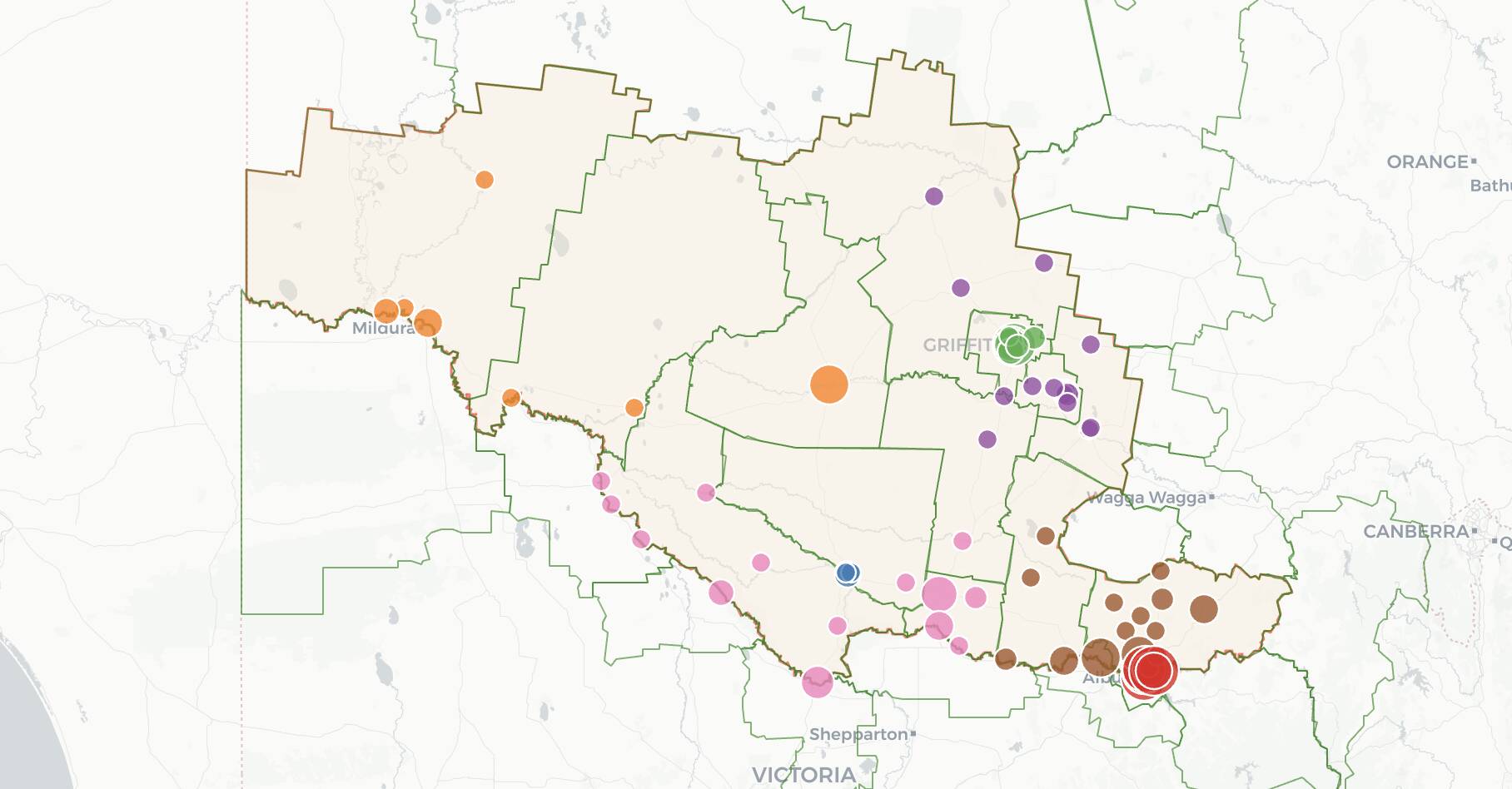
Finally, I wanted to do something with the fact that the AEC publishes preference flows by booth. I grouped the booths according to the categories I used in my pre-election guide, except I included pre-poll booths in each geographic area.
This confirms that Michelle Milthorpe did win Albury, but only slightly, with 51.6% of the two-candidate-preferred count. It was Milthorpe’s weak lead in Albury that allowed us to call the result on election night, since she needed a much bigger lead to outweigh large One Nation leads in other areas.
I wondered if there would be an interesting trend in how strongly Coalition preferences flowed to One Nation by area, and there is some interesting evidence. The Coalition preference flow is relatively weaker in Albury and Griffith, the biggest towns, but it’s also relatively weak in the rural booths of the north-east. Some of this would reflect the relative distribution of Liberal and Nationals votes but not entirely – the Nationals did much better in the north-east, but the preference flows were weaker there than in the north-west, which had a stronger Liberal vote.
Overall this is useful new data for understanding how preferences will flow, in a situation where we have very little information.

It seems that not only can’t the Liberal Party garner a significant primary vote, it is unable to direct its preference votes either. The Liberals were directing preferences, albeit indirectly to PHON; & yet 2 in 5 did not follow the direction. This, from recollection, is a similar pattern overall to South Australia.
Although known preference directions are bread and butter to cognati, often yelled from the tree tops, from my years of experience in handing out HTV cards we would be surprised by how many ordinary voters pay no attention to where their preference is directed and blindly follow their party’s HVT card. So a deviation of this magnitude is a significant phenomenon.
If it had been Liberal only or National only, I wonder if they would have offered an open ticket without directing preferences. As they are obligated to direct ‘2’ to the coalition partner, it only makes sense to issue full tickets. It would seem that Liberal and to a lesser extent National voters treated it like an open ticket.
A question – what sort of presence did the Libs and Nats manage at polling booths? Were there lots left without HTV volunteers? That might have made a difference too – to primary vote as well as preferencing.