

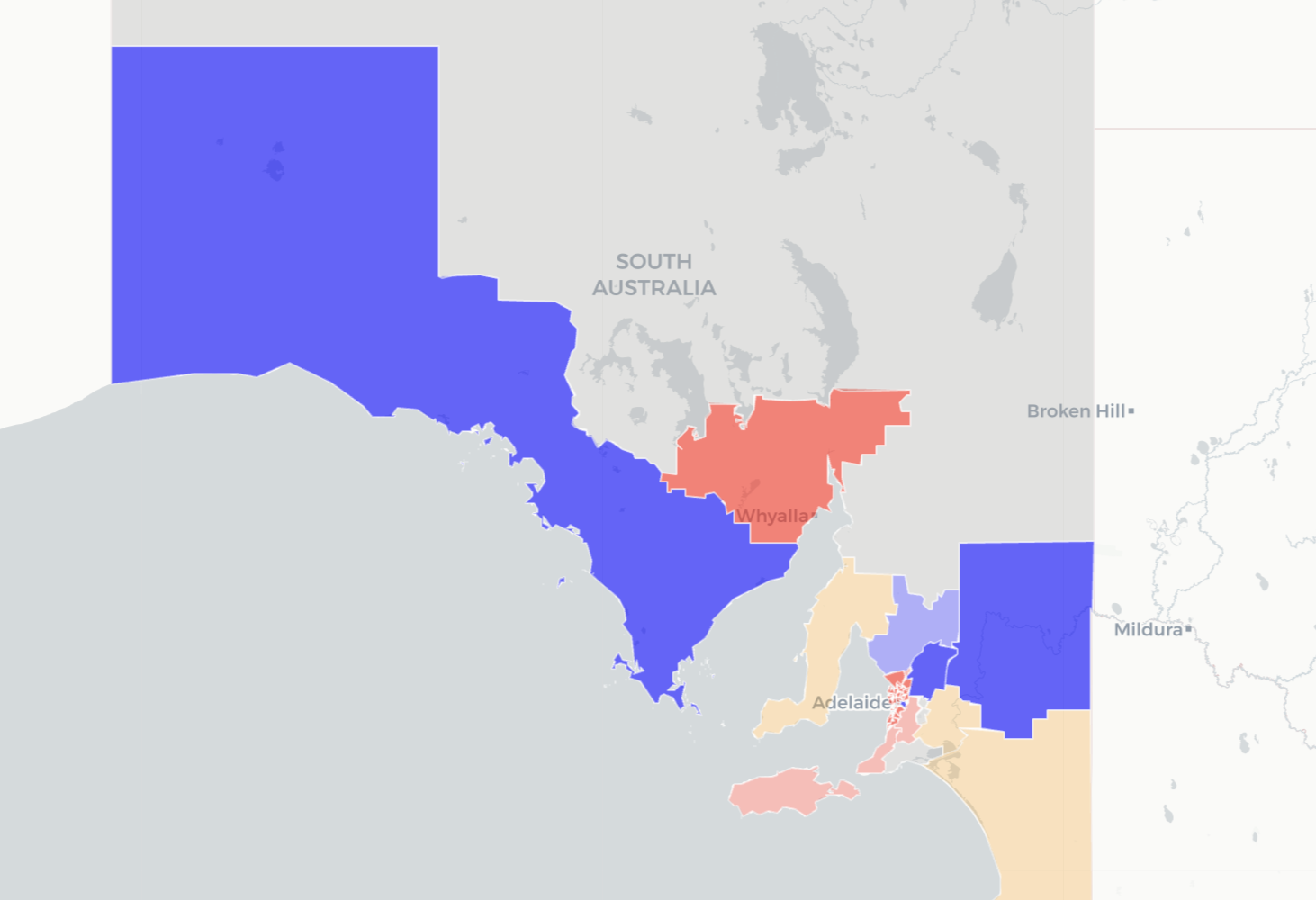
We have almost reached the end of the House of Assembly count for the recent South Australian state election. We know the winner in all 47 seats. In 46 seats, we have a full distribution of preferences. The only exception is in Narungga, where a recount confirmed that One Nation won the seat by a 77-vote margin over the Liberal Party. We don’t yet have a full distribution of preferences for Narungga, and I assume we’ll need to wait until after the Easter long weekend for that to be published.
UPDATE: I’ve now added the Narungga data to this blog post. The rest of this blog post reflects all 47 seats.
Pretty much all of the analysis I am doing for this blog post is based on the three-candidate-preferred count, which is the second-last round of the preference count.
This South Australian election was extremely complex, with doubt about who would come in the top two, and with preferences potentially playing a larger role than in the past. So for this post I will be going through what the final preference distributions tell us about the shape of South Australia’s election: how preferences flowed, how close the gap was between second- and third-placed candidates, and how many seats featured a particular combination of candidates.
For my next blog post, I am going to use this data to publish not just the actual margins, but also my estimates of alternative margins, where it was plausible that a different candidate could have made the top two.
Let’s start by looking at how often a particular party made the three-candidate-preferred count.
Until 2026, Labor and Liberal made the top three in almost every seat. Over the previous six elections, Labor missed the top three twice, and the Liberal Party never missed the top three.
This year, Labor missed out in four seats, and the Liberal Party missed out in sixteen! One Nation reached the top three in forty seats. The Greens also had a significant downturn in the number of seats where they made the 3CP.
From 2002-2022 (and likely for much longer) there was always a third spot in the 3CP and that position has varied. The Australian Democrats had that role in most seats in 2002, and SA Best dominated in 2018. Otherwise, the Greens have usually made the count in a majority of seats, while Family First regularly made the 3CP in 2006-2014.
The specific combination of 3CP sets is:
- ALP-LIB-ON – 20
- ALP-ON-GRN – 13
- ALP-LIB-GRN – 6
- LIB-ON-IND – 4
- ALP-ON-IND – 3
- ALP-LIB-IND – 1
And the specific combination of 2CP sets is:
- ALP-ON – 25
- ALP-LIB – 13
- LIB-ON – 4
- ON-IND – 2
- ALP-GRN – 1
- ALP-IND – 1
- LIB-IND – 1
The next question I was wondering about was whether the gap between second and third has been shrinking. We have noticed this trend in federal politics, where we have more seats where the 3CP count becomes critical. It turns out that the gap has shrunk slightly, but is roughly back to where it was in 2018 when SA Best made a splash.
This actually rings true when considering the actual results. While there was a lot of seats where the top two wasn’t known before election day, there were only a few where it was unclear after election day, and most of those became clear without needing a full 3CP count.
Four seats had a gap of less than 4% between second and third on the 3CP:
- Heysen – ALP 0.4% over GRN
- Croydon – GRN 0.6% over ON
- Schubert – ALP 2.2% over ON
- Enfield – ON 2.9% over LIB
Only in Heysen did this come close to mattering for the result, but I’ll come back to that in the next post.
So did preferences make much of a difference to the result?
There were only two seats where the winner came from behind. In the other 45 seats, the primary vote leader ended up winning. In Finniss, independent Lou Nicholson came from fourth place to win, overtaking the Liberal primary vote leader. In Kavel, independent Matt Schultz overtook Labor.
In the seat of Hammond, One Nation topped the primary vote but actually fell behind on the three-candidate-preferred vote, into second place, and relied on preferences from the Liberal candidate to defeat Labor.
So overall it doesn’t look like preferences had a big impact one way or another, but there were a lot of them. Now that we have 3CP data, we can calculate how preferences flowed on the final round of the count. This is not the same as having preference data based on the candidate’s primary vote (apparently we will get this at the end of the year) but it does have the benefit of isolating other effects.
When comparing primary vote figures to the final preference count, it is difficult to isolate preferences from particular partisan elements – for example, how Liberal preferences flow. But by taking the second-last round of the count, there’s just the votes of one party left to be distributed. This does include votes that were cast for another candidate, but that’s not a bad thing.
So this next chart shows the proportion of preferences that flowed from each party for each two-candidate-preferred pairing. I’ve noted how many seats had this preference flow.
The most common 2CP contest was Labor vs One Nation. About half had the Greens in third, and most of the rest had the Liberals in third. Greens preferences flowed to Labor at about 80%, while Liberal preferences flowed at two thirds to One Nation.
In the Labor-Liberal contests, there is a similar mirror image, but even more polarised – Greens preferences were even stronger to Labor, while One Nation preferences favoured Liberal even more. But again, the parties of the left have tighter preference flows amongst each other than the parties of the right.
When you break down this data by electorate, there are some interesting trends. Greens preferences tend to be a little more pro-Labor in a race against the Liberal Party. In the seat of Elizabeth, almost a third of Greens preferences flowed to One Nation. That was a seat where a donkey vote would go to the Greens then One Nation, and it is a relatively weak area for the Greens.
Liberal preferences favoured One Nation over Labor in every seat, ranging from 53% in Enfield to 73.5% in Hammond. In general, One Nation does not favour Liberal quite so strongly.
Preferences do clearly have a skew, but it seems that multi-party politics means that they often cancel each other out. So I thought I would look at how much preferences helped each party, subtracting the party’s primary vote from their 2CP vote in every seat where they made the 2CP.
The political parties all benefited to similar degrees, but unsurprisingly One Nation does worst out of preferences, with Liberal doing a bit worse than Labor. The Greens didn’t do that well, but this only covers one seat (Croydon) which isn’t exactly Greens heartland.
It is remarkable, however, how well independents who made the final preference count benefited.
This can be seen clearly in my final chart, which shows the preference gain for each candidate in the top two, compared to that candidate’s primary vote.
Labor candidates fairly consistently did better than One Nation and Liberal candidates, but three independent candidates are way off the chart. Independents in Finniss, Kavel and Mount Gambier gained 30-40 percentage points from preferences. No major party candidate gains more than 28%.
That’s it for this post – in the next one, let’s look at some ways to understand the marginality of seats as we lose the simplicity of the pendulum.

The really significant matter here is that 32% of the anti-Labor non-PHON vote (the large majority of which were Liberal voters on the day) at the last resort, preferenced Labor over PHON, despite the very clear instruction/advice from the Liberal Party machine to preference PHON over Labor.
Really bad news for the newly electoral funding impoverished Liberal right-wing clericalist powerbrokers running the Liberal Party machine in SA. Also bad news for the rightwing dominated Federal Liberal Parliamentary Party who appear to be inclined to direct preferences to PHON.
And this is really good news for the sensible centre of Australian politics. But also, interestingly, for the Greens who also shared a statistically significant part of this vote before it passed on to Labor, when they finished ahead of the Liberals in a few seats.
It will be interesting what the more liberal Liberal Party do in the Victoria State election about preference instruction/advice.
It is interesting to see the dispersion and number of 2CP contests for such a relatively small lower house.
I believe One Nation and Greens voters have some anti-establishment or anti-major party sentiment and overlap in economic populism and this played out in the preferencing. They would be more willing to preference each others’ party than the major party that they are least aligned to (Greens voters mostly prefer Labor and One Nation voters mostly prefer Liberals in a classic 2PP contest).
I remember on one of Ben’s podcasts, a guest, who once scrutineered at an election, said it was common to see ballot papers with 1.One Nation and 2.Greens or vice versa.
Based on the data, I guess that Greens voters of the outer suburban “red wall” seats (Elizabeth, Ramsay, Reynall, Hurtle Vale) were more keen on preferencing One Nation than on preferencing the Liberals. Normally, well under 20% of Greens preferences flow to the Liberals in a classic 2PP contest.
A correction: The last excluded candidate in Mount Gambier is a Labor candidate, not a Greens candidate. Therefore Mount Gambier should be placed in the “Labor” group in the “Preferences from third-placed candidate, SA 2026” chart, and under the ON-IND group, Greens (1) should instead be Labor (1).
If you look at the ALP vs ON races from Libs and Greens , the areas with lower preferences towards ON are either non-white CALD heavy and/or areas with a higher University attainment which means ON has a toxic image from non-whites and/or more cosmopolitan Anglos.
You’re right, Joseph. Not sure how that happened. Will be corrected shortly.
I wonder if notional classic TPP will be published for each electorate for the non classical contests?
ECSA will not be counting Labor vs Liberal for every seat but they are planning to do a Labor vs someone else count for the seats where Labor didn’t make the top two.
ok thanks Ben for letting me know
“That’s it for this post – in the next one, let’s look at some ways to understand the marginality of seats as we lose the simplicity of the pendulum.”
Perhaps you’re talking about extending the traditional pendulum into a 2nd dimension like my 3PP triangles. I’ve charted the 46 seats with available DoPs and posted on my Twitter and BlueSky.
Not getting a heap of engagement though. I think maybe I should always draw the full triangle instead of zooming in on only a small region of the graph. That might require less mental work for the reader to understand.
Yes that is part of what I’ll be posting. I will reference your work on Bluesky too.
I went to compare the booths between the Voice Referendum and the ON TPP, I actually noticed a trend which is a gap tends to be roughly around 20-25% between the No Vote and the ONP TPP but it is much higher in CALD as much as likely 40% (although I concede it might be slightly inflated since the most CALD areas in SA tends to be located in Peter Malinauskas’s seat). I wonder if there is (or will be) a chart to show the correlation plot chart to show the ON TPP vote between things such as the Voice Vote, CALD percentages, income, education etc