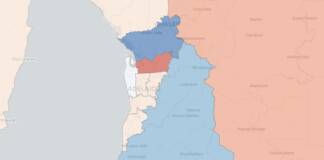
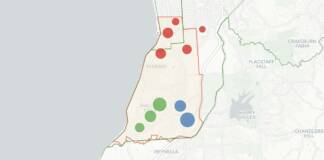
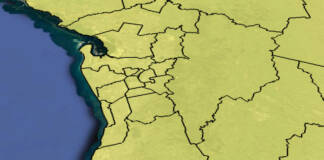
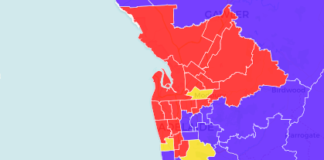
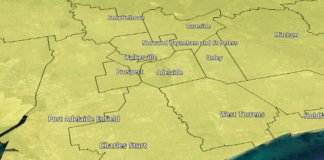
Port Adelaide is a safe Labor seat in northern Adelaide. The seat covers the aforementioned port and surrounding areas. It was first created in 1949 and has always been held by Labor MPs. It was won in 2007 by Mark Butler, a prominent figure in the South Australian Labor Left, and now a Parliamentary Secretary. The ALP shouldn’t have any trouble retaining the seat in 2010.
South Australia Archive
Seat profile #96: Mayo
Mayo is a large regional seat covering the Adelaide Hills and areas to the south and east of Adelaide, including Kangaroo Island. The seat has been held by the Liberal Party since its creation in 1984, but it has been targetted by minor parties on a number of occasions. The Democrats came close to beating Alexander Downer at the 1990 and 1998 elections. Downer retired in 2008 and the ensuing by-election saw the Greens come close to defeating Liberal candidate Jamie Briggs.
Seat profile #84: Barker
Barker is a safe Liberal seat covering a large part of rural South Australia. Barker covers the southeastern corner of South Australia, stretching from Mount Gambier in the south up to the Barossa Valley and the Riverland, covering the upper parts of the Murray River within South Australia. The seat has been held by Liberal MP Patrick Secker since 1998.
Seat profile #79: Adelaide
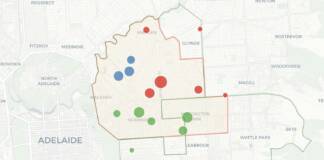
Adelaide covers the central suburbs of Adelaide in South Australia. It has been held since 2004 by Minister for Youth and Sport, Kate Ellis.
She holds it by a sizeable 8% margin, although the seat has a long history of switching between the major parties, and was held by the Liberal Party from 1993 to 2004.
Seat profile #68: Wakefield
Wakefield is a seat on the northern fringe of Adelaide, covering the suburbs of Elizabeth and Gawler and rural areas as far north as Clare. The seat has only been won by the ALP three times, and had been held by the Liberal Party continuously from 1946 until the ALP’s Nick Champion won it in 2007. The seat underwent a redistribution in 2004 which moved it into more urban areas on the northern side of Adelaide. The seat is held by the ALP by a 6.6% margin.
Seat profile #60: Grey
Grey is a massive seat covering most of South Australia, including the outback towns of Roxby Downs, Coober Pedy and Woomera, as well as the South Australian coast from the Yorke Peninsula to the Western Australian border and the coastal towns of Port Pirie, Port Augusta, Whyalla and Port Lincoln. Grey has a long history of Labor victories, but has been held by the Liberal Party since 1993. Rowan Ramsey won the seat for the first time in 2007, suffering a swing of over 9% to hold on to the seat with a 4.4% margin.
Profiles of key Adelaide seats
I’m still slowly making my way through writing my guide to the federal election. I have now finished 13 House of Representatives seat guides, with the latest being the four most marginal seats in Adelaide: Boothby, Hindmarsh, Kingston and Sturt.
Now that redistributions have concluded in New South Wales and Queensland, I will start working from the top of the pendulum, starting with supermarginal Bowman, in order to ensure that marginal seats are finished in case an early election is called. It’s quite time-consuming to write these guides so I’m prioritising the more interesting seats. So keep an eye out on the pendulum page for new guides to be posted.
SA Greens choosing their next state MP
The South Australian Greens are also in the middle of choosing their ticket for the Legislative Council for the March 2010 state election. The meet-the-candidates forums are currently taking place, and the ballot and endorsement of the ticket will take place in September.
The four candidates are:
- Carol Vincent – Chief Executive of the SA Farmers’ Federation.
- Tammy Jennings (nee Franks) – Convenor of the SA Greens, Jennings was on the Democrats Senate ticket at the 2004 election.
- Paul Petit – Former Convenor of the Australian Greens, Greens SA lead Legislative Council candidate at the 1997 election.
- Mark Andrew – I don’t really have any info at hand about him.
There are no incumbent MLCs up for election, as Mark Parnell’s term does not expire until 2014. The quota to win a seat is just over 8%, which they should get considering recent polling. Recent polling putting them on a vote of 11% suggests that, with strong preference flows, they could have a small chance of electing two new MLCs.
Democrats MP in fight with party…wait, Democrats?
I know, I know. I’d forgotten there was any Democrats MPs left too, but David Winderlich is the sole remaining Democrat MP, holding a seat in South Australia’s Legislative Council after taking over from Sandra Kanck last November.
The party appears to be effectively dead, with a small rump of activists keeping the party going. In a desperate move, Winderlich has threatened the party that he will resign if they don’t recruit 100 members by the end of November.
“The Democrats have a proud history. Our achievements include banning tobacco print advertising, introducing World Heritage legislation, calling for a national takeover of the Murray back in 2001, and securing the independence of the ABC.
“We have always supported country SA by fighting against Government cuts to health and education services, and by opposing the centralisation of Government jobs in the city.
“But the Democrats’ membership, resources and morale have been declining for years.
“1,000 new members will secure the future of the party and ensure that South Australia has a genuine third choice.
“This bold strategy is the only way to revive the Democrats – and no one will be recruiting harder than me.
“But if the party does not embrace this challenge, or if the community does not respond, it will prove that the Democrats’ time has passed and I and others will have to look for a new way to keep Democrat values alive.
It seems a pretty unlikely strategy to work. Although to be fair, I don’t know what else you’d do in his position. If he’s a Democrat or an Independent, it doesn’t make much difference. He doesn’t have any sort of support from a real party, and has practically no chance of winning election in 2010. Might as well go for it.
What seems even stranger is the response from the party’s President, who has gone for the angle of savaging the sole shred of relevance the party still has.
The Australian Democrats were notified this morning of David Winderlich’s challenge – recruit 1,000 members or he will go independent.
National President Julia Melland rejected this ultimatum as a massive sign of disloyalty to the party, and demanded Mr Winderlich resign his seat in parliament immediately.
“We owe David Winderlich nothing. We are not going to rush our rebuilding plans just because he clearly doesn’t believe in the party.
“He would not be in parliament if it weren’t for the Australian Democrats allowing him that privilege, and as he does not respect those who have given him that privilege, he should resign his seat in parliament immediately.”
The Democrats seem to be attempting a “rebuilding” plan:
Ms Melland said the party’s extensive rebuilding efforts are going well, and are currently focused on fixing the underlying structural problems that resulted in the party’s decline.
“Previously the party membership was largely focused on support for an individual Senators and other parliamentarians, and the functions of the party largely dependent on their staff. As part of our rebuild plans we have been expressly working towards an organisational structure that is not dependent on the cult of personality.
“If we were to comply with Mr Winderlich’s ultimatum then we would only have more people who are members because they support him – rather than supporting the ideals of the party. This is not healthy for our long term prospects, and demonstrates the political naiveté of Mr Winderlich.”
“The Australian Democrats are far from dead. We have a very good strategic plan for rebuilding the party, guided by professional consultants, that is making good headway on what is a very tough road to resurgence. This latest act of disloyalty by Mr Winderlich is unfortunate, but will not disrupt our rebuilding plans.” Ms Melland concluded.
I think it’s safe to say this won’t have any success. There’s always a possibility for small political parties to grow into real forces as the Democrats, the DLP and the Greens have done in the past. But once you fall out of the sky, it’s impossible to rise again. I tend to think this is primarily because any serious political party has so much political baggage that it would not be able to rise from nothing. Small political parties are able to rise by people not having a lot of grudges against them. The Democrats are dead.
This wouldn’t be so funny if it was serious.
Rann attacks Legislative Council
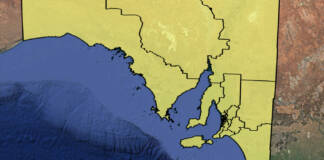
South Australia’s Premier, Mike Rann, yesterday announced the details of a referendum to be held alongside next March’s state election, which, if passed, would see the number of seats in the Legislative Council cut from 22 to 16, with all MLCs elected for a four-year term at every election, and would allow the government to call an early election in the case of disagreement with the upper house.
I think it’s wise to be distrustful of any politician that proposes reducing the number of MPs. It’s a superficially populist policy that ultimately concentrates power in the hands of the government. It seems bizarre that, in a time when population is growing rapidly all across Australia you would consider reducing the number of representatives in Parliament. If anything, a larger population merits an increased size of Parliaments, state or federal.
It seems it is a blatant attempt to destroy the only serious check on the power of the Rann government. While a 16-seat Legislative Council would still allow minor parties like the Greens and Family First to win one seat each, it would undoubtedly harm the ability of the upper house to work as a house of review, in terms of forming functional committees that can investigate issues closely. I’m sure many party leaders would be happy to be rid of some of their backbenchers, who are always more free to rebel and disagree with the government’s direction. If a majority of your party are in the cabinet, it’s much easier to keep a tight leash. Yet these microparliaments result in bizarre scenarios like those in Tasmania and the ACT where a governing party has no depth on the bench, and has to bring into cabinet every MP who is not blatantly incompetent or insane.
It’s understandable that South Australians would not want to continue to elect MLCs for an eight-year term. However, you could achieve a four-year term in the upper house without reducing the size of the Legislative Council to a ridiculously small size. Either you could leave the chamber at its current size, which would produce a quota only slightly lower than in New South Wales. Another option, which would probably be prefered in terms of the types of MLCs you would elect, would be to adopt the Western Australian/Victorian model with MLCs being elected to represent a region. You could easily elect the Legislative Council from five regions, with each region electing 5 MLCs.
The ABC’s story also includes bizarre comments from Business SA, who, like many business lobby groups, appear to want to strip away any semblance of democratic accountability from our modern governance, be it upper houses not controlled by governments or local council control of planning decisions.
Chief executive officer Peter Vaughan says Legislative Councillors have promised to address key issues for the business community but the the nature of the Upper House prevents them from doing so.
“When that’s denied by a coalition in the Upper House that can have very low electoral mandates and be one-purpose only elected personnel in the Upper House, that defeats and destroys the real reason for electing governments in the first place,” he said.
“There is far too much government and far too little action.
“Let the people have their say, I think that’s an appropriate way to go by referendum and let’s see if we can reform a form of governance in South Australia which really belongs more to the 18th and 19th centuries than it does to the 21st.”
I could go on about how the real 18th century form of governance is the bizarre system of single-member electorates which forces a two-party system on a political world where there are never only two sides to an issue, and locks in majority governments when no political party commands the support of the majority.
The Legislative Council in South Australia, like its counterparts across the Australian mainland, represents the democratic voice of the people in a political system where major political parties try their hardest to streamline government decision-making to prevent any sort of democratic accountability. Rather than attacking the upper house, we need to take lessons from upper houses to reinvigorate lower houses that have become little more than electoral colleges for the purposes of supporting elective dictatorships.
It is particularly bizarre that the proposal has arisen only a day after former Beattie cabinet minister Gordon Nuttall was convicted for corruption. Queensland is Australia’s only state without an upper house, and this lack of democratic oversight arguably has allowed state governments runaway power. New Zealand likewise abolished its Legislative Council in 1951, and New Zealand’s system of one-party governments controlling a unicameral parliament helped lead to runaway neoliberalism in the 1980s and 1990s, creating such a backlash that led to the introduction of proportional representation in 1996.
Mike Rann’s referendum, rather than improving South Australia’s system of government, simply is a blatant attempt to grab further power and prevent pesky oversight of government.