

Incumbent Senators
| Term expires 2011 |
Term expires 2014 |
| Judith Adams (LIB) |
Mark Bishop (ALP) |
| Chris Back (LIB)1 | Michaelia Cash (LIB) |
| Mathias Cormann (LIB)2 | Alan Eggleston (LIB) |
| Chris Evans (ALP) | David Johnston (LIB) |
| Rachel Siewert (GRN) |
Scott Ludlam (GRN) |
| Glenn Sterle (ALP) |
Louise Pratt (ALP) |
1Chris Back replaced Chris Ellison on 12 March 2009 after Senator Ellison’s resignation.
2Mathias Cormann replaced Ian Campbell on 19 June 2007 after Senator Campbell’s resignation.
History
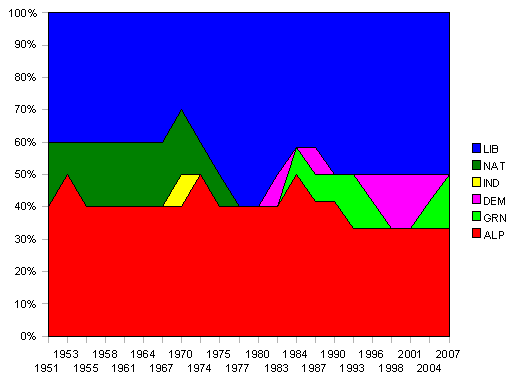
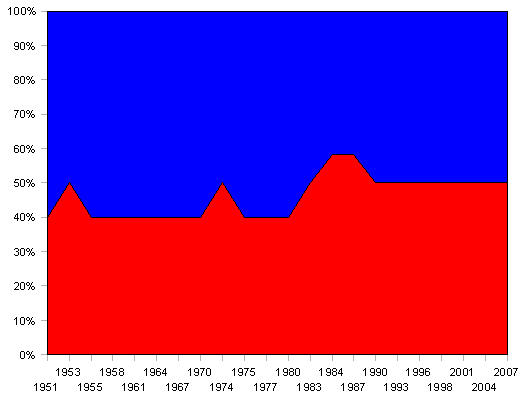
Western Australian Senate races were dominated by the Coalition from 1951 until the beginning of the 1980s. The 1951 election produced a result of four ALP senators, four Liberal senators and two Country Party senators. The 1953 election saw the ALP win a seat off the Country Party, but the previous result was restored in 1955. The 4-4-2 result was maintained at every election throughout the 1950s and 1960s. The 1970 Senate election saw the Liberal Party lose one of its four seats to independent Syd Negus, who was elected on a platform of abolishing death duties.
The 1974 double dissolution saw Negus defeated and the Country Party lose one of its two seats. The result saw five Labor senators alongside four Liberals and one Country senator. The 1975 double dissolution saw the Coalition regain its majority in Western Australia, with the ALP losing its fifth senate seat to the Liberals. The 1977 election saw the National Country Party lose its senate seat to the Liberals, producing a result of six Liberals and four Labor senators.
The 1983 double dissolution saw the Liberals lose their majority, with five Liberals, four Labor and one Democrat elected. The 1984 election saw Labor gain both new Senate seats while the Democrats lost their seat. In addition to 6 ALP and 5 Liberal, the Nuclear Disarmament Party’s Jo Vallentine was elected. At the 1987 double dissolution, Vallentine was re-elected as an independent along with a Democrat and five each for the two major parties.
The 1990 election saw the Liberals win six seats, along with five Labor and the re-elected Vallentine, who was re-elected as a Green. The Liberals have maintained six WA seats ever since. The 1993 election saw the Greens win a second seat off the ALP. From 1993 until today, WA has been represented by six Liberals, four Labor senators and two minor party Senators from the Greens or Democrats.
In 1996, the Greens lost one of their seats to the Democrats, losing their other seat in 1998. The Democrats held onto their seat in 2001 before losing one of their seats in 2004. The last Democrat was defeated by the Greens candidate in 2007.
2007 result
| Group | Votes | % | Swing | Quota |
| Liberal | 555,868 | 46.22 | -3.12 | 3.2351 |
| Labor | 433,046 | 36.00 | +3.48 | 2.5203 |
| The Greens | 111,813 | 9.30 | +1.24 | 0.6507 |
| Christian Democratic Party | 21,179 | 1.76 | -0.12 | 0.1233 |
| Nationals | 17,365 | 1.44 | +0.58 | 0.1011 |
| Democrats | 12,604 | 1.05 | -0.95 | 0.0734 |
| One Nation | 11,623 | 0.97 | -1.48 | 0.0676 |
| Democratic Labor Party | 11,390 | 0.95 | +0.95 | 0.0663 |
| Family First | 10,341 | 0.86 | +0.01 | 0.0602 |
| Others | 17,521 | 1.46 | 0.1020 |
The Liberal Party won three seats on primary votes and the ALP won two. After preference distribution, the last four candidates standing were Scott Ludlam of the Greens, Gerard Goiran of the Christian Democratic Party, #3 ALP candidate Ruth Webber and #4 Liberal candidate Michael Mischin. They each had the following number of votes:
- Ludlam (GRN) – 0.7612
- Webber (ALP) – 0.5270
- Goiran (CDP) – 0.4607
- Mischin (LIB) – 0.2498
Mischin was excluded, and the vast majority of his preferences flowed to Goiran of the CDP, producing the following count:
- Ludlam – 0.7669
- Goiran – 0.7015
- Webber – 0.5300
Webber was then excluded, and her preferences elected Ludlam, and the final count was:
- Ludlam – 1.2917
- Goiran – 0.7062
Candidates
No information on major party candidates. Greens Senator Rachel Siewert will be running for re-election for the Greens. The Nationals are running Bunbury City Councillor John McCourt.
The Socialist Alliance is standing Ben Peterson, Family First are standing Linda Rose and One Nation is standing Craig Bradshaw.
Political situation
Western Australia is the weakest state for the ALP, based on 2007 figures. The Liberals clearly came first in the Senate vote in 2007, outpolling the ALP by 10%. It is also the one state where the Greens are at risk of losing a seat, regardless of whether the election is called as a half-Senate election or a double dissolution. In the case of a half-Senate election, a swing to the ALP away from the Coalition puts Rachel Siewert at risk of being squeezed between three quotas for each of the major parties, in a similar way that Kerry Nettle was defeated in NSW in 2007.
If the Greens manage to increase their primary vote by about 3.4% of the vote through swings away from the major parties, they should be able to be elected with major party preferences. Short of that, the following swings between the major parties (ignoring the Greens vote level) would result in a seat change from the current 3-2-1 split:
- A 10.2% swing from Liberal to Labor would give the ALP a third seat at the expense of the Liberals.
- A 4.3% swing from the ALP + Greens to the Liberals + CDP would give the Liberals/CDP a fourth seat at the expense of either the Greens or Labor, depending on vote levels for CDP and Greens candidates.
- A 1.3% swing from Liberal to Labor would give the ALP a third seat on primary votes, locking out the Greens.
Using primary vote levels from 2007, a double dissolution would produce a clear result. The Liberals would hold their six seats, the Greens would hold one of their seats, the ALP would hold their four seats and the fifth ALP candidate would be in a very strong position to win the last seat, costing the Greens one of their two seats. A 6.8% swing from the combined right-wing vote to the ALP + Greens would be needed to allow the Greens to hold their second seat at the expense of the Liberals.
“A 3.5% swing from Liberal to Labor would give the ALP a third seat on primary votes, locking out the Greens.”
I can’t sleep, so I had a fiddle with this…
Shift 3.5% = 0.2447 quotas from Lib to ALP, and you get (Lib, ALP) = (2.9904, 2.765) on primary votes – round the Libs up to 3, so they get 3 elected with no surplus. So then that’d filter through to your first table as:
Webber (ALP) – 0.7717
Ludlam (GRN) – 0.7612
Goiran (CDP) – 0.4607
The CDP then go out, presumably electing the ALP.
However, the swing wouldn’t need to be that big. If the Libs had a small surplus which went to the CDP but didn’t push them ahead of the ALP, the same thing above would happen. The minimum swing would need to be (CDP + Lib surplus – ALP surplus)/2 = (0.7015-0.5300)/2 = 0.0858 quotas, or 1.23%, which would change your next table from this:
Ludlam – 0.7669
Goiran – 0.7015
Webber – 0.5300
to this:
Ludlam – 0.7669
Webber – 0.6158
Goiran – 0.6157
and Webber wins as before – close run thing. It’s lucky Labor didn’t get much Kevin07 swing… we got Scott Ludlam instead of some time-serving Labor #3. (I’d never heard of Ruth Webber before, actually. Why do I know so little about my own senators?)
So, yeah, tl;dr version… Greens need to get their vote up if Rachel Siewert wants to keep her job. I imagine she got up in 2004 with a Mark Latham-inspired low ALP vote and Democrats preferences from Brian Greig… that won’t be happening this time. I don’t think the WA Dems even exist any more, and I haven’t heard of Greig in a while.
#1
Bear in mind in that last calculation that the Liberal surplus, unlike the rest of the CDP votes, goes to the Greens ahead of the ALP. Did you take that into account?
Ben, the last sentence in the history section should have ‘in 2007’ at the end.
Thanks @1, you’re probably right. While it is true that the Liberal preferences would flow to the Greens, the majority of the CDP’s votes would go to the ALP and would be enough to give the seat to the ALP.
You know Antony’s Senate calculators from 2007 are still online:
http://www2b.abc.net.au/Elections/View/SenateCalculator.aspx?e=1&ca=wa
I just plugged in the 2007 results, and it took a 2.9% shift in primary vote from Libs to Labor for the Greens to lose. CDP also accumulated prefs from the Nationals, Climate Change Coalition, Carers Alliance, One Nation and Conservatives for Climate and Environment, 2.95% in total not including the Libs, which went to Greens ahead of Labor.
Clive Palmer reckons the Nats can win a seat in WA and is willing to put $1m into it. The Nat vote will almost certainly go up, with the WA Nats popular amongst their constituency, but unless the Libs fall well below 3 quotas he must be dreaming.
You’ve got me really interested in trying to figure out the best way to work out these swings required to change results now.
Firstly, Ben, I think you might have caused some confusion by saying the Liberal to Labor swing would give Labor a third seat ‘on primary votes’, neither a 1.3% or a 3.5% swing would do that – Labor would need to increase their vote by 6.86% to get 3 quotas on primary votes.
Let’s take the 1.3% scenario. The total formal votes were 1,202,750, so 1.3% of that is 15,636 – let’s say 15,650.
So let’s go to counts 187-192, where the Libs are excluded (taking 15,650 votes off the Libs would still see them excluded at this point). Goiran is on 120,541, Webber on 91,063 and Ludlam on 131,765. The quota is 171,822. If 15,650 votes were shifted from the Libs to Labor, then this would reduce Goiran’s total to 104,891, and increase Webber’s to 106,713.
So Goiran gets excluded before Webber. At this point we have no way of knowing what happens with BTL votes, so I’ll just treat everything as ticket votes. Assuming that every vote for each of the groups whose tickets preferenced the ALP ahead of the Greens now flows to the ALP, we can add the following to the ALP total at the exclusion of the CDP: 1,002 votes from the CEC, 21,179 from the CDP, 946 from the NCP, 11,390 from the DLP, 10,341 from FF, 819 from Group M (Wynne), 1,621 from Group P (Campbell), and 591 from the LDP. That’s 47,889 in total, putting Webber on 154,602, well short of the 171,822 quota.
Now I’ll work backwards, 154,602 – 15,650 = 138,952, ie 138,952 would’ve been the ALP total in 2007 in an ALP v Greens contest with no leakage of BTL prefs from ALP-preferencing groups to the Greens (so in reality we can assume this is an optimistic scenario for the ALP). Subtract that from the quota (171,822) and you get 32,870, which translates to 2.73% of the total formal votes – ie 2.73% would be the minimum swing required for the ALP to have won the last seat instead of the Greens.
How does that sound? Anyway, my head hurts so I’m going to bed.
Btw Ben, you misread my suggested correction in #2, and obviously didn’t read the sentence you were correcting.
Some more playing around with this for those interested. Although the senate calculator doesn’t take into account BTL votes, it is reasonably close to the mark (for the mainland states where there are relatively few BTL votes at least) and at least gives a rough guide to how different swings alter the result. As I’d pointed out earlier, entering the 2007 results with a 2.9% primary vote swing from Liberal to Labor gave Labor the last seat at the expense of the Greens, but enter a 3.5% swing and the seat goes back to the Greens again, and it takes a 6.5% swing before Labor again gets the last seat. Hours of fun here.
Hi Ben and co, I have made a senate calculator at http://um.com.au/cassandra, where you can drag and drop your own preference lists. Still working on it, but it’s usable now…
In news on other minor party candidates, Ben Peterson is standing for the Socialist Alliance, whilst respective party websites name Linda Rose as lead candidate for Family First and Craig Bradshaw for One Nation.
Scott Cowans, a former ALP member, is reportedly setting up a new party, WA First, with the aim of running a Senate ticket.
I remember Scott Cowans being a Young Labor boy from Murdoch Uni. I also see that he is the “youngest President of the WA Club” – talk about establishment!! The #2 on the ticket is a former Liberal Party backer, so i think we can see where this is headed… Given the #3 on their ticket is a uni student, I smell a Lib feeder ticket riding on the tax issue, backed by the business establishment. Expect some big ads from them.
I thought that this would be a hard Senate seat for the Greens to hold, what with the rising Labor vote in WA until about 6 months ago. But with the Mining Super Profits tax being highly unpopular in WA and the corresponding fall in the Labor vote (there is significant evidence that Hasluck is gone and even Brand is in trouble), it’s looking much more likely to return 3-2-1 again. And Labor may end up with only Perth and Freo in WA. Do we have any Western Australians here with a view from the ground?
The Democratic Labor Party (WA) Branch have announced their two candidates for
the upcoming Federal Election.
They Are …………at no 1. Elaine McNiel and Joe Nardizzi at no 2.
The polled 11390 votes at their first attempt in over 25 years in 2007 and should gain a healthy increase on that vote this time around. The increase could see them rise and threaten for a seat bouyed by preferences from FF, CDP and One Nation and the Nationals
Congratulations to the WA Team and I wish them all the best.
Hamish, in response to your query, my view is that the most likely situation would be a 3-2-1 split instead of a 3-3 split. With the mining tax there was quite an anti-Rudd sentiment in various circles in WA. A lot of people I know are still cynical about Labor and view that the Liberal’s economic policies will maintain the prosperity associated with the mining industry.
Interestingly enough, when the State Liberal govt increased electricity charges by ridiculous amounts, the WA public were not anywhere near as up in arms as they were about the proposed super profits tax. At one point there, I thought that it may have even been likely that the parties on the right would collectively get more than 57% of the Senate vote and grab 4 senates seats.
I am quite curious to see if Steve Innes, the 2008 Liberal candidate for Armadale and Ben (is it?) Morton, the Belmont candidate with each have another tilt, or even find themselves endorsed for such once again, given their Labor oppostion/incumbents have left the scene.
Innes did well for a first timer in the safest Labor seat in the state and I think he’ll do better this time.
Anyone care to comment?
@ Mark Tanston: Steve Innes lives in Southern River and actually was approached initially to be that candidate in 2008.
Senator Abetz kyboshed that and had lil’ brother Peter nominated and endorsed as the Southern River candidate instead, and Innes endorsed instead for the near impossible feat of taking on Alannah’s Armadale.
Might have been better to leave Innes locked in in Southern River as the current Abetz incumbant has made no impression at all.
Any news on major candidates for Libs, Labor or Greens. And, any news of a Democrat running?
Senator Rachel Siewert is running for re-election for the Greens.
Dems = kaput. The election section of their website is ‘coming soon’ (it’d wanna be pretty soon), and the WA section doesn’t mention anything about it. I doubt they’re running.
The question on everybody’s lips (OK, maybe not quite): whatever happened to WA First? Read their badly designed website here.
So, fail then. I tip ’em to get <1% of the vote. They may help the Nats gather up a quota if the Libs drop well below 3 quotas, but apart from that they're irrelevant.
Dems have announced two candidates in WA Senate race.
Do they have names / weblinks? As a former Democrats voter, I’m genuinely interested, but the main theme of the WA Dems seems to be “we’re rebuilding” as far as that crappy website is concerned.
Paul Young and Matthew Corica – the Dems have also announced their election platform now, I think, however, I don’t know that it’s that different from the last election?
The 2008 election was quite a surprise to Labor and the AEC where Armadale was concerned.
While still a Labor retain it was a shock when on a 2pp basis, the Liberal Steve Innes garnered 35% of the vote, impressive in the safest Labor seat in the state.
I recall the AEC forcasting only about 10-15% 2pp going to the Liberals.
With Labor’s MacTiernan out of the picture to contest federal Canning, Innes should have a smooth run, if he is contesting again this time, across the Line against the unknown Labor candidate T. Buti, given the Labor brand has soured somewhat in that eletorate since the last incumbant lost government and her important portfolio and all the funding and developement the electorate had enjoyed while she still was still the planning and infrastructure minister.
Armadale and surrounding areas have experienced a hefty downturn since sept 2008 and a Liberal member of a Liberal government may very well be the best thing for that place.
Really makes me wonder why they did not contest the other blue ribbon Labor seat of Fremantle.
Scoring Fremantle and Armadale would give Liberals a solid majority and cancel the dependence on the Nationals support to retain balance of power.
The Liberals need to take some more risks, I think.
I have just looked at the WAEC website and amazingly the Liberals have not endorsed a candidate for the Armadale by-election!
Given their 2008 state election victory, the Canning Liberal retain and a probable Liberal minority federal gov’t it seems to me that Armadale would be a special target, given the identity of the previous incumbent who was just defeated by Randall over Canning.
For the Liberals to have forwarded Steve Innes, the 2008 Liberal Armadale candidate or someone similarly well placed and for that person to win, in what is considered safe Labor heartland would have been a body blow to the Labor brand in WA and perhaps federally.
Only Labor and a few minor and independant candidates are listed and it is safe to assume that the Labor candidate will cross the line.
Why the Liberals have not grasped this opportunity and just handed the electorate to a Labor unknown is beyond me, when a Liberal candidate could have made history in becoming the first sitting member for Armadale ever.
Given that Armadale has suffered financially since Sept 2008, when Alannah MacTiernan retained Armadale for Labor but lost her ministerial portfolio and all that goes with it when Labor lost government has resulted in many of that electorate to question is it really worthwhile to have a member from a particular party when it is not the party in government?
As such, the Labor brand has soured in Armadale, with the Liberal goverment all but forgetting it’s existance and the funding, development and attention lavished upon it by it’s previous Labor incumbent had evaporated over night (from Sept 6 2008)
The result is that the Labor incumbent did not realise any of the promises or commitments made in 2008 to retain Armadale and the number of development projects downgraded or even cancelled is considerable.
Of course, in fairness to the electorate, who really thought the Liberal party would win government and that their high profile, cashed up benefactor, in MacTiernan, would become a backbench, oppostion nobody overnight?
If they had perhaps voted Liberal then, then combined with a Liberal state government and that electorate a part of the federal Canning electorate, the “good times” might have continued.
The WA Liberal party has really missed a good opportunity on this occasion and it will go to a Labor unknown and Mactiernan plant that does not deserve it.
Perhaps Steve Innes should have lobbied his party harder to pursue this or even stood as an independent?
Armadale, being the only election taking place in the nation, it should be no issue for the party to muster the resources to campaign effectively, given it’s a single electorate by election and not a multi electorate state or federal one.
Opportunity for history missed – Just dumb.