
Martin Hamilton-Smith clings on

July 4th, 2009

SA Liberal leader called a sudden leadership spill today in order to resolve the leadership issues over the ‘dodgy documents’ affair earlier this year and the loss of frontbencher Mitch Williams last week. Instead, the spill appears to have made Hamilton-Smith’s position untenable, as he won 11 votes, to 10 votes for his deputy Vicky Chapman, with one abstention. Another spill has been called for Wednesday, with the hope of a more decisive result.

Ben Raue South Australia

Gender balance in NSW Parliament

July 2nd, 2009

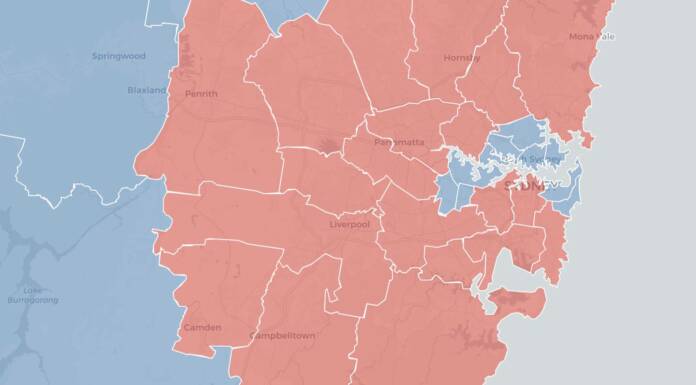
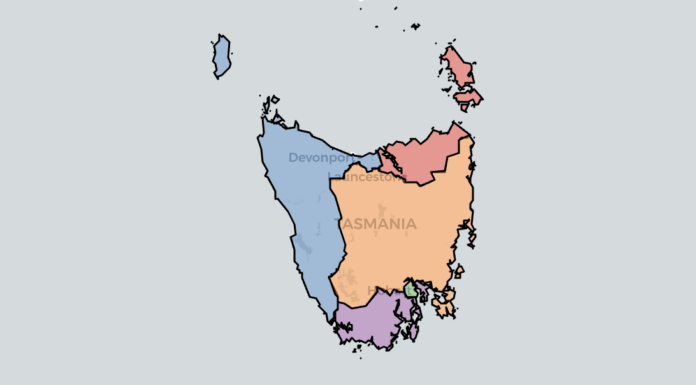
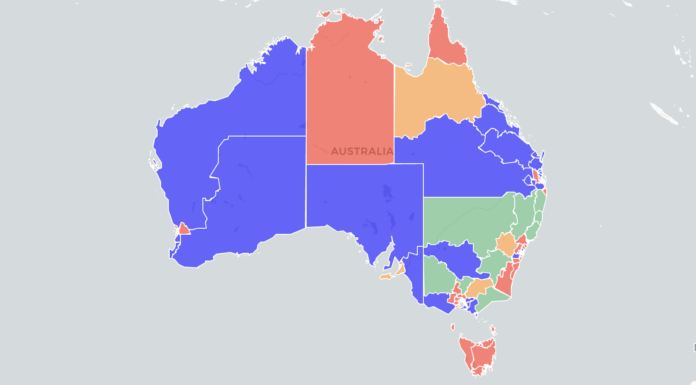
I was looking the boundaries of the federal seat of Grayndler earlier today when I noticed that all five state electorates that overlap with Grayndler are held by female MPs, along with a number of other neighbouring seats. I thought it would be interesting to get an idea of how the gender balance in the Legislative Assembly is distributed geographically.

There are 25 women in the NSW Legislative Assembly, out of a total of 93 MLAs. Each party has the following gender balances:

  • Labor - 17/51 - 33.3%
  • Liberal - 5/23 - 21.7%
  • National - 1/13 - 7.7%
  • Independent - 2/6 -  33.3%

Read more…

Ben Raue New South Wales

Random election stat

July 2nd, 2009

I’ve been looking over the Senate results in the NSW seat of Grayndler at the last federal election, and I found this interesting information. This is the list of the top 10 polling individual candidates in terms of below-the-line votes.

  • Kerry Nettle (GRN) - 1691 (1.93%)
  • Mark Arbib (ALP) - 398 (0.45%)
  • Karl Kruszelnicki (Climate Change Coalition) - 280 (0.32%)
  • Helen Coonan (LIB) - 194 (0.22%)
  • Lyn Schumack (DEM) - 187 (0.21%)
  • Patrice Newell (Climate Change Coalition) - 105 (0.12%)
  • Marylou Carter (Carers Alliance) - 68 (0.08%)
  • Ursula Stephens (ALP) - 60 (0.07%)
  • Paul Green (CDP) - 59 (0.07%)
  • Jack Mundey (GRN) - 58 (0.07%)

Amongst below-the-line votes, Kerry polled 46.11%, and the Greens six candidates collectively polled 51.02%. Interesting.

Ben Raue Electoral history

Death by a thousand polls

June 29th, 2009

Well, three polls, at least.

In a moment of synchronicity, three of Australia’s four pollsters have released federal voting intention polls, all clearly showing a collapse in support for the Coalition and possibly spelling the end of Malcolm Turnbull’s leadership.

Read more…

Ben Raue Polls, South Australia, Victoria 2010

Latest NSW Newspoll hits hard

June 24th, 2009

The latest Newspoll has reversed the small gains made by Nathan Rees in the previous Newspoll, with the Coalition polling 41%, the ALP 31% and the Greens 14%. The two-party-preferred figure put the Coalition on 55%, however, as many have pointed out, two-party-preferred figures are largely meaningless in current NSW politics, with a large number of seats being contests between a major party candidate and a Green or independent, and with high rates of exhaustion expected. This factor makes it difficult to calculate the impact of a uniform swing from a poll using a pendulum.

I thought it would be worth making an attempt to calculate uniform swings based on primary votes. Of course, that is not simple and there is a wide margin of error in any predictions that can be made. I also calculated swings based on a proportion of the vote previously received. So a swing for the Greens from 10% to 14% was translated into a 40% increase in the Greens vote, rather than a uniform swing. I then tried to estimate the likely impact of preferences in all seats where no-one won a majority of primary votes. I assumed that Green preferences would be practically neutral, with far fewer Greens preferencing the ALP. I projected that independent preferences would favour the Coalition. I’ve included what this exercise came up with in the post below the fold.

Elsewhere: Posts at Macquarie Street, Poll Bludger and Pollytics.

Read more…

Ben Raue New South Wales

NSW Greens choose Lee Rhiannon for Senate

June 21st, 2009

In breaking news, the NSW Greens conducted their preselection ballot count yesterday, with Lee Rhiannon winning comfortably to be chosen for the first position on the ticket. The second position went to Executive Director of the Nature Conservation Council of NSW, Cate Faehrmann, with Lane Cove councillor Keith McIlroy taking the third position on the ticket.

This appears to be a strong ticket for the Greens, with a candidate with extensive experience in state Parliament and a record of going after the state Labor government bringing valuable experience to the Senate team from a large state currently unrepresented by Greens. In the case of a double dissolution, there would also be an outside chance of electing a second candidate, and Faehrmann would make a strong Senator, as a younger candidate with strong environmental credentials.

Meanwhile, the picture of the Greens lead Senate candidates around the country is becoming clearer. Richard di Natale, the 2007 lead candidate and candidate for Melbourne at the 2002 and 2006 state elections, has been selected to run in Victoria. It appears likely that Larissa Waters will run again in Queensland after performing well in 2007. I assume that Senators Rachel Siewert and Christine Milne will easily be re-endorsed by their respective states to run for second terms. I have no information on any potential candidates in South Australia.

In the ACT, it appears that the leading candidate could be a prominent left-wing intellectual with no previous history with the Greens. Hopefully I can say more in the future after checking some sources in the ACT.

Ben Raue Australia 2010, Greens

5 things not to do when you’re trying to rig an election.

June 19th, 2009

5. Rig an election where 80% of people turned out to vote

The turn out at the recent election in Iran was the largest in the country’s history.

This shows that the people were very committed to this particular election – and since the establishment has to give their blessing to candidates that are running, it might have been wise to just leave this one alone.

4. Give the election by a huge margin to an unpopular candidate - subtlety is the key

If you’re going to rig an election – any election – remember to do it by a believable margin. The Iranian government announced that Ahmadinejad polled over sixty percent of the vote. This is practically impossible to achieve in any context where any sort of diversity of opinion exists – if rigging an election, it’s best to be subtle and give the winning candidate a more believable vote.

3. Don’t announce the results until you count the votes

This is just a matter of good common sense or else people start to cut corners and then something like this happens.

This screen shot shows voting numbers being announced on Iranian television, and actually shows one of the candidates losing some 100 000 votes during the vote count.

2. When the people get angry tell them it’s just like a soccer game

Now this is just putting ideas into people’s heads. Especially when the analogy seems to be so ironic – dodgy referees anyone? But on a serious point any good dictator – especially one in a country where soccer is more like a second religion than a sport – should better than to mix politics with ‘the beautiful game’ or else you have it bite you in the ass. It certainly did in this case where some of the Iranian football team in a match that was aired on Iranian state owned television wore green wrist bands to support the pro-Mousavi protests.

1. If you have veto power, don’t let someone run that has links to the institution and will be able to find proof the election was rigged

Mousavi was Iran’s Prime Minister back in the 1980s. He then decided to run off and design buildings and be an artist for the last twenty years. Since he once held such political office he still had many people loyal to him in the establishment who would have no qualms telling him that the votes were dodgy. The lesson here is that, if you get to pick which guy runs, don’t let the ones with any power do anything or else they’ll be able to find out if you do anything dodgy.

Remember, rigging an election is all about being able to hide your tracks.

Sara Haghdoosti Iran 2009

Europe 2009 - summary

June 17th, 2009

The overall results for the European Parliament were:

  • EPP-ED - 264
  • PES - 161
  • ALDE - 83
  • G/EFA - 53
  • EUL-NGL - 33
  • I/D - 18
  • UEN - 14
  • Other - 110

While all of the groups except the Greens lost seats, due to the reduction in size of the Parliament, these were on very different scales. ALDE and the EUL-NGL each lost 5 seats, once you take into account the parliamentary reduction. The Greens gained 13 seats. The People’s Party and Democrats gained 20, and the Socialists lost 35. This shows that there was a clear swing away from the centre-left which effectively went to both the centre-right and the Greens.

The UEN and Independence/Democracy are reduced to effective rumps. In both cases a majority of the group’s remaining seats are held by a single party. 13 of the 18 seats in the Independence/Democracy group are held by the United Kingdom Independence Party, while 9 of the 14 UEN seats are held by Italy’s Lega Nord.

It appears that Italy’s Democratic Party will join in a coalition with the Party of European Socialists, which will become the Alliance of Socialists and Democrats for Europe. These 21 MEPs will lessen the losses suffered by the PES.

There appears that there will be a reorganisation of the groups of the European right, with the creation of a European Conservatives group led by the UK Conservative Party. There will be a group of MEPs left over from the dissolution of UEN and I/D. There are also a sizeable number of far-right MEPs, some of which were formerly part of Identity, Tradition, Sovereignty during its brief existence and others from parties that have never had seats before (such as the British National Party). There may well be sufficient right-wing MEPs, once the Conservative group has formed, to create some sort of far-right coalition.

In one final note, I produced an elaborate prediction just before the election predicting where every seat would go. I’ve gone back and revisited the prediction, and calculated that I correctly predicted 89.95% of the seats, or 662 seats (with 74 seats being incorrectly predicted). It’s not quite as impressive when you bear in mind that all EU countries use proportional representation, so it’s easy to guess the bulk of seats, and it’s always the last few that are up for grabs. Anyway, it’s always good to review your predictions after the election.

Ben Raue Europe 2009

Guest post at FairVote Blog

June 17th, 2009

I’ve been taking a break post-EU but will be back to usual transmissions soon, with a final concludig post on the EU and a couple of other posts. However, you may satisfy yourself in the meantime by reading a guest post I wrote for the blog of FairVote, a US group campaigning for fair electoral processes, proportional representation and preference voting in US elections. The post deals with the impact of preference voting on the Greens in Australia.

Ben Raue Electoral systems

Today’s elections

June 13th, 2009

Since I focused all my attention on the European Parliament election, I’ve missed a few other elections. I thought it would be good to mention a few interesting elections that are taking place today:

  • Iran’s voters are almost finished going to the polls to elect their President. The race has turned into a fierce contest between hardline supporters of Mahmoud Ahmedinejad and reformists led by Mir Hossein Mousavi. It has been really hard to provide sensible psephological analysis of the election, so I won’t try, but a good source of  information is the Guardian liveblog.
  • Voters are going to the polls in Auckland to elect a new Member of Parliament in Helen Clark’s old seat of Mount Albert. Although electorate seats help determine the number of list seats each party wins, a change in party holding Mount Albert would result in Labour losing one of their seats. The National Party has largely given up on the race, and recent polls suggest Labour is on track for about 60%  of the vote. The interesting element is in the campaign for Green Party co-leader Russel Norman, who is a sitting list MP. He won’t win, but it would be a strong result for the Green Party and their new leadership team of Norman and Metiria Turei if they manage to overtake the National Party candidate.

Ben Raue Iran 2009