

The Australian Electoral Commission has officially opened the first round of submissions for the federal redistribution of Queensland. The state will maintain thirty electorates, but the current boundaries, first used at the 2019 federal redistribution, are showing their age and are due for a freshening-up.
This redistribution was due last year, but was postponed due to doubt about whether Queensland could gain a thirty-first seat for the 2028 federal election. That is why this redistribution is only commencing now, while redistributions for federal seats in South Australia, Tasmania and the ACT are almost finished.
Along with the opening of submissions, the AEC has also published detailed enrolment figures for every SA1 block in the state, as well as projections of what they expect enrolment to be in August 2028. This is a shorter projection period than what I’ve seen for past redistributions, and I’ve asked the AEC why this is the case.
The main point of this blog post is to analyse those projected enrolment figures.
Australian federal electoral law allows electorates to be drawn with up to 10% variation in current enrolment, but just 3.5% variation as of the projection period. So those projection numbers end up more important and ensure that fast-growing seats are drawn smaller than slow-growing seats.
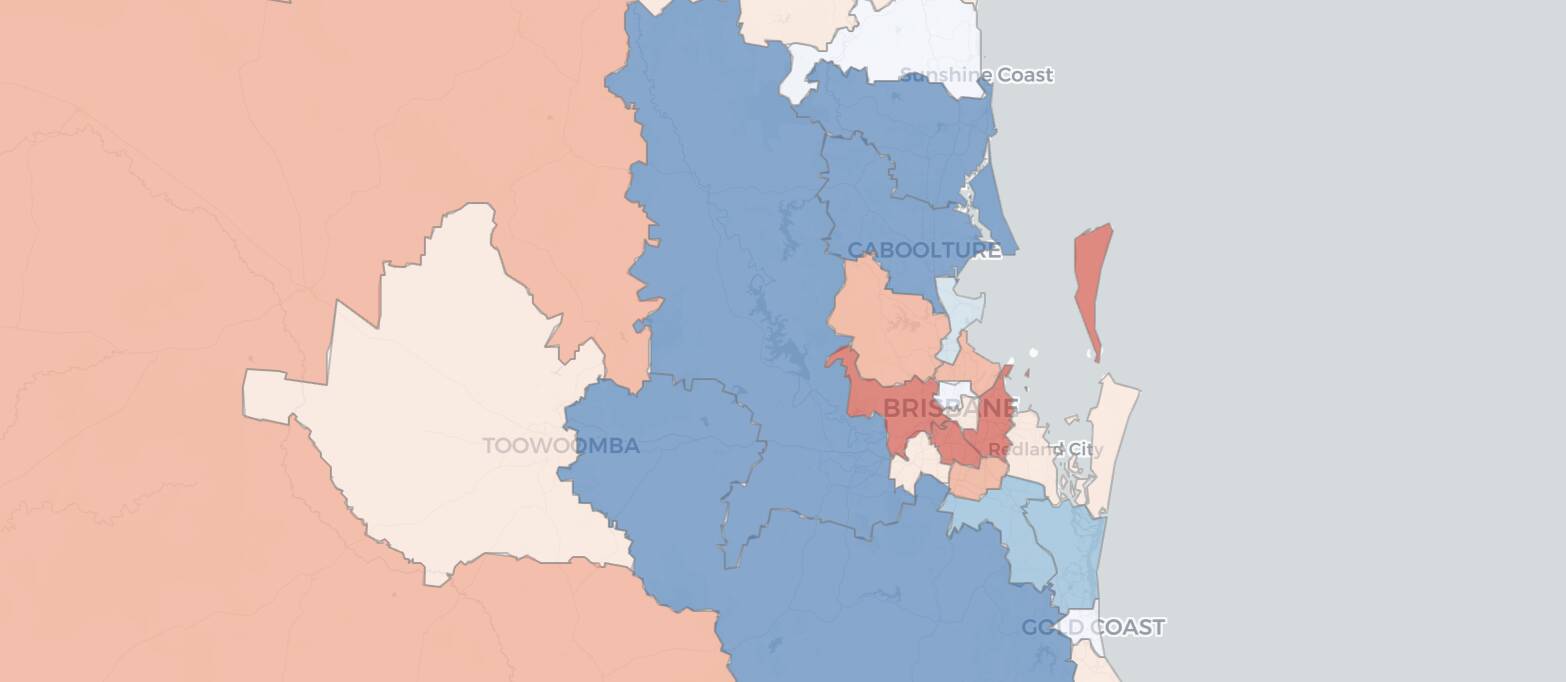
This map shows how much each seat deviates from the average on the projected figures. You can click on any seat to see the precise deviation on both metrics for that seat.
There is a very distinct ring wrapping around Brisbane where seats 15%+ over the projected quota: Wright, Blair, Longman and Fisher collectively are projected to have about 73% of a seat in surplus enrolment by 2028.
Seats in Brisbane proper, on the other hand, are mostly well under quota. Ryan, Moreton and Bonner are all at less than 90% of the average. Most other urban seats are all under quota by smaller degrees, although Brisbane and Petrie are above average.
The Gold Coast has some seats over quota and some under quota, but they mostly cancel out. Forde and Fadden have over a quota of surplus voters between them while Bowman, McPherson and Moncrieff are close to quota. Fairfax on the Sunshine Coast is slightly over quota.
Looking further field, just one seat outside of the south-east is over the average: Hinkler in central Queensland is projected to be 2.9% above the average. But none of the seats are as far below the average as Ryan, Moreton and Bonner.
This table groups electorates by region, and then ultimately into urban South-East Queensland and the remainder of the state. When one seat is over quota but it’s neighbour is under quota it is easy enough to adjust both seats by moving a suburb. But when a region systemically is under quota, it forces more significant changes.
The twenty seats of urban South-East Queensland are due to contain surplus voters equivalent to 40.9% of an electorate by August 2028, but that masks significant differences within these seats. The nine seats of Brisbane will only have about eight and a half seats worth of voters, while outlying south-east Queensland and the Sunshine Coast will have over 80% of a surplus seat.
Regional Queensland is significantly under quota, in particular the seats of North Queensland.
I suspect we will see shifts along the coast with seats expanding southward, and that will absorb some of the surplus enrolment on the outskirts of south-east Queensland, but Brisbane electorates will need to expand outward to absorb the remaining growth.
You can make suggestions now, and they must be in by Friday 16 October.

This dropped when I wasn’t expecting it. Time to get cracking on a suggestion/“idea”!
Initial observations after having played around with QGIS a bit, focusing on the regions:
– If Herbert, Kennedy, and Leichhardt are left slightly over quota, it is possible kick Dawson out of Townsville.
– It is possible to draw Dawson as precisely the union of Burdekin, Mackay, and Whitsunday LGAs.
– There are two good possibilities for Capricornia that follow LGA boundaries only. One is Banana + Central Highlands + Isaac + Livingstone + Rockhampton + Woorabinda. The other is similar but excludes Banana and instead has Capricornia stretch inland to Winton.
– It is possible to draw Flynn as precisely the union of Bundaberg and Gladstone LGAs. If Flynn keeps Banana Shire, it gets a bit messier but it should be possible for all or most of the Bundaberg urban area to be located in Flynn.
That’s a lot of cleaning up of some of the weirder boundaries in Central and North Queensland.
Unfortunately, some of Cairns will still need to remain part of Leichhardt, unless Cape York goes into Kennedy. Further south, it looks like Gympie might have the short end of the stick this redistribution. I’m struggling to see a way to avoid an awkward split of Gympie.
It wouldn’t surprise me if the LNP submission suggests that the Labor seat of Moreton be abolished, and a new notional LNP seat be created in the Sunshine Coast.
Both Dawson and Moreton/Oxley ought to be on the chopping block, new seat needed in the Caboolture/Sunshine Coast corridor which can then push the under quota rural seats north whilst the Ipswich/Logan corridor can receive an additional seat which pushes the existing under-quota South Brisbane seats north
I don’t see any abolitions in this redistribution. The projected deviations are not large enough, and are easily cancelled out before there is any room for divisions to be abolished or created.
In the draft I’ve prepared so far, the “nexus” of the enrolment deficiencies in North Queensland and inner Brisbane and the surpluses around the Sunshine Coast is that Petrie shuffles slightly north and Longman loses the Woodford area. The Central Queensland divisions shift southward quite significantly, but nothing is abolished.
It’s a similar case in the south. The surpluses in the outer suburbs and Gold Coast cancel with the deficiencies closer to the city and in Maranoa. The inner divisions expand, Fadden contracts, Wright loses the Lockyer Valley, and nothing is created or abolished.
@ Nicholas
Do you have any suggestions for Greater Brisbane i am particularly interested in Lilley and Rankin?
I’ll share some maps in time, but on Lilley and Rankin specifically the changes are relatively minor:
Lilley gains the balance of McDowall, Bridgeman Downs, and Carseldine from Dickson and Petrie; it loses Everton Park west of South Pine Road and Old Northern Road to Ryan.
Rankin gains Boronia Heights and Park Ridge from Forde; it loses Algester to Moreton. (This does create an unfortunate panhandle. It may be possible to massage the boundaries to eliminate it while satisfying numerical requirements, but at least for my first draft I’m erring on the side of keeping the numbers tight.)
Thanks Nicholas
I look forward to seeing your maps. I prefer that Lilley not include the Old Money areas of Ascot, Clayfield rather it stays is a middle ting focused seat
Done!
I’ve uploaded some screenshots here:
https://drive.google.com/drive/folders/1YzSU14RMESt1s6ha4xsrUs0qWdIdNavb?usp=sharing
I’ll summarise the key changes:
– There is a general clean up of some of the boundaries around regional cities in the north. More of Townsville’s southeastern suburbs (admittedly not all) are consolidated in Herbert. Towns to the west of Mackay are consolidated in Dawson. Gracemere joins Rockhampton in Capricornia.
– Divisions from Central Queensland to the Sunshine Coast are significantly redrawn. Flynn now unites Gladstone and Bundaberg. Hinkler now unites Hervey Bay and Maryborough. Wide Bay (having lost Maryborough) moves deeper into the Sunshine Coast. Fairfax and Fisher are reoriented such that Fairfax centres on Maroochydore while Fisher takes in Caloundra and the hinterland.
– Moreton gains the Centenary suburbs from Oxley, and Oxley in turn gains the balance of Greater Springfield, Redbank Plains, Collingwood Park, and the older suburbs along the rail line up to the eastern boundary of Bundamba from Blair.
– Wright loses the Lockyer Valley. The acreage suburbs in the northeastern corner are transferred to Blair. The rest is transferred to Groom, which in turn cedes many of the Darling Downs towns within Toowoomba Regional Council such as Oakey and Pittsworth to Maranoa, retaining only the Toowoomba urban area and some towns immediately outside of it.
For what it is worth I fed the AEC projection spreadsheet into an AI to see what it would give me. It was not very successful. The parameters I fed in were:
– maximum and minimum quotas for 2026 and 2028
– try and keep electorates in local government areas
– minimise numbers of voters to be moved.
– I also fed the ABS SA2 map into the model.
The downfall was that I did not specify that the electorates had to be contiguous. As a result, the map that came out had a series of exclaves particularly for Dawson and Rankin for some reason. The other outcome was that it made a very strong effort to keep the quotas very near the middle. At this stage, probably best to go back to a human centred method.
Nicholas
Interesting stuff. Before my little escapade, I had made a start working from the north. I have not got into the Sunshine Coast yet. The outcomes so far seem pretty similar to yours. I am not sure yet whether Flynn should be abolished. Like you I have a Hinkler / Flynn which has Gladstone at one end and Bundaberg at the other, as well as Hervey Bay and Maryborough combined into one division. Part of my issue is the name ‘Hinkler’ – Bert Hinkler is so associated with Bundaberg that one one hand Hinkler should include Bundaberg but the name Flynn is left looking for a division. As founder of the RFDS, Flynn is probably more deserving of division named after him rather than an earlier aviator. Thoughts anyone?
I honestly think the boundaries for this redistribution in large part draw themselves, unless radical change is considered (e.g. Mount Isa going into Maranoa and Cape York into Kennedy, which I doubt the committee will entertain). I think most of the difficult questions faced by the committee will be small-scale.
A key observation I made is that if you take all of the electorates north of the Brisbane River – excluding Blair, Groom, and Maranoa – and then add in the Karana Downs area – you have almost exactly 16 quotas. If we proceed by subdividing the north into 16 divisions, and the south into 14, we are in effect ensuring: a) the northern boundary of Maranoa remains unchanged, b) no division crosses the Brisbane River (other than the Blair if we’re being pedantic, since the Brisbane River technically continues a bit into the Somerset Region before becoming Lockyer Creek); both of which I think are desirable.
I haven’t put much thought into names and I don’t think I will be commenting on them too much in my submissions. Regarding Bert Hinkler’s connection to Bundaberg, the Hinkler I ended up with still has Childers and Gin Gin, if that counts.
“Wide Bay” might be another name to be questioned, given that my Wide Bay (and I don’t see a way to avoid this) is now Gympie + Noosa + the northern end of the Sunshine Coast Region (as far south as Kenilworth, Yandina, and Mount Coolum). Wide Bay is a federation name, but there has been recent precedent for abolishing federation names in certain situations. I remember there was some talk about naming a Sunshine Coast division after Steve Irwin.