Redistribution Archive

NSW redistribution boundaries – the next day

A substantial amount of analysis was produced yesterday about the draft boundaries for the NSW redistribution.

You can look at the maps here.

Antony Green has posted his estimated margins for each electorate.

He estimates that the ALP has lost two seats net to the Liberal Party. A Nationals seat was abolished in Western Sydney, while the new seat of Newtown was created, and is considered to be notionally Green.

As expected, there was a significant knock-on effect through southwestern Sydney and southwestern NSW.

This knock-on effect sees the seat of Goulburn changed dramatically. The town that gives the seat its name is now at the eastern edge of the seat, while Goulburn has gained large parts of Burrinjuck, including Yass.

The remainder of Burrinjuck has been merged with eastern parts of Murrumbidgee as the new seat of Cootamundra.

The three seats of Goulburn, Burrinjuck and Murrumbidgee are all held by ministers: Pru Goward, Katrina Hodgkinson and Adrian Piccoli. These three seats have been reduced to two, and this could see a clash between ministers, or force one of them to grab a seat off a neighbouring MP.

The seat of Murray-Darling has been renamed to Murray with the loss of Broken Hill, while Barwon has grown even larger to cover the sparsely populated north-west of the state.

Bathurst has been largely left alone, while Dubbo and Orange have swapped quite a bit of territory, shifting from a north-south axis to an east-west axis.

Changes were relatively mild in other parts of regional New South Wales.

In Sydney, the north shore has been left alone with only minor changes. The biggest changes start with the creation of the seat of Newtown, which has absorbed most of the excess quota from Heffron and Sydney and allowed those two seats to largely remain intact.

Antony Green estimates that Newtown is a notional Greens seat. I haven’t had a chance to crunch numbers myself, but this makes sense. The Greens seat of Balmain has largely been left intact, except for the loss of the suburb of Haberfield, which is considerably more conservative than the rest of the seat.

The ALP should have less trouble holding the new seat of Summer Hill than its predecessor of Marrickville, although the seat is still likely to be strong for the Greens.

Quite a few more seats are reshuffled throughout south-western and north-western Sydney. The seats of Menai and Smithfield have been renamed as Holsworthy and Prospect respectively. The ALP seat of Macquarie Fields has shifted south, gaining areas in the seat of Campbelltown which swung much more strongly to the Liberal Party. This is enough to switch the seat from notional Labor to Liberal.

Former Premier Nathan Rees’ seat of Toongabbie has shifted significantly and has been renamed Seven Hills, and his margin of 0.3% has become a Liberal margin of 8.5%.

2011 was a terrible result for Labor, and it’s probably not worth focusing too much on seats right at the bottom of the pendulum. Labor will presumably gain at least some swing back to them, and if there was to be a competitive election, the seats on current margins from 10% to 20% that would prove decisive.

So far, the boundaries seem very sensible, and a good attempt at dealing with all of the contradictions and demands that come with electoral redistributions.

I have started work on my Google Earth map of the new boundaries, but won’t have it finished until later this week. I will come back with those when they have been completed.

NSW redistribution – draft boundaries released

The NSW Electoral Commission has released the draft boundaries for the NSW state redistribution this morning.

I’m at work today so won’t be able to do any in-depth analysis until later. I’m sure Antony Green will post his analysis today, and in the meantime you can post your comments about what this means in the comments section below.

Some quick thoughts:

  • Marrickville has effectively been split into two seats: Summer Hill and Newtown. Newtown stretches from Petersham to Redfern and Surry Hills and is likely to be very strong for the Greens.
  • Balmain has been largely left alone – losing Haberfield and gaining a bit of Ultimo.
  • Sydney has lost part of Ultimo and all of Surry Hills.
  • Summer Hill covers all of the suburb of Marrickville, most of Lewisham, all of Dulwich Hill and most of Ashfield LGA.

Please have a look at the maps and post interesting information you find below.

I have the day off on Wednesday, so I hope that by the end of Wednesday I can complete a new Google Earth map of the boundaries.

Victorian redistribution: round one

The four parties represented in the Victorian parliament have all put in submissions for the redistribution leading up the 2014 election.

These boundaries were last drawn prior to the 2002 election, and in some areas seat populations have diverged quite dramatically from the average.

Generally the Labor and Greens proposals suggest a substantial amount of changes, while the Liberal and Nationals proposals try to avoid significant changes.

Read the rest of this entry »

NSW redistribution: round one

Last week, the first round of suggestions for the NSW state electoral redistribution were released.

From here, there will be a chance to lodge a comment on these suggestions by Wednesday, March 20, and then the Commissioners will produce a draft map of the state. Following this stage there will be an opportunity for objections and comments on those objections before a final map is produced.

In this blog post I’m going to focus on the submissions from the four main political parties: Labor, Liberal, National and Greens. I should disclose that I played a large role in drawing up the Greens map.

These four parties all submitted a submission, covering the entire state, including a Mapinfo file map of the whole state. The ALP, Liberal Party and Greens provided static maps of varying quality, unfortunately the National Party provided no maps that could be viewed without Mapinfo. I’ve converted each party’s submission to Google Earth format, and you can download them, along with the spreadsheet I’ve used to analyse the results, at the end of this post.

In summary, across the state, the Greens have made changes to the smallest number of seats, leaving 22 out of 93 seats with no changes at all. The Labor submission is close behind, leaving 18 seats unchanged. The Liberal Party changed all but six seats, and the Nationals changed all but five.

Read the rest of this entry »

NSW – drawing a new map

I have an article in New Matilda today about the upcoming NSW state redistribution and I wanted to post some additional information here at the Tally Room.

The NSWEC has posted the enrolment data for December 2012 on the redistribution website. The following table breaks the enrolment data down by region, giving a sense of how much each region is above or below quota.

Region No. of seats Quotas
Central Sydney 10 10.44
Northern Sydney 11 10.85
Southern Sydney 6 5.86
South-West Sydney 10 10.09
Western Sydney 15 15.25
Sydney total 52 52.47
Far North Coast 4 3.96
Hunter & Central Coast 14 14.03
Mid North Coast 3 2.98
South-East NSW 9 8.90
Western NSW 11 10.66
Regional NSW total 41 40.53

Overall there are large over quotas in Western Sydney and Central Sydney. The over quota in Western Sydney (largely due to a massive over quota in Riverstone) will partly be used to bring the seats in Northern Sydney up to quota, while the surplus in the centre of Sydney will need to be shifted through South-West Sydney to make up for the shortfall in Western NSW.

Western NSW is 34% below its eleventh quota, and this will likely see Barwon and Murray-Darling take on territory from their neighbours and pretty major changes around Burrinjuck and Goulburn.

Most seats will change in minor ways, but the major changes will likely take place along a chain from Sydney to Burrinjuck.

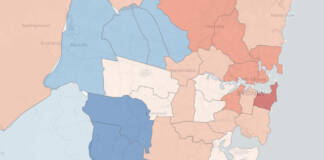
The following maps show (in red) which seats are likely to have major changes as a chain reaction. As an example, Canterbury and Strathfield are likely to gain quite a lot of extra territory to absorb the excess quota in Marrickville, Balmain, Sydney and Heffron. This would result in even more territory having to be transferred to the next group of seats.

In terms of individual seats, Antony Green produced a map a few months ago showing which seats are above or below the quota.

The first round of submissions will close in early March, and I’ll return to the issue then.

South Australian redistribution: draft maps released

Late last week the Electoral District Boundaries Commission of South Australia released draft boundaries for the next South Australian state election in March 2014.

Antony Green has covered the changes and their significance in more depth, including margins for every seat and a description of each seat’s change. You can also see the maps at the ECSA website.

South Australian electoral law requires a redistribution following every election. In addition, SA electoral law requires that electoral boundaries be ‘fair’, which in the past has been interpreted as drawing electoral boundaries that would result in the party that wins a majority of the two-party-preferred vote winning a majority of seats.

Despite this law, the last election saw the ALP win a majority of seats while the Liberal Party won a solid majority of the vote (51.6% of the 2PP vote). This was largely achieved due to the ALP suffering massive swings in their safest seats while largely holding their ground in their marginal seats.

It was expected that this would require a significant redrawing of the electoral map to give the Liberal Party a notional majority of seats. However, the Commission instead decided to make relatively minor changes. Not a single seat held by the major parties has changed hands on the boundaries. As Antony Green has said:

The Commission’s justification is that it has decided the boundaries at the 2010 election were fundamentally fair. However, the differential nature of the swing denied the Liberal Party a majority. The Commission has decided the differential swing was a campaign factor, not one caused by an unfairness in the boundaries drawn in 2007.

It is yet to be seen if the final boundaries will produce a more significant change. Even with boundaries that preserve the ALP’s majority, it is likely the ALP government will suffer a significant swing in 2014, making this redistribution largely irrelevant.

You can download my Google Earth map of the draft 2014 boundaries along with the previous four seats of maps at the maps page. You can also download a time series map that shows the changes in SA electoral boundaries since 1997.

2010 South Australian electoral boundaries, showing the Adelaide area.

Draft 2014 South Australian electoral boundaries, showing the Adelaide area.

WA redistribution finalised

The final boundaries for the next WA state election were finally released on Monday. After a couple of days of work on it I have now published my Google Earth maps of WA, and you can download them from my Maps page.

You might want to also look at the margins for the new seats calculated for Antony Green’s ABC Elections website.

This means that I have now updated all Australian federal and state electoral maps up to the latest maps provided. We are waiting on the final federal boundaries for South Australia, which are expected later this year. Following that, we won’t have any state redistributions until those for the state elections in South Australia, Victoria and New South Wales, who will go to the polls in 2014-15.

I had been hoping to put together a ward map of Western Australia for their elections this Saturday but this sadly won’t happen in time. I am planning on completing ward maps for the NSW, Victorian and Queensland council elections due next year but I don’t think I will go back and do them retrospectively for WA.

More redistribution news

Following on from my post earlier in the week after I posted new electoral maps for Victoria and South Australia, there was more news yesterday on redistributions.

The final boundaries for next year’s ACT Legislative Assembly election have been announced. The committee reverted to the first draft, which was a minor change bringing Ginninderra and Molonglo into quota. The second draft had proposed radical changes to the boundaries, reducing Molonglo to a 5-member district and making Ginninderra a 7-member district, but these were rejected after vocal opposition. I have now posted the final version on the maps page.

In other news, the latest report from the Australian Bureau of Statistics on population for each state and territory makes it clear that there will be no changes in the number of seats for each state and territory at the next federal election. In the next month the AEC will make a determination about seat numbers, and this data makes it clear they will remain the same. This will mean that no more federal redistributions will be held in time for the next federal election once the current South Australian redistribution is completed.

An ACT redistribution is due in 2013, but won’t be finished before the election. Antony Green has also blogged about the new update.

So with the NT and ACT territorial boundaries now completed, the only redistribution map I need to work on now is the draft boundaries for next year’s WA state election. Later this year we will be getting final boundaries for the WA state election and for SA federal boundaries. I’ll keep you posted.

Apart from those, I am also looking to update my ward maps for New South Wales, Victoria and Queensland, as all three big states have council elections next year. Sorry Western Australia and South Australia, I just haven’t had time to cover those states.

Anyway, Victoria and Queensland’s state electoral commissions are doing a good job of covering the redistributions being held for council wards on their websites, but not in New South Wales, where it seems to be a job for the individual council.

So I’m calling on my readers to help me out by posting here any news about New South Wales council ward boundaries:

  • A decision by a council to get rid of or implement ward boundaries.
  • A clear decision to redistribute the boundaries, preferably with a link to the maps
  • A clear indication that ward boundaries are not changing.

This will make it a lot easier to produce a state ward map well before the September council elections.

New maps posted

The blog has been quiet for a while. Partly this has been due to me being very busy with other projects and with my day job, but the main reason has been due to me doing my work on this website behind the scenes.

Over the past two months I’ve produced maps of the election results for all 89 Queensland state electorates for the 2009 state election. This is part of my plan to produce a guide to the upcoming Queensland state election, as I have done for the last state elections in New South Wales and Victoria, and last year’s federal election.

Over the last week I’ve been working on a different project. Maps have now been posted on the blog’s maps page for two jurisdictions. The new boundaries that will be used in Victoria for the next federal election have been posted, along with the draft boundaries for South Australia. The Victorian maps are the result of a redistribution which was concluded at the end of 2010. The South Australian redistribution is expected to be finalised in the next few months.

In the next few months the calculation will be made as to whether any states or territories gain or lose seats at the next election. It doesn’t appear likely that there will be any change in seat numbers, so there isn’t expected to be a redistribution in New South Wales, Queensland, Western Australia, Tasmania or the Northern Territory, as all of these states held redistributions before the 2010 election. A redistribution is due next year in the Australian Capital Territory, which should be a relatively simple endeavour. I’ll keep you posted.

Update: I have now finished the redistribution for the NT Legislative Assembly, which will face an election on the new boundaries next year. I have also checked the timetable for the ACT redistribution, and it appears it won’t commence until January 2013, leaving an open question of whether it will be finished in time for the federal election. I also realised that I had improperly marked the two previous sets of ACT federal boundaries, so these have been fixed.

Cameron cutting seat numbers in UK

David Cameron, the leader of the Opposition in the United Kingdom, is planning to immediately cut the number of seats in the House of Commons following an election victory this year, according to reports.

Cameron’s plan involves immediately introducing legislation following an election which would trigger a rapid review of electoral boundaries in England and Wales in order to cut the number of seats by approximately 10%.

Electoral boundary reviews in the past have taken as long as seven years, and the new boundaries being used for the 2010 election are based on registered voter figures from the year 2000. Cameron’s legislation would give only 18 months for a new review.

The Conservatives are arguing that the cut in the size of the Commons, which will have 650 members after this year’s election, is intended to cut the cost of politics, not to achieve electoral gain. While it is probably a good idea to shrink the Commons to less than 600 seats, the costs of those 65 members of Parliament really don’t add up to a lot in the scheme of things.

There is some electoral benefit for the Conservatives in speeding up the process of boundary reviews. Strong Labour areas like the inner cities tend to be depopulating, which means that boundaries drawn using out-of-date data will tend to mean that the number of voters in Labour seats is less than in Conservative seats. Yet this is only a minor issue. The main bias against the Conservatives in the electoral system comes from the geographical distribution of Conservative voters. Labour voters tend to be more ‘effective’, spread efficiently over marginal seats, while Conservative voters are locked up in huge majorities in safe seats. This is the main reason why the Conservatives need to beat Labour by a wide margin to win a majority. No redrawing of the boundaries will fix this: all systems of single-member electorates favours one party over another.

Labour in the UK is crying ‘gerrymander’ over the proposal, although it seems that numerical fairness is on the Conservative side. It seems that the Conservative plan is a good idea, but won’t achieve any of the aims being spun by either side about removing the bias in the electoral system.

In other news, I have just finished the South-East England region in my map of the 1997-2005 electoral boundaries, which I am hoping to finish before the UK election later this year. Maps below the fold.

Read the rest of this entry »