Electoral reform Archive

The built-in coup

As yesterday’s abortive coup played out, Nick Bryant from the BBC penned a fascinating piece laying out the differences in political cultures between Australia and the United Kingdom when it comes to leadership coups. Australia’s culture of sudden, brutal and frequent internal leadership changes is not at all seen in British politics.

Bryant, however, missed the primary reason why Australian politics has so many leadership coups compared to countries that appear to have similar political cultures. Australia is the only Western English-speaking democracy where the choice of political leaders is made solely by that party’s members of parliament.

Read the rest of this entry »

The end of gerrymandering in California

I’ve blogged a few times over the last couple of years about the perverse processes used in most US states when drawing electoral boundaries for Congress and state legislatures.

In a series of referendums in 2008 and 2010, California’s voters approved the creation of an independent commission to redraw California’s boundaries after the decennial census.

New boundaries will be used for the first time next week for the House of Representatives. The previous boundaries were used from 2002 to 2010 (and you can download Google Earth maps of those boundaries from this page), and the new boundary will be used until 2020.

California’s previous boundaries were drawn to ensure that incumbents, both Democrat and Republican, were able to retain their seats, and these boundaries were very successful in preventing competitive races over the last decade.

These boundaries were severely gerrymandered – jagged boundaries interlocking with each other and covering different areas. This was a similar style to other big states such as Florida and Texas, where districts are transparently designed to produce a particular result.

The new boundaries in California are completely different – seats tend to be far more compact – covering a much smaller geographic area and reflecting local communities. Looking at the new boundaries, it’s immediately obvious what a massive affect these changes have made.

The following maps show the old and new boundaries for the Los Angeles area and the San Francisco Bay area.

Congressional districts in the Los Angeles area, 2002-2010.

Congressional districts in the Los Angeles area, 2012.

Congressional districts in the San Francisco Bay area, 2002-2010.

Congressional districts in the San Francisco Bay area, 2012.

The new boundaries have already had some interesting effects, with incumbents running against each other.

California has also recently instituted the ‘jungle primary’ system, where all candidates from all parties compete in a single primary, and the top two candidates, regardless of party, proceed to the general election. This has meant that there will be a number of races this week where two sitting Democratic members of Congress will be running against each other for the same seat.

USA 2012: The shrinking middle

It’s not new to write about the flaws of the electoral college: how it makes some states important and makes other states irrelevant, and how it produce perverse incentives in terms of policy. However what has become clear as we enter the final stretch of the 2012 is that the electoral college system is becoming more problematic in the age of precise and scientific campaign techniques.

The major parties have become remarkably good at targeting over the last 15 years. They have a better of sense of who can be won and who cannot, and are able to target their resources far more effectively.

When you combine these techniques with the electoral college, you see elections where fewer and fewer states are contested as battleground states.

Over the weekend the New York Times published a piece about how the number of states seriously contested by both parties has shrunk dramatically since close elections in 1960 and 1976. Indeed, the change is evident when comparing the 2012 race to the last three elections.

There are ten states that have been targetted by the Obama and Romney campaign for nearly all of their general election campaigning. As the campaign has wore on the seriously-contested states have narrowed to a bare eight states: Ohio, Florida, Virginia, Colorado, New Hampshire, Nevada, Iowa and Wisconsin. The states of North Carolina and Indiana were both won by Obama in 2008 but are generally considered out of reach.

The eight states considered tossups are coloured grey (click to visit Real Clear Politics' 'create your own map' tool)

The Times piece compares this to 1960, when Kennedy and Nixon visited almost every state, and in 1976 the biggest states were almost all swing states. This map is even tighter than the map in 2000, 2004 and 2008, which were historically tight elections in terms of the number of states up for grabs.

It has serious consequences for the election. Turnout is lower in safe states, and the most important election in the United States is becoming increasingly dominated by the parochial issues of a handful of states.

Read the rest of this entry »

ACT redistribution proposes radical change

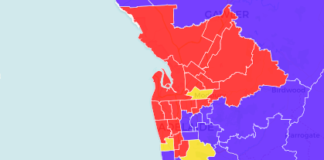
Today Elections ACT announced new electoral boundaries that radically change the electoral boundaries used since 1995, and making very difficult or impossible for the Greens to retain all four of their seats at next year’s election.

I’ve posted analysis on the impact and maps of the changed areas below.

Read the rest of this entry »

Alice Springs Council: bad electoral systems at work

A friend recently referred me to an academic paper (PDF) produced by Centre for Aboriginal Economic Policy Research at the Australian National University. The paper discusses the electoral system used by the Alice Springs Town Council (and all local government in the Northern Territory) to elect council members.

Alice Springs has an elected mayor and a further eight aldermen elected to represent the entire council area. Darwin elects twelve aldermen through four three-member wards, as well as an elected mayor.

Rather than using a system of proportional representation, NT councils use a system of exhaustive preferential voting to fill seats in multi-member districts. This page shows the counting process and results of the 2008 council election.

Under this system, the first seat is filled using a regular preferential ballot (like how a House of Representatives seat, or a mayoral race, is decided). The second seat is decided by a similar preferential ballot after excluding the candidate who has already been elected. This process continues until all seats are filled.

This tends to result in lopsided results, with a majority voting block winning most of the seats up for election. While you would win one of eight seats with a vote of 11% under a proportional system, most or all seats would go to the majority under the exhaustive preferential system.

A similar system was used to elect Senators from 1919 to 1946. Almost all elections produced a result where all three of a state’s Senators up for election were from the same party. The United Australia Party and the Country Party collectively held 33 of 36 seats following the 1935 election, and the ALP commanded a similar lopsided majority following the 1946 election.

It is also used to elect two-member wards in New South Wales. It was used to elect Wollongong and Shellharbour councils prior to their sacking in 2004, and is used for the City of Botany Bay. Botany Council consists entirely of Labor members, who were all elected unopposed in 2008.

Alice Springs is a controversial council, with a recent history of targeting the homeless and conflict between the council and communities on the fringe of the town. The area has been the centre of conflict over the federal government’s intervention on indigenous issues. In 2009, the council decided to begin fining beggars and remove blankets from local homeless people.

The paper focuses on the indigenous population who live in town camps on the outskirts of Alice Springs. They make up approximately 10% of the population of the town of Alice Springs but are socially distinct from the urban Alice population.

While this population could consistently elect a single alderman to the Town Council under proportional representation, they have been locked out of the council under the current system.

With Alice Springs Council regularly taking a hostile attitude to local homeless people and the indigenous population, it is interesting to consider the way that the majoritarian electoral system encourages neglect of minorities and locks them out of representation.

Councils to be restored in the Illawarra

Voters in the UK are currently voting in a referendum on electoral reform, and the results should come in tomorrow morning. Closer to home, some electoral reform is taking place in two councils in the Illawarra area south of Sydney.

Wollongong City Council and Shellharbour City Council were both sacked in 2008 after allegations of corruption on the councils, and have been run by unelected administrators since then. Both of those councils previously were elected using a system of “winner takes all” preferential voting. Each council had six wards of two councillors each, along with a directly elected mayor. Each ward used a system that meant that the group winning a majority of votes after preferences would almost certainly gain both seats.

In contrast, most councils in NSW use some system of proportional representation, as is mandated for all wards electing at least three councils. Following the sacking of Wollongong and Shellharbour, the only councils still using the old system were Botany and Ku-ring-gai in Sydney and a number of small rural councils. There was an attempt to impose the system on a newly-created New England Regional Council last year, but the merger was scrapped and the electoral plan also went on the scrap-heap.

The new Coalition government has decided that the Illawarra councils will move away from the majority-rule system to the proportional system used in most NSW councils.

Firstly, they have decided that the two councils will face election this September, a year before all other councils in New South Wales are up for election. Secondly, they are making changes to councillor numbers and ward systems in both councils.

In Wollongong, the state government has decided that they will continue to have a directly-elected mayor and twelve more councillors, but they will be elected through three wards, each ward electing four councillors. This will mean that, rather than the majority winning all seats in each ward, a councillor will need to achieve a 20% quota to win a seat in any ward. This reflects many other councils in urban NSW, with 3-member or 4-member wards being the most common model.

In Shellharbour, the number of councillors will be cut to seven, with the mayor to be elected from amongst the councillors. No wards will be using, allowing candidates to win election with 12.5% of the vote in the council area. This is an extremely low number of councillors for a reasonably large council. Most urban councils in the Sydney, Hunter and Illawarra regions have between nine and fifteen councillors each. Kiama Council, immediately to the south of Shellharbour, has less than one third of Shellharbour’s population, but has nine councillors. The only councils in Sydney with less than nine councillors are Burwood (approximately 33,000 residents), Strathfield (approximately 35,000) and Hunter’s Hill (approximately 15,000). They each have seven councillors. Shellharbour, in contrast, has approximately 67,000 residents.

The Coalition government has made the argument that “Fewer councillors has shown that council can effectively focus on the bigger picture and seek whole of council outcomes”, but I don’t really see any evidence for that argument. Considering that councillors are paid very little money for their role, and considering the large size of Shellharbour Council, it seems like halving the size of their council brings little financial benefits while substantially reducing the link between the community and their representatives.

I have previously argued that councils in Sydney should be designed so that there are more councillors on each council, not less, and that bigger councils have more councillors. While the government’s decision makes these councils’ electoral systems far more democratic, the unnecessary reduction in councillor numbers in Shellharbour reduces democracy.

A note on my local government maps: New South Wales, Victoria and Queensland will all be holding local government elections in 2012. The ward maps I have on my maps page are for the 2008 council elections in those three states. At some point when I have time I will go through and identify which councils have redistributed their ward boundaries and produce new maps. Obviously I will have to produce a map of the new Wollongong City Council wards once they have been announced, which will be added to the 2012 ward map for New South Wales when it is produced. Sorry Western Australia and South Australia, I don’t think I’ll have time to do yours.

Preference experiments growing in the Bay Area

Today I visited the election administration in Alameda County, which covers areas on the eastern side of San Francisco Bay, centred on the City of Oakland. One point of interest that I wasn’t aware of is that three of this county’s larger cities will be experimenting with using preference voting (what they have called “ranked choice” voting for city elections such as Mayor and City Council, using it for the first time at next week’s election.

The cities of Oakland, Berkeley and San Leandro have all introduced preference voting recently, and it will be used for the first time in 2010.

Voters in the City and County of San Francisco have been using preference voting for local elections since a ballot initiative in 2002.

The system is similar to optional preference voting in Australia, except preferences are limited to three options, due to the system of scanning and counting ballots which is necessitated by the dozens of electoral contests to be counted at each election. The ballot design is also very different.

Attached below is a copy of the leaflet showing how US ballot papers are designed in order to conduct a preference ballot that can be read by a machine. Click to enlarge the image.

California in referenda battle over redistricting

I’m currently staying in San Francisco, visiting for the US midterm elections. California is a more interesting state than you would normally expect for such a Democratic state at this year’s midterm elections. You have a highly competitive gubernatorial race, a strong Republican challenge to a three-term senator, and a ground-breaking referendum on legalising the use of cannabis.

Yet there is another fascinating contest going on, where the majority Democratic establishment is pitted against a grassroots movement for electoral reform.

Read the rest of this entry »

Keneally’s grab for cash

The NSW Labor government is currently using the cover of supposed “campaign finance reform” to rig the public funding system to give more money to major parties and radically cut the funding to smaller parties.

Last Tuesday, Keneally announced that she would be proposing campaign funding reform legislation before the impending state election. While the details were vague, they included a cap on donations of $5000 and a cap on spending of $100,000 per electorate. Pretty weak, but a step in the right direction.

Hidden in her plans was a vague reference to plans for a “tiered” funding system.

A Sydney  Morning Herald article on Saturday revealed that this plan is to fund a proportion of each’s candidate’s expenditure, with a greater proportion for candidates receiving a higher vote. This scheme would massively increase funding  to major parties, while slashing it for smaller parties, and forcing political parties, particularly smaller parties, to rely on even more donations to supplement the limited public funding.

In addition, it’s now been revealed that the Keneally government also plans to introduce a new scheme for funding of administrative party activities outside of election periods.

In New South Wales we currently have the “Political Education Fund”, which gives funding to all parliamentary parties for non-election work outside of election periods, based on the number of Legislative Assembly votes received at the last election. While it is meant to be spent on ‘political education’, all parties use much of their funding for general costs of running a party outside of campaigns.

The new administrative scheme would be based on the number of Members of Parliament each party has elected. It doesn’t need to be said that this would also massively assist the major parties, due to the current electoral system disadvantaging smaller parties by locking them out of the Legislative Assembly. It doesn’t seem clear to my why a party with more Members of Parliament, with all the extra resources that provides, needs a disproportionately greater amount of public funding to run their party.

Read the rest of this entry »

Brown proposes referendum on preference voting

UK Prime Minister Gordon Brown yesterday announced plans to hold a referendum on changing the electoral system for the House of Commons to the “Alternative Vote” system, a preference voting system similar to that used in Australia.

Electoral analysis has shown that preference voting would favour Labour and the Liberal Democrats, whose voters already employ tactical voting to defeat Conservative candidates by voting for whichever candidate is in a stronger position. Rather than producing a proportional result, it would have resulted in an even larger Labour majority in 1997 when they did not come close to winning a majority.

Unsurprisingly, the Conservatives have come out strongly against the proposal and continue to support the first-past-the-post system, while the Liberal Democrats have argued that the proposal does not go far enough.

The Conservatives have a solid lead in polls for the election, which is expected in May or June, but the electoral system means that a large lead is needed for the party to win a majority, suggesting a strong possibility of a hung parliament with the Liberal Democrats and parties from Scotland, Wales and Northern Ireland sharing the balance of power. This means that it is plausible that negotiation following the election may revolve around kick-starting the electoral reform process, with Labour now committed to a first step and the Liberal Democrats insisting on proportional representation as a key priority.

The legislation will be passed before the election, which would mean the referendum could go ahead regardless of who won, although it is conceivable that a Conservative government could call the referendum to a halt or a deal with the Liberal Democrats could see the scope expanded.